Genesee County, Mich., is looking to build new single-family homes for working families, a move that would have seemed improbable in a region that has spent the last two decades tearing houses down rather than putting them up.
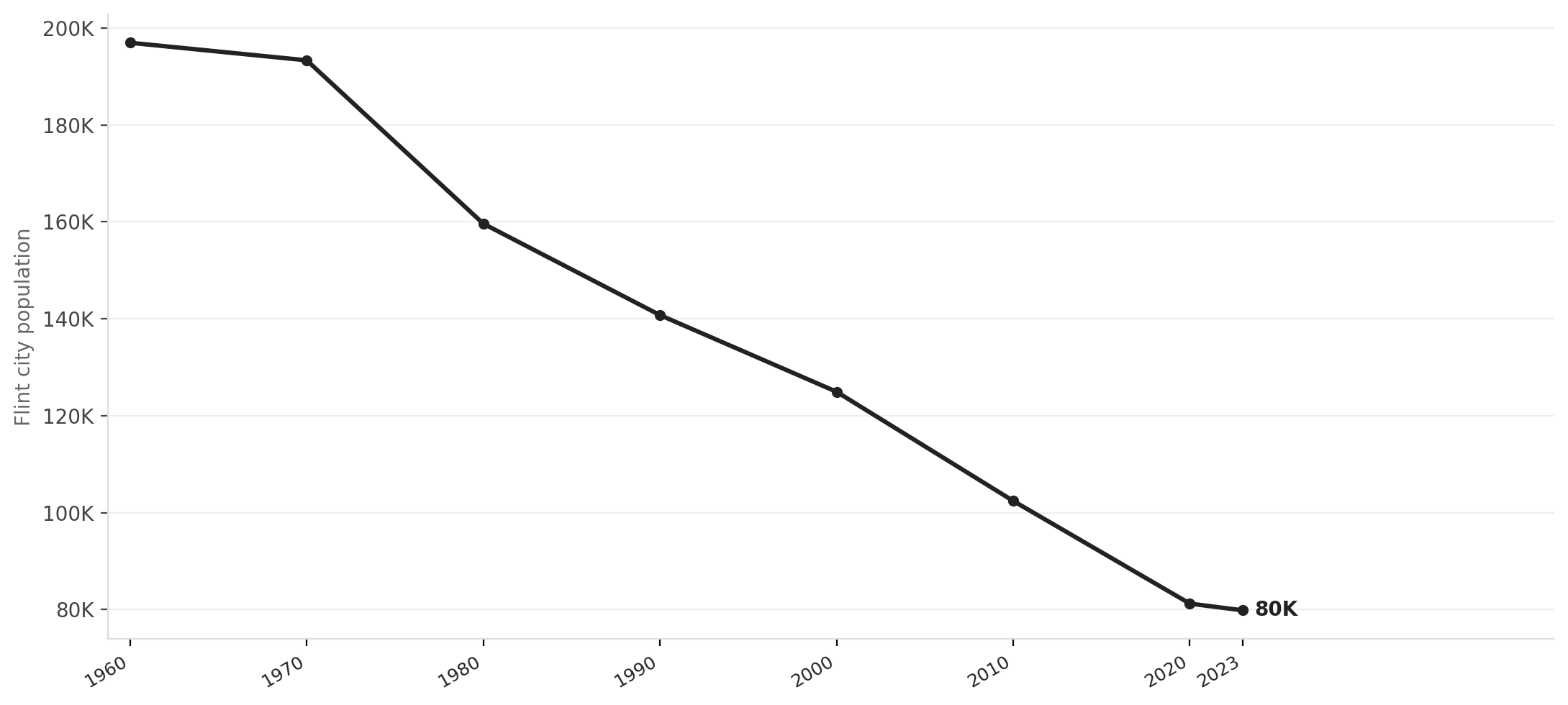
The county anchored by Flint has lost roughly 70% of its peak manufacturing employment since General Motors began downsizing in the late 1970s. Flint's population fell from around 200,000 in 1960 to under 80,000 today, leaving behind tens of thousands of vacant lots and blighted properties. The Genesee County Land Bank Authority, founded in 2004 and now a national model for assembling abandoned parcels, has demolished thousands of homes. But demolition doesn't rebuild a tax base, and for years the county has had a housing paradox: abundant vacant land and almost no quality homes working families can actually buy.
That may be changing. The county has posted a solicitation seeking a developer to build a mix of workforce and market-rate single-family homes. Workforce housing typically targets households earning 60 to 120 percent of Area Median Income, the range that includes nurses, teachers, tradespeople and factory workers who earn too much to qualify for deep subsidies but too little to afford rising home prices. U.S. home prices climbed roughly 50% between 2019 and 2024, and even in historically depressed Midwest markets like Genesee County, suburban home prices have surged enough to price out many workers.
Source: NationGraph.
The Land Bank's large inventory of buildable parcels gives the county unusual leverage to make new construction feasible, since land costs are effectively eliminated from the equation. That positions Genesee County to take advantage of Gov. Gretchen Whitmer's Statewide Housing Plan, which set a goal of 75,000 new or rehabilitated housing units by 2026 and directed state and federal recovery dollars toward exactly this kind of infill development.
The water crisis that began in 2014 remains a backdrop to every housing conversation here. The disaster accelerated population loss and froze private investment for years, and while federal and state recovery funds have since flowed into the county, very little has gone toward new for-sale housing construction. New homes in stable, walkable neighborhoods could help attract workers tied to revived auto and electric vehicle manufacturing; GM's Flint Assembly still builds heavy-duty trucks, and Michigan has landed several EV and battery plant investments in recent years.
The solicitation does not publicly specify how many homes would be built, where sites would be located, or what subsidy structure would support affordability. Those details are expected to emerge as the county reviews developer proposals and moves toward selecting a partner.