Florida's battered citrus industry is getting nearly $7 million in federal support to fight the insects and diseases that have already destroyed most of it, underscoring how expensive it has become just to keep the remaining groves alive.
The USDA grant of $6,895,541 flows through the federal Plant Pest and Disease Management program to the Florida Department of Agriculture and Consumer Services. The bulk of it, roughly $6.26 million, covers the salaries and benefits of 149 full-time and 58 part-time workers who will fan out across the state's citrus belt in vehicles, ATVs, and trailers to inspect groves and nurseries and collect disease data.
The target list is long. Citrus greening, formally known as Huanglongbing, remains the central threat. The disease, spread by the Asian citrus psyllid, was confirmed in Florida in 2005, and in the two decades since, the state's orange output has fallen from roughly 242 million boxes per season to fewer than 20 million. There is still no cure and no widely available resistant variety. Growers can only slow the spread through intensive pesticide applications, tree removal, and nutrition regimens that prop up infected trees long enough to keep them producing.
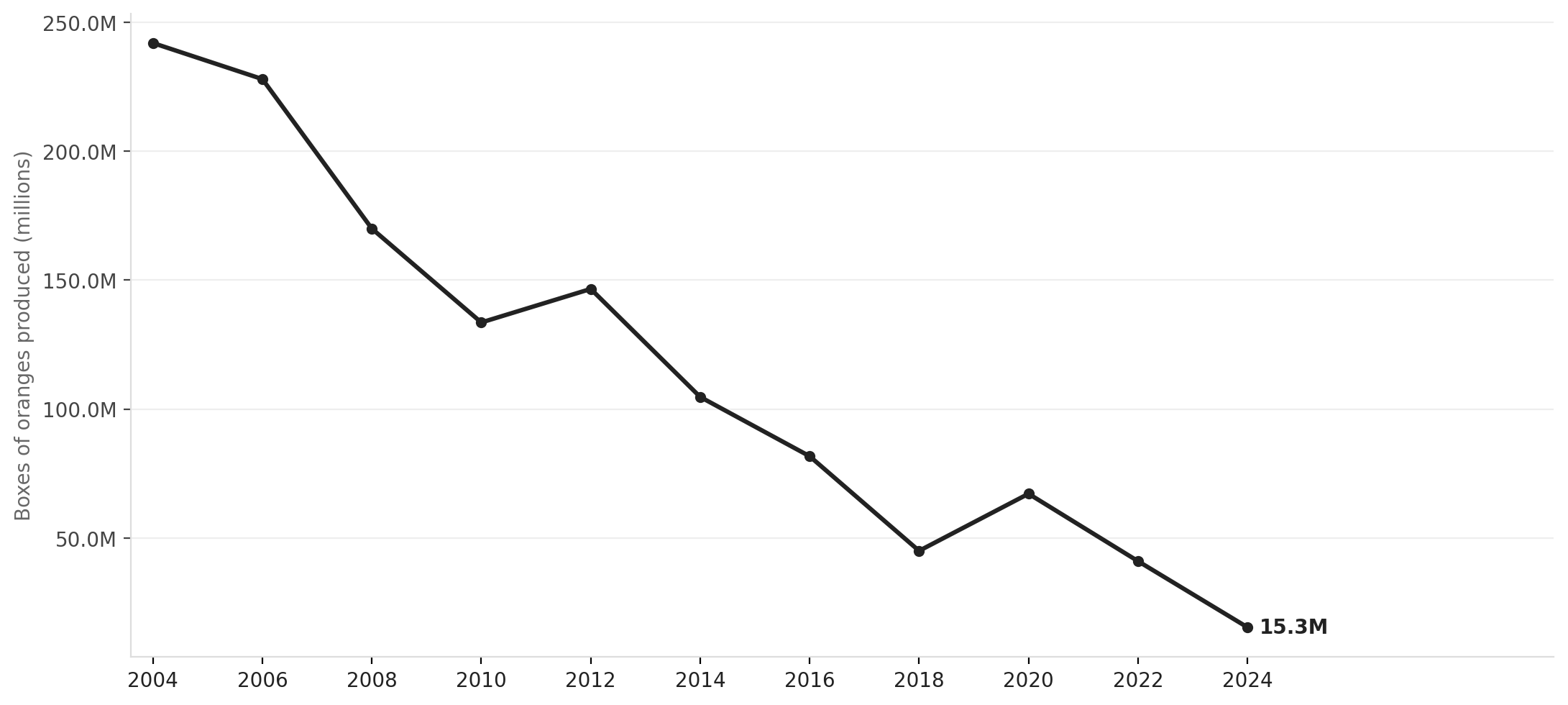
Source: NationGraph.
Beyond greening, the grant funds monitoring for citrus canker, citrus black spot, and sweet orange scab, all of which are already present in Florida and all of which carry trade consequences. Citrus black spot, a fungal disease confirmed in the state in 2010, has complicated exports to markets with zero-tolerance policies, including in Europe. Surveyors will also look for pests that have not yet arrived in Florida, including citrus leprosis, exotic fruit flies, and citrus fruit borer, attempting to prevent a second wave of agricultural crisis.
The stakes extend beyond Florida's borders. USDA's explicit goal with this funding is to prevent Florida's quarantine pests from reaching other U.S. citrus-producing regions in Texas, California, and Arizona. The spongy moth fight in places like Kentucky illustrates how quickly invasive species can spread once they gain a foothold, and USDA has emphasized early detection as its best tool in both cases.
Florida's citrus industry once generated more than $9 billion in annual economic activity and supplied roughly 70 percent of the nation's orange juice. Today many growers have walked away entirely, converting acreage to cattle pasture or selling land to developers in a state where real estate pressure is intense. Counties in central and south Florida that built their economies around citrus, Polk, Highlands, Hendry, DeSoto, and others, have seen processing plants close and farmworker jobs disappear.
For those still farming citrus, this federal program is a lifeline. Whether it buys time for a scientific solution, gene-edited or transgenic citrus varieties are in development but years from commercial use, or simply slows an inevitable decline is a question the industry has not answered.