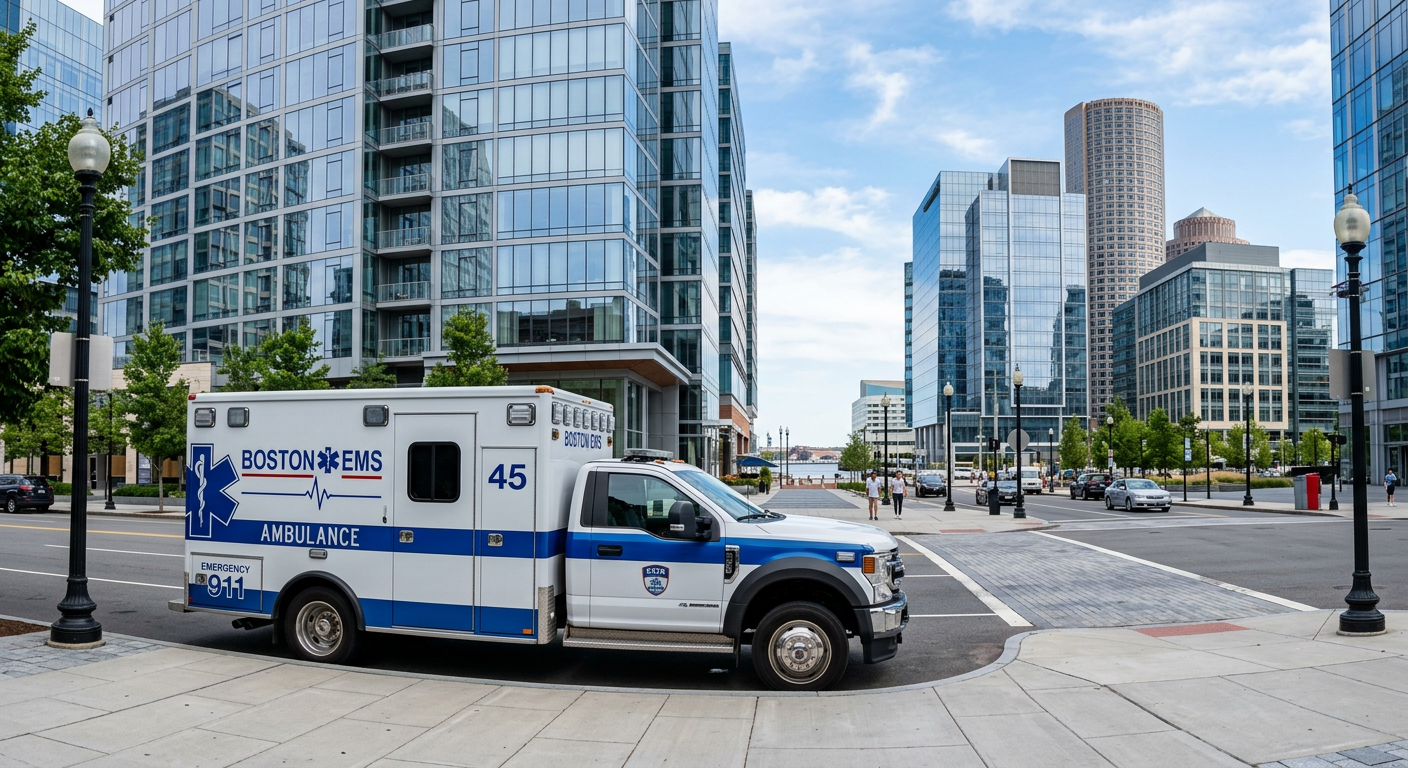
Emergency responders in Boston's Seaport District have long had to race in from neighboring areas like South Boston and Downtown to reach a neighborhood that barely existed 20 years ago. That's about to change: the city is outfitting a new, purpose-built EMS station in the Seaport, a sign that the facility is nearing operational readiness.
Boston is now seeking contractors to furnish the station with furniture, fixtures, and equipment, the final step before medics can move in. The project is being managed through the city's Property and Facilities Department.
The Seaport's transformation from parking lots and warehouses into one of New England's priciest neighborhoods has been one of the most dramatic urban development stories in the country. The area has added more than 5,000 residents since 2000, with a daytime population many times larger thanks to major employers like Vertex Pharmaceuticals, Amazon, and PTC, along with a steady flow of convention-goers and tourists. Yet public infrastructure has consistently trailed the private investment that reshaped the skyline. Transit remains a sore point, with the Silver Line widely criticized as inadequate, and schools, parks, and emergency services have all lagged behind.
For EMS, the gap has real consequences. National standards call for ambulances to arrive within eight minutes on at least 90 percent of calls. Without a station in the Seaport itself, units dispatched from adjacent neighborhoods lose critical time navigating congested streets and construction zones. Boston EMS, which operates as a standalone city department with roughly 400 EMTs and paramedics serving a population of about 675,000, has faced rising call volumes and staffing pressures that intensified during and after the pandemic.
City councilors began raising alarms about Seaport response capacity as early as 2019, particularly as large events at the Boston Convention and Exhibition Center added surges in demand. The new station reflects a broader push under Mayor Michelle Wu's administration to direct more public investment into a district long criticized as a case study in growth without proportional city services. There has also been an ongoing political debate about whether Seaport developers contributed enough through linkage and impact fees to cover the infrastructure their projects required.
The station carries additional significance given the Seaport's vulnerability to coastal flooding. Positioning EMS resources directly in one of Boston's most flood-prone areas doubles as a climate resilience investment.
With the building apparently near completion, the city's next step is selecting a vendor to outfit the interior, after which the station can begin staffing up and accepting calls.