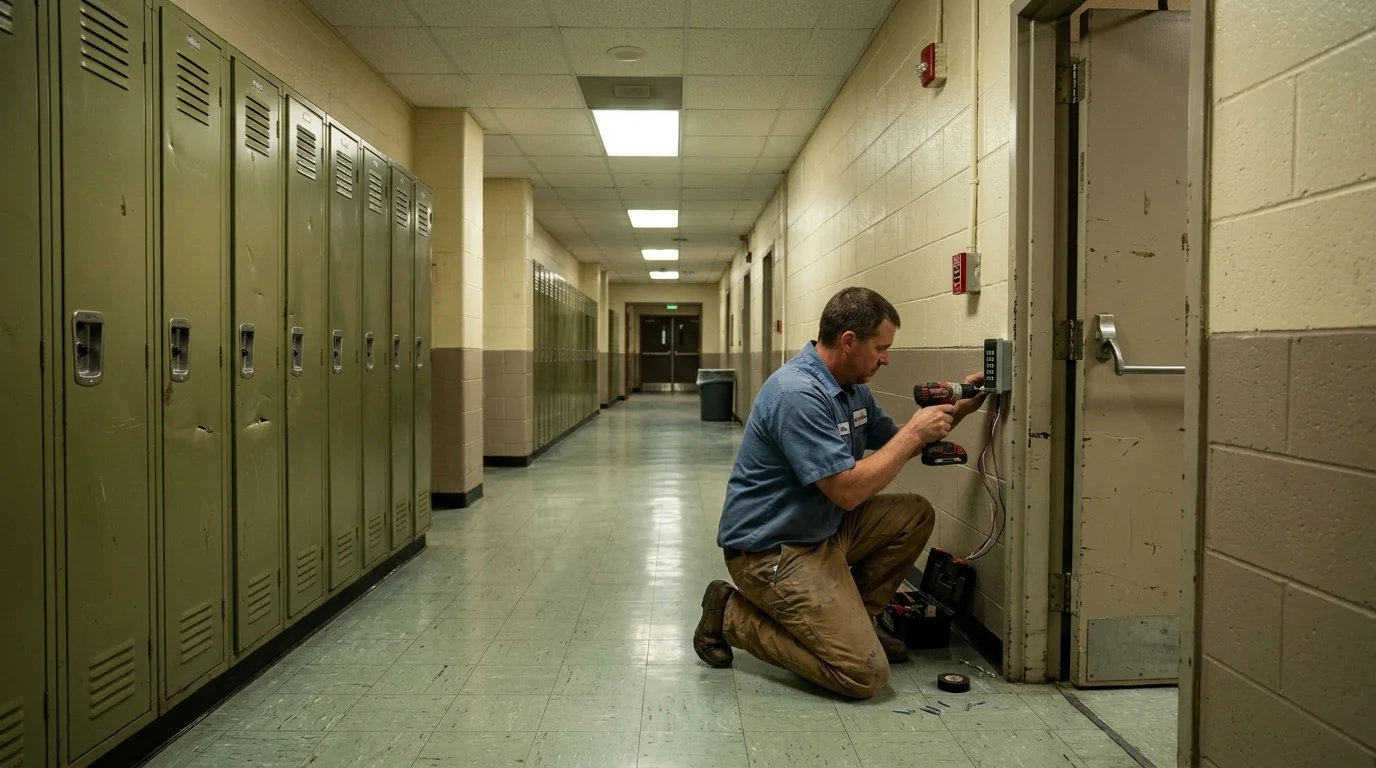
More than ten West Virginia county school boards issued solicitations for secure vestibules, access control systems, and safety mapping services in a single six-month window this year, a procurement cluster that veterans of the state's school construction market say is without recent precedent. The force behind it is not a single program. Three distinct policy clocks struck almost simultaneously in 2026, and the districts caught unprepared had no choice but to run.
The first clock is a state compliance mandate. West Virginia HB 3166, enacted in the 2025 Regular Session and codified as §18-9F-10a, requires all 55 county boards of education to produce standardized digital school safety mapping data compatible with public safety dispatch software, effective September 1, 2026. The state offers up to $4,500 per school in WVDE reimbursement, a planning subsidy, not a construction grant, and West Virginia joins only four other states nationally with a mandatory mapping requirement. For most of the state's 55 boards, the mandate arrived as an unfunded operational task on top of whatever physical security work they already owed.
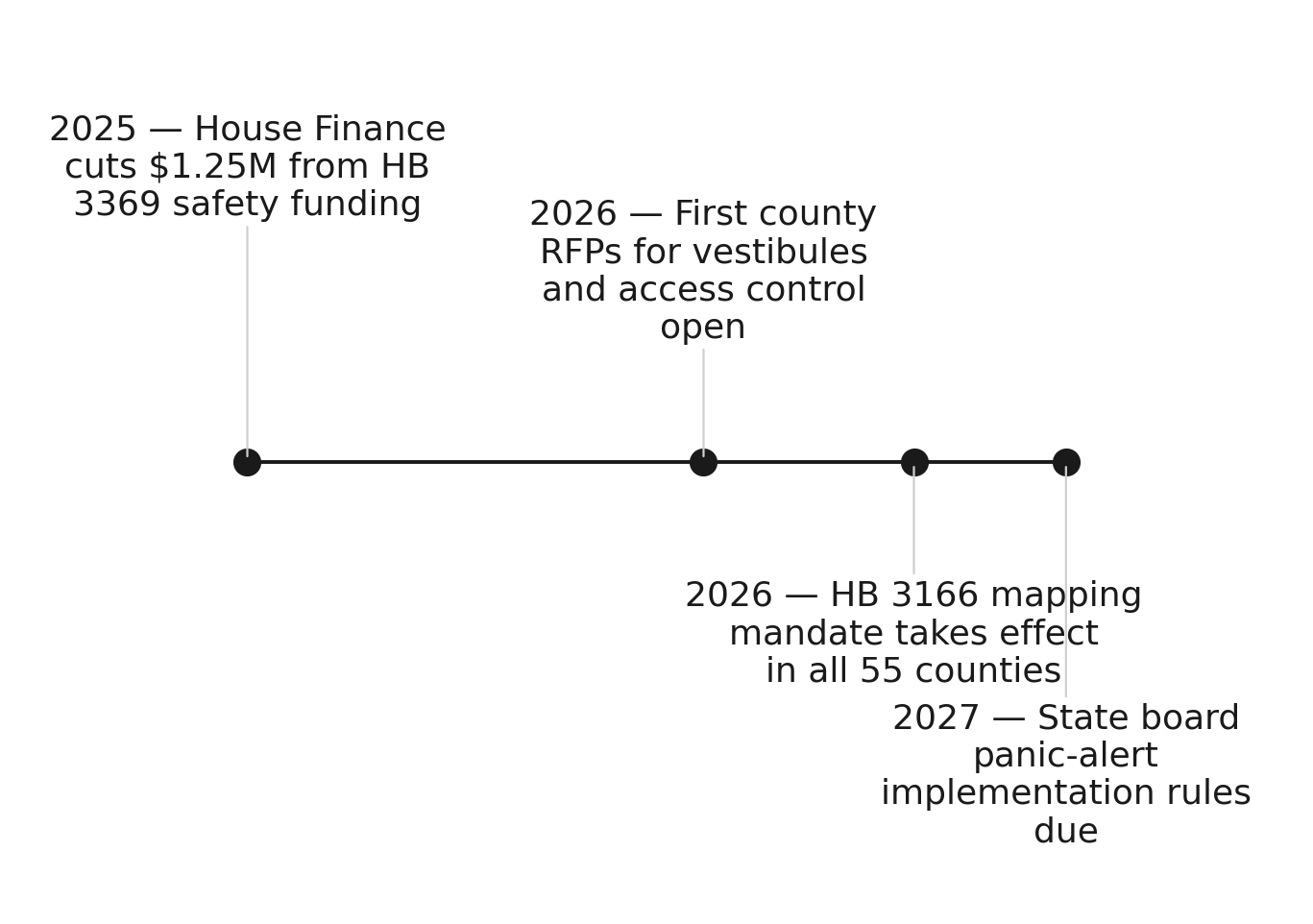
The second clock is permissive but politically charged. Governor Patrick Morrisey signed Alyssa's Law (HB 4798) on April 1, 2026, authorizing wearable panic alert systems at every public school and directing the state board to establish implementation rules by December 31, 2026. The law does not require adoption and provides no dedicated funding, but it signals a clear legislative direction and gives districts legal cover to spend on systems they had previously deferred. As Raptor Technologies notes in its state-by-state breakdown, Alyssa's Law variants have accelerated panic-alert procurement in every state where they have passed.
Source: NationGraph.
The third clock is federal, and it is the most financially consequential. The Bipartisan Safer Communities Act's Stronger Connections Grant allocated $5,771,691 to West Virginia, a formula grant administered through WVDE as sub-grants to districts for school climate, safety technology, mental health supports, and physical security. The obligation deadline for unspent balances was September 30, 2026. Under a use-it-or-lose-it structure, that deadline converted months of administrative delay into an emergency. Districts that had queued up capital projects but not yet formally obligated funds faced a hard stop.
The DOJ's School Violence Prevention Program added direct competitive awards on top of the formula stream: McDowell County Board of Education received $500,000 and Logan County Commission received $170,500, both beginning in October 2025, for physical security technology, threat assessment, and emergency response coordination. Those awards are modest by national standards, the SVPP program distributed $73 million nationally in fiscal year 2026, but in a state where the House Finance Committee removed $1.25 million in school safety funding from HB 3369 in spring 2025, even a half-million dollar federal competitive award is a significant share of a rural district's safety capital.
What matters about these three mechanisms is that they are genuinely distinct. HB 3166 is a data compliance requirement administered by WVDE, with state reimbursement money attached. Alyssa's Law is a permissive statute that moves authority, not dollars. The Stronger Connections Grant is a federal formula flow through the state educational agency, with its own allowable-use rules and its own deadline. None of them is the same program. But their deadlines, their activation dates, and their procurement lead times all collapsed into roughly the same fiscal year, which is why Kanawha, Upshur, Wyoming, Grant, Wayne, Clay, Hardy, Doddridge, Raleigh, and Barbour counties were all in the market for contractors at the same time.
For West Virginia, the structural problem this exposes is durable. The state has no dedicated standalone school safety equipment grant program. The primary capital channel for physical security work runs through the WV School Building Authority's Section 206 School Access Safety Funding, a per-project appropriation with unconfirmed FY26 new funding. That leaves most of the 55 boards dependent on federal competitive grants and formula sub-grants that arrive irregularly and carry strict spend-down windows. When those windows align, the result is exactly what 2026 produced: a demand surge that the state's rural contractor market and district procurement offices were not sized to handle simultaneously.
The next signal to watch is December 31, 2026, the deadline by which the state board of education must finalize Alyssa's Law implementation rules. If those rules impose specific hardware or certification standards for panic alert systems, they will trigger a second procurement wave among districts that installed systems before the standards were set. And the September 1, 2026 mapping compliance deadline will produce its own reckoning: state officials have not disclosed how many of the 55 boards met it, and no penalty provision exists in the statute to force laggards. What happens to districts that missed the mapping deadline, and whether the WVDE reimbursement funding was fully appropriated, are questions the legislature will face when it convenes in early 2027.