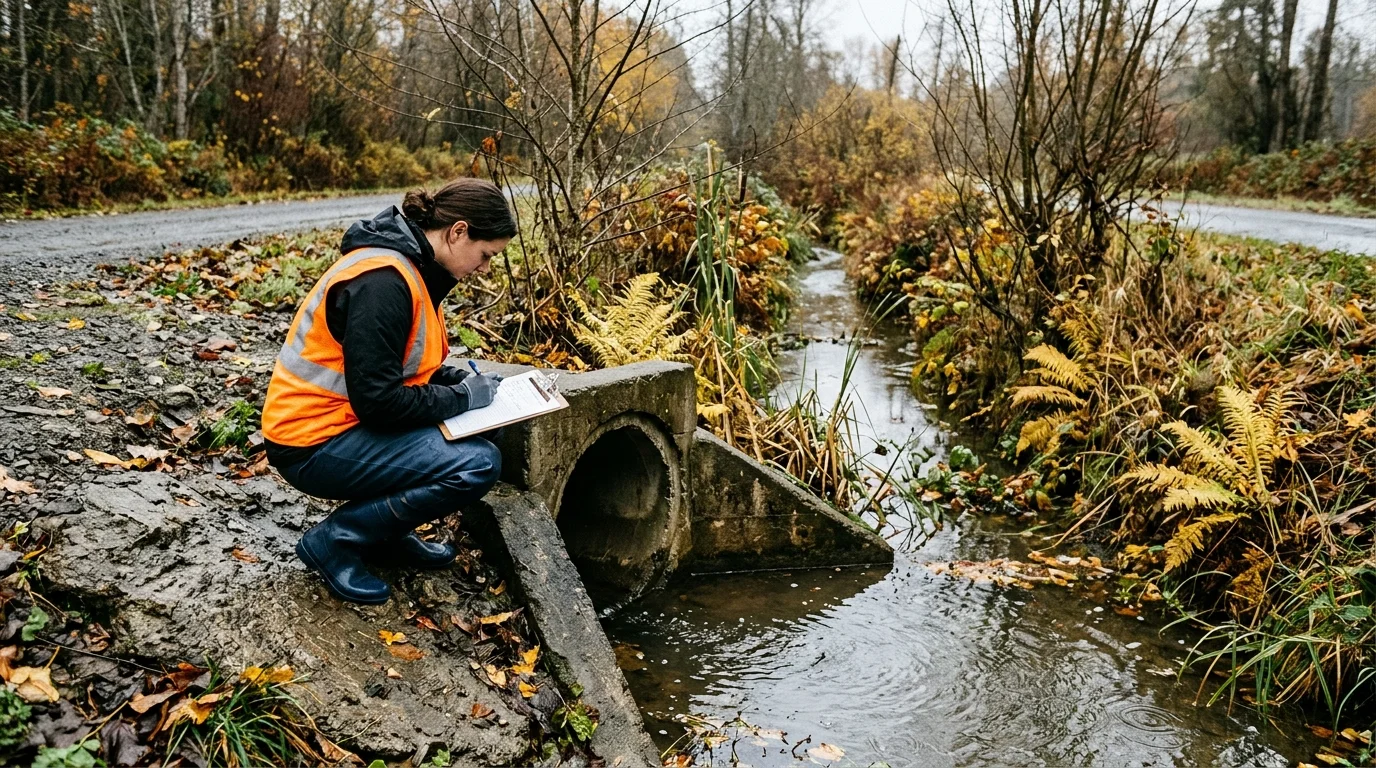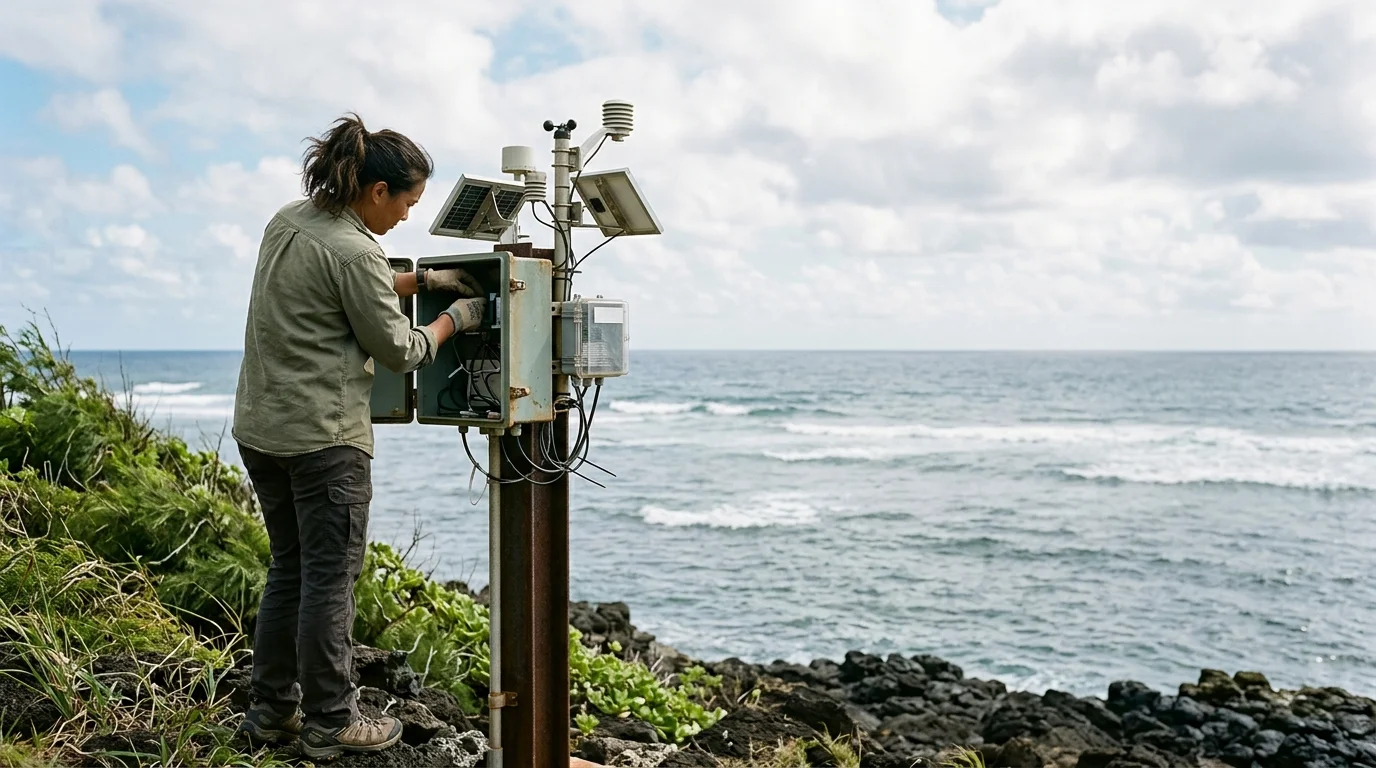
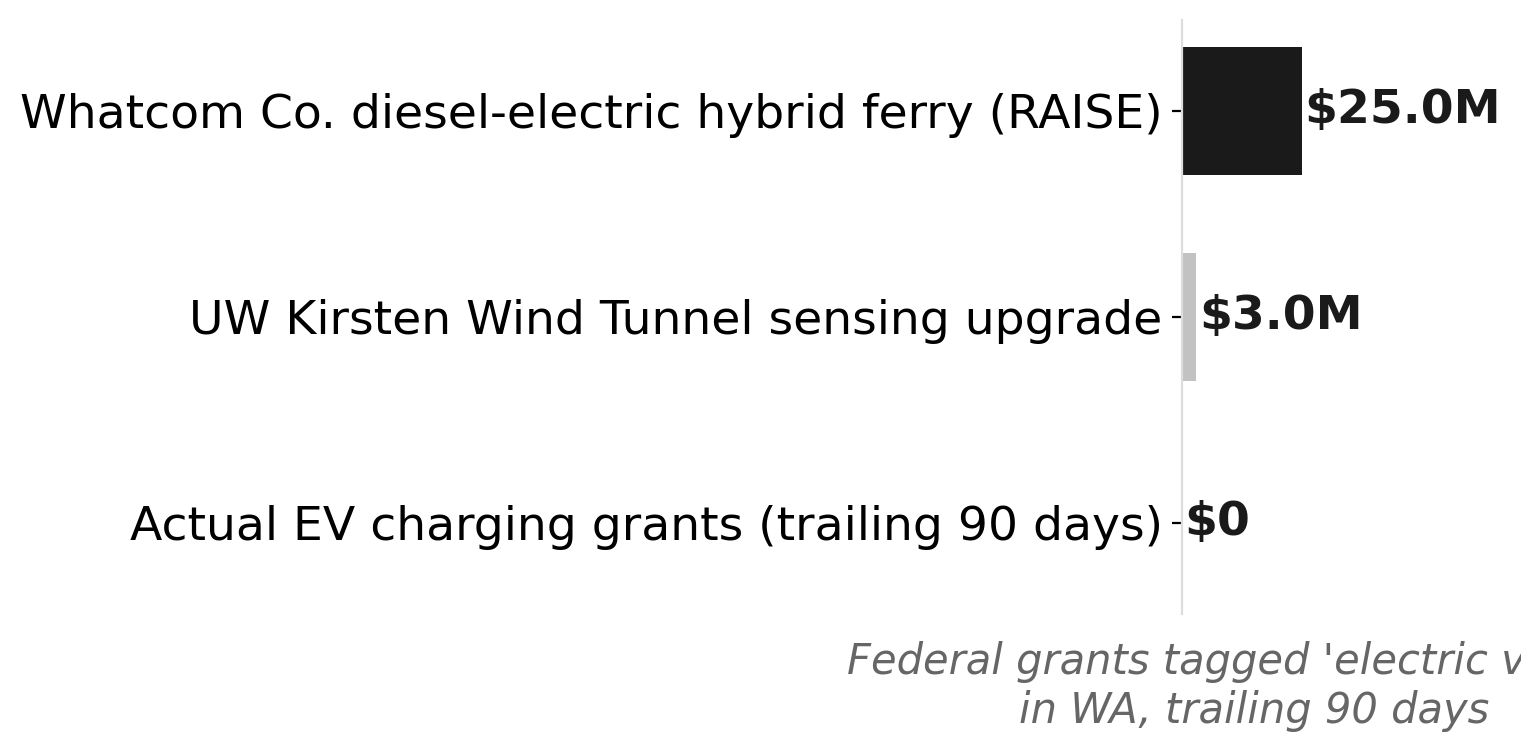
Federal grants tagged 'electric vehicle' in Washington totaled $28 million in the last 90 days, against $8.2 million in the same window a year ago. That 241% jump looks like a charging-infrastructure boom. It is not. Two grants account for every dollar of it: a $25 million USDOT RAISE grant to Whatcom County for a diesel-electric hybrid ferry to replace the 64-year-old Whatcom Chief, and a $3 million Commerce Department grant to upgrade the University of Washington's Kirsten Wind Tunnel electrical sensing systems. Neither is an EV charging program.
The ferry grant alone is 89% of the trailing-90-day total. Whatcom County finalized the agreement on September 17, 2026, covering roughly half the cost of a vessel designed with what county officials describe as 'flexibility for future full electric conversion.' The wind tunnel grant, announced in October 2026, was scored against EV keywords in federal grant databases because it involves electrical infrastructure, but its purpose is aerospace measurement science. The year-over-year comparison is essentially an artifact of how federal awards get classified.
That caveat matters because the genuine EV infrastructure story in Washington is worth telling on its own terms, and it does not need the ferry to prop it up.
Source: NationGraph.
Washington led a 17-state coalition that sued the U.S. Department of Transportation in May 2025 after the Trump administration froze NEVI Formula Program funds on its first day in office. The National Electric Vehicle Infrastructure program, created by the 2021 Infrastructure Investment and Jobs Act, allocated $5 billion nationally to build out charging networks along designated highway corridors. When DOT halted disbursements by executive order, Washington Attorney General Nick Brown and counterparts in California, Colorado, and 14 other states went to federal court.
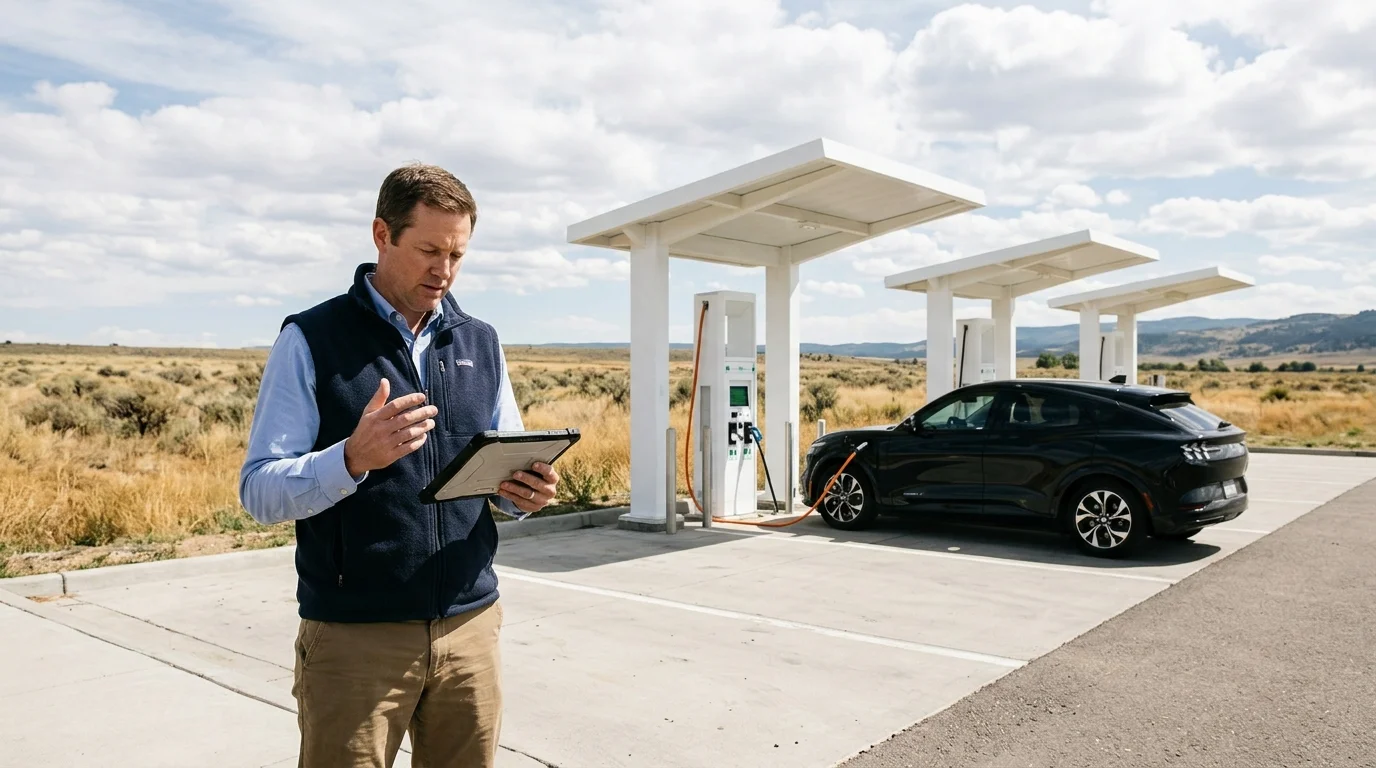
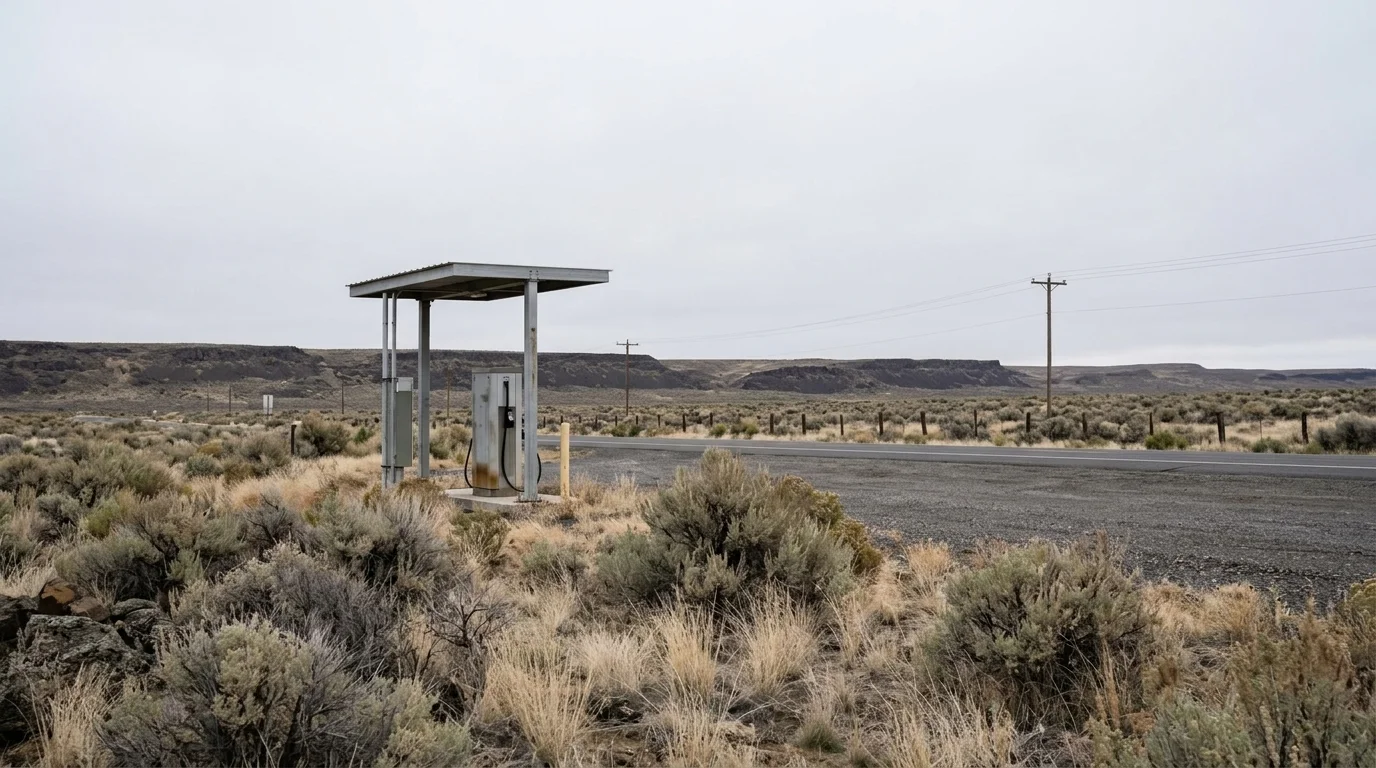
On January 23, 2026, U.S. District Judge Tana Lin of the Western District of Washington entered a permanent injunction barring DOT and FHWA from withholding the funds, finding the agencies had acted 'outside the law' and 'arbitrarily and capriciously.' The ruling restored access to roughly $1 billion in NEVI funds for 20 states and the District of Columbia. Six days later, WSDOT moved. On January 29, the agency announced $12.16 million in Round 1 NEVI awards to five companies, Electric Era, Energy Northwest, EV Gateway, EVgo, and Tesla, funding 14 charging stations along I-90, US-97, US-195, and US-395. WSDOT Secretary Julie Meredith said the grants 'fill key gaps in the state's highway EV charging network.'
The legal victory was real but incomplete. Ten days after Judge Lin's ruling, Congress clawed back approximately $879 million in unobligated NEVI funds through a February 2026 appropriations act. The original $5 billion authorization is now closer to $4.12 billion in play nationally. Washington's own five-year NEVI allocation sits at approximately $71 million across FY2022 through FY2026. FY2026 is the final year, and WSDOT has requested $15.09 million in that tranche.
That deadline is now driving procurement activity statewide. WSDOT issued its NEVI Round 2 Notice of Funding Opportunity on October 20, 2026, with awards available through October 2027. Since November 2025, Washington has seen 70 EV-related RFPs issued across the state, from Pierce Transit and the Port of Tacoma to the City of Vancouver, Link Transit in Wenatchee, and multiple tribal nations. The procurement pipeline reflects Washington's unusually high EV adoption rate: the state has genuine market demand that makes federal corridor-charging investments commercially viable in ways they are not in lower-adoption states.
For residents, the practical stakes are straightforward. Round 2 awards will add charging capacity along the same rural highway stretches where Round 1 stations are going in, pushing coverage farther east and north from the urban core. The five-year clock on the original IIJA allocation was always going to create a final-year sprint; the freeze, the litigation, and the partial congressional clawback compressed the timeline further. What WSDOT awards before October 2027 is likely the ceiling on what gets built under this program.
The number to watch is not the $28 million in the trailing-90-day federal grant total. It is the $15.09 million WSDOT has requested in FY2026 NEVI funds, and whether the Round 2 NOFO draws enough qualified applicants to commit that money before the allocation expires. Washington won the legal fight to keep these funds available. Spending them is the remaining test.