Federal school safety grants to Pennsylvania entities have risen 171% year over year, reaching $20.9 million in the trailing 90 days compared to $7.7 million in the same window last year. That federal surge is real, and it matters. But it is the smaller number in a much larger story: Pennsylvania just built a statutory foundation beneath its school safety spending that no annual budget fight can easily dismantle.
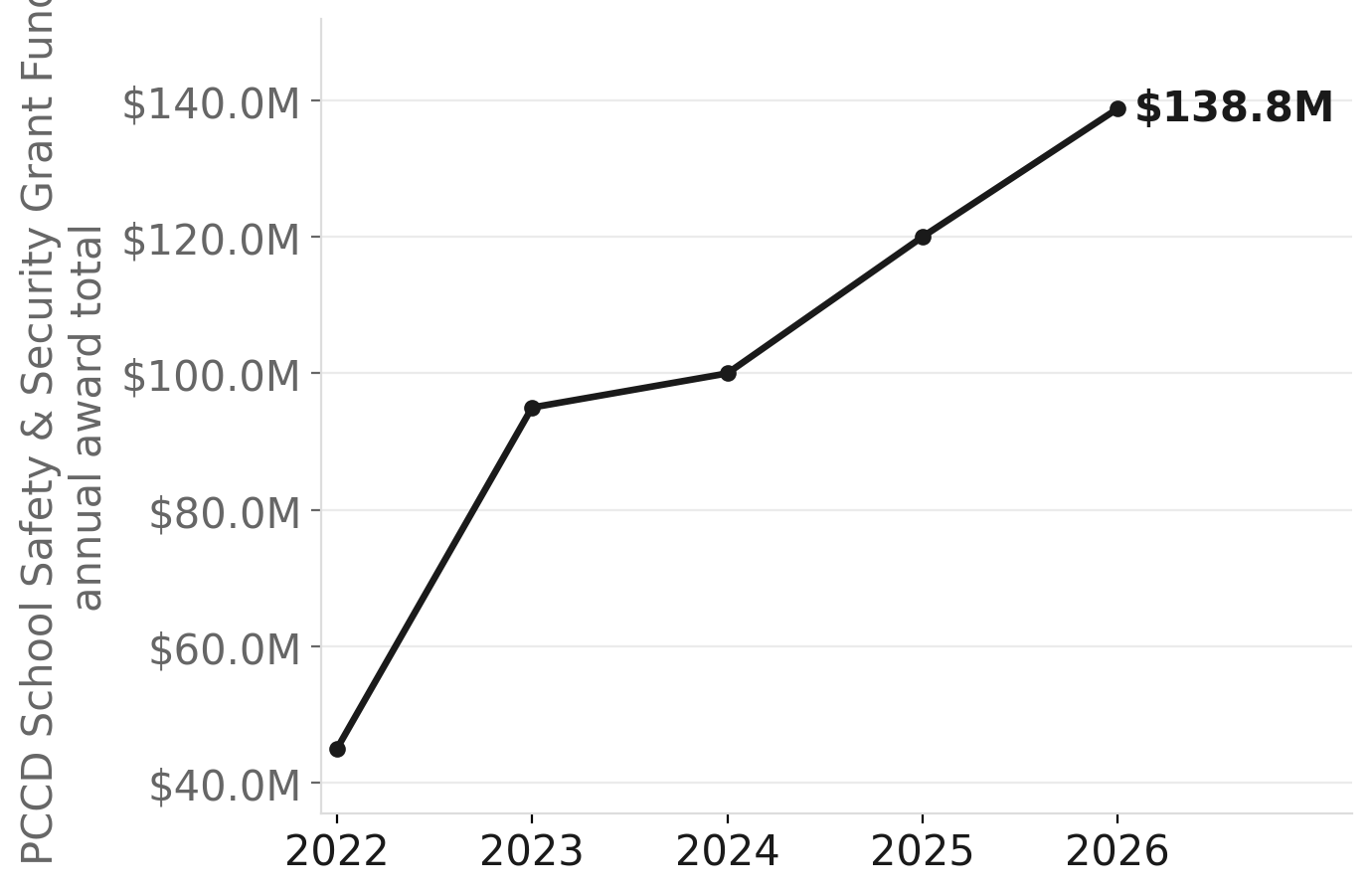
On July 12, 2026, Governor Josh Shapiro signed Act 20 of 2026, amending Section 1306-B of the Pennsylvania School Code to direct $100 million in annual state appropriations into the Pennsylvania Commission on Crime and Delinquency's School Safety and Security Grant Fund. That codified floor, combined with $38.8 million in prior-year unspent carry-forward, produced a single-cycle PCCD grant round of $138.779 million announced on August 18, 2026, the largest in state history. Add the concurrent federal awards, and Pennsylvania's school safety grant ecosystem now exceeds $160 million in a single year.
The critical distinction is what Act 20 changed structurally. Before this law, the annual PCCD school safety appropriation had to be negotiated into each budget cycle. A bad fiscal year, a divided legislature, or a prolonged budget impasse could reduce or delay the funding. Act 20 ends that vulnerability by writing the $100 million figure directly into the School Code, where it now functions as a statutory commitment rather than a discretionary line item. PCCD can also pull forward up to 75% of any prior-year unspent balance, which is exactly how $38.8 million in carry-forward entered this cycle.
Source: NationGraph.
The state funding flows through two distinct channels that the brief requires keeping separate. The $138.779 million PCCD round is a noncompetitive, formula-based state appropriation available to public school entities, charters, and intermediate units. Every eligible district receives at least a $100,000 base; charter schools and IUs receive a $70,000 floor, with enrollment-weighted additions on top. That design is deliberate: a small rural district in Tioga or Cameron County with no dedicated grant writer receives floor funding automatically. PCCD expects approximately 775 individual grants to flow from this single cycle, with applications closing October 16, 2026. A parallel, competitive $20.7 million state tranche covers nonpublic schools, municipalities, and law enforcement agencies, nearly double the $11 million Governor Shapiro originally proposed.
The federal layer operates entirely separately and answers to different rules. DOJ's Bureau of Justice Assistance administers the Stop School Violence Program, which announced $111.1 million nationally for FY2026 and funds threat assessment teams, anonymous reporting tools, and training rather than physical hardware. Pennsylvania recipients in recent award cycles include Penn State University ($1.79 million) and Northern Tioga School District ($307,000). The COPS School Violence Prevention Program, also federal, offers up to $73 million nationally for K-12 security hardware, with individual awards capped at $500,000 and a 36-month performance period beginning October 1, 2026. School District of Philadelphia received $957,000 through the federal pipeline. These are competitive federal dollars administered by DOJ components and available to Pennsylvania districts alongside the state PCCD program, not through it.
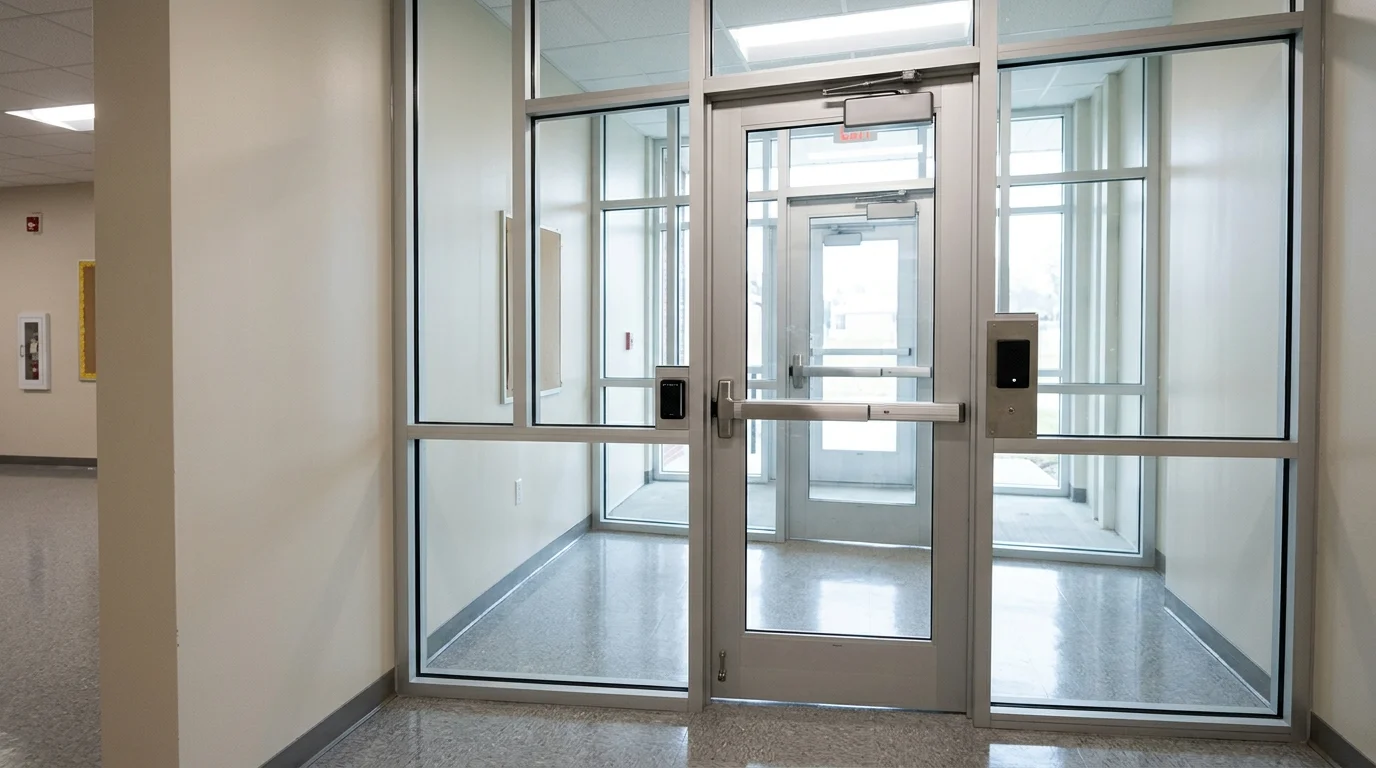
What makes the combined surge visible on the ground is a procurement wave running through Pennsylvania school districts in 2026. Districts from Bucks County to Luzerne County to Erie County have issued RFPs this year for secure vestibule construction, access control systems, security cameras, and unarmed guard services. Council Rock School District in Bucks County is among those pursuing vestibule upgrades; Upper Darby and Keystone Oaks have moved on camera systems; Western Wayne is addressing access control; Chester-Upland and Crestwood have sought guard services. These procurements are the downstream signal that grant dollars are converting into physical changes, not sitting unspent.
PCCD updated its Baseline Criteria on June 3, 2026, restructuring how districts must demonstrate eligibility across three tiers before accessing funds, covering both physical security enhancements and behavioral and mental health improvements. That restructuring creates a compliance floor that districts have to clear, ensuring the money follows an assessment framework rather than moving as an unrestricted block grant.
Since taking office, the Shapiro-Davis administration has cumulatively awarded nearly $400 million to more than 1,100 Pennsylvania schools for safety and mental health purposes. Act 20 means the next administration will start from a $100 million statutory baseline rather than from zero in the appropriations process.
The immediate deadline to watch is October 16, 2026, when PCCD's application window for the $138.779 million public-school round closes. Districts that miss it forfeit their formula allocation for the cycle. For anyone tracking where the money goes next, PCCD's grant awards from this cycle will be the first full-scale test of whether the statutory floor translates into 775 completed projects across a 500-plus-district state.