
Nine genuine cybersecurity grants worth roughly $4.6 million reached Virginia in the past 90 days, a real, if modest, increase over the $3.4 million baseline from the same window last year. What makes the number interesting is not its size but its composition: the money comes from three separate federal programs, targets three different kinds of recipients, and arrives at precisely the moment when one program is writing its last checks and another is writing its first.
The older program is the State and Local Cybersecurity Grant Program, funded by the 2021 Infrastructure Investment and Jobs Act and administered nationally by DHS, CISA, and FEMA. FY2025 is the final year of SLCGP's four-year, $1 billion cycle, and Virginia is working through the last of its awards. Virginia Emergency Management, acting through the state's central IT agency VITA, holds two active SLCGP grants totaling $8.7 million, a $6.5 million award that started in December 2024 and a $2.1 million award that started in September 2025. Both are flowing downward through a Cybersecurity Planning Committee to 170 local government sub-awardees, covering the defensive IT infrastructure those entities own and operate. This is infrastructure money, not people money: it hardens networks, not careers.
The newer program does the opposite. On July 28, 2026, NSF announced the first 14 recipients of the CyberAICorps Scholarship for Service, a renamed and restructured version of the 25-year-old CyberCorps program that, for the first time, explicitly requires students to develop AI competency alongside traditional cybersecurity training. Old Dominion University in Norfolk is one of those 14 inaugural national recipients. The solicitation, NSF 26-503, was released in April 2026 and is authorized under both the cybersecurity workforce statute and the CHIPS and Science Act's AI workforce provisions, a legal structure that signals the program was designed to outlast any single appropriation cycle. Students who receive CyberAICorps scholarships graduate with government service obligations, feeding directly into the federal agencies and contractors that anchor Virginia's northern corridor.
Source: NationGraph.
ODU's selection is not the only university signal in this window. George Mason collected $830,000 across two NSF cybersecurity awards. UVA received $639,000. VCU received $250,000. Virginia Tech received $291,000 for fleet cybersecurity research through the Department of Transportation. And Virginia State University received a $1.03 million congressional earmark from the Department of Commerce to build a Center for Generative AI and Industrial Cybersecurity, a physical facility that includes a cyber range, a digital forensics lab, and AI computing infrastructure. Five institutions, three federal agencies, three distinct program types, one 90-day window.
No other state absorbs this combination as naturally as Virginia does. The northern Virginia cluster of federal agencies, defense contractors, and cleared-workforce employers creates a standing demand for the kind of talent CyberAICorps is designed to produce. VITA's administrative maturity, it submitted a detailed Phase 2 SLCGP implementation report to the General Assembly (RD330, 2026) accounting for all 170 local sub-awardees, means the infrastructure dollars are being tracked and distributed with more accountability than most states manage. The density of research universities, spread from Fairfax to Norfolk to Blacksburg to Richmond to Petersburg, means NSF had multiple credible applicants to choose from in a single state.
The practical effect for Virginians depends on where they sit. For a local government IT director in a rural county, the SLCGP sub-award may be the first dedicated cybersecurity funding the jurisdiction has ever received; CISA required all SLCGP Cybersecurity Plans to be submitted by January 30, 2026, so the planning work is already done and implementation money is what's moving now. For a computer science student at ODU or one of the other participating universities, the CyberAICorps program represents a scholarship with a government job attached, and a signal that the federal government views AI fluency as a baseline requirement for the next generation of cyber defenders, not an elective skill.
What happens after the SLCGP cycle closes is the open question. FY2025 is explicitly the final year of the IIJA appropriation that funded the program, and no successor infrastructure grant program has been authorized at the same scale. If Congress does not renew or replace SLCGP, the 170 local governments Virginia has been bringing up to baseline will need to sustain those defenses without the federal subsidy that built them. The CyberAICorps pipeline, by contrast, is structured to run continuously, but it produces people, not firewalls.
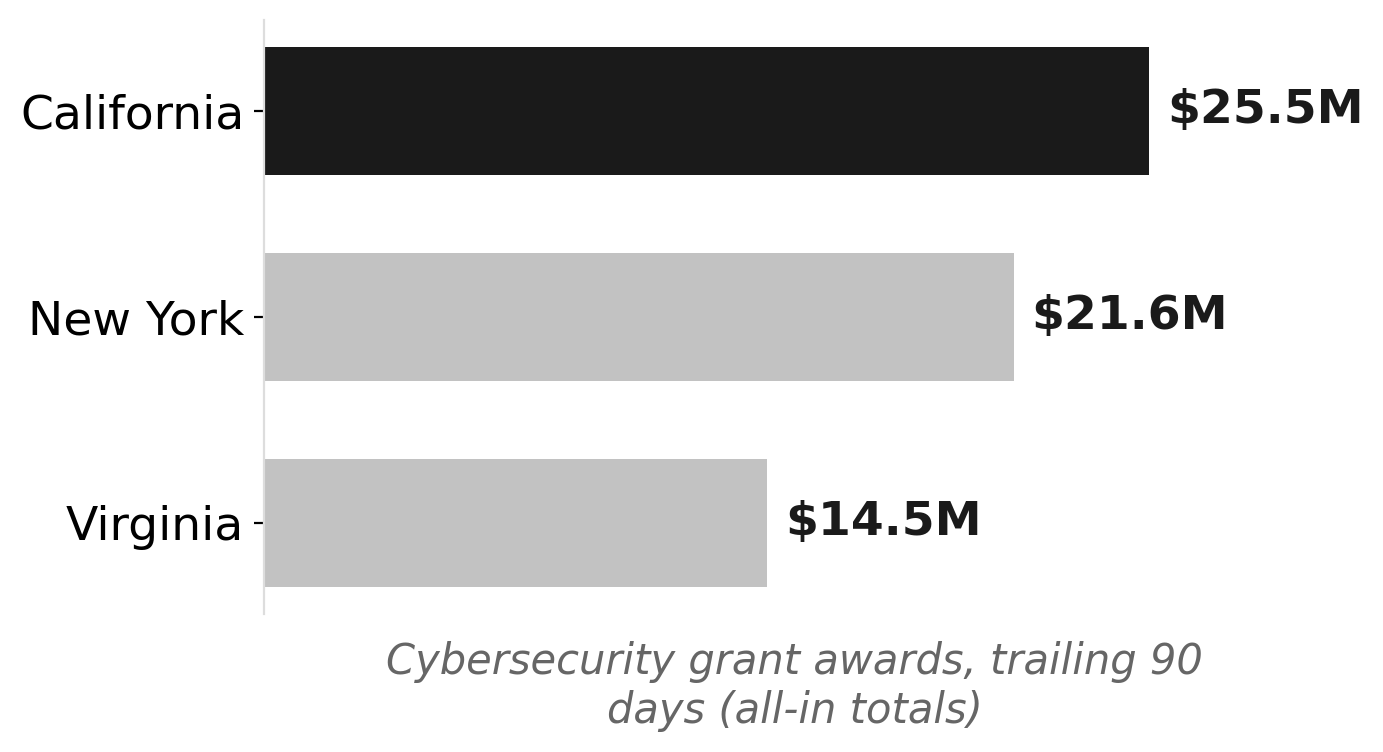
Virginia has ranked third nationally in cybersecurity grant volume over this window, behind California and New York. The more telling measure may be what that money is doing: the last major federal bet on government IT infrastructure and the first federal bet on AI-integrated cyber talent are landing in the same state, in the same quarter, through institutions that were already built to receive both.