Federal opioid grants to Oklahoma hit $10.69 million in the last 90 days, a 894% increase over the $1.075 million awarded in the same window a year ago, and the money is reaching corners of the state that previous funding cycles never touched.
All 17 of the new awards carry a September 30, 2026 start date, the federal fiscal year deadline, confirming they arrived as a single coordinated release from SAMHSA's FY2026 Prevention and Treatment Projects of Regional and National Significance (PRNS) grant cycle. The Oklahoma Department of Mental Health and Substance Abuse Services (ODMHSAS) is the largest recipient at $2 million for prevention programming. Tulsa received $904,000. Choctaw Nation received $740,000, Comanche Nation $731,000, and six other tribal nations split the remainder of a $3.5 million tribal tranche, 33 percent of the entire award cohort.
That tribal concentration is not an accident. Oklahoma has 39 federally recognized tribal nations, more than almost any other state, and SAMHSA's PRNS and companion Opioid STR programs explicitly authorize grants to tribes and tribal organizations as direct recipients. The result is that Oklahoma functions as a natural stress test for federal tribal-funding infrastructure. The Cherokee Nation, for instance, became the first tribe nationally to receive a SAMHSA public health grant covering syringe services, a milestone that reflects how the tribal-federal relationship in Oklahoma has matured into a template other states are watching.
Source: NationGraph.
The PRNS awards are distinct from, and sit on top of, Oklahoma's existing Opioid STR portfolio. That older federal program has already committed $130.3 million to the state, anchored by a $32.2 million ODMHSAS award made in September 2024, with $59.8 million disbursed so far. The new $10.69 million is not a replacement cycle; it is an additional layer.
And then there is a third layer entirely, one with a different legal authority and a different clock. Oklahoma's opioid litigation against manufacturers and distributors, which began with the first-in-the-nation Johnson & Johnson trial in 2019, has now produced at least $920 million in settlement agreements. AG Gentner Drummond's Opioid Abatement Board, created to govern those proceeds, awarded $29 million in 2025 to 45 recipients. A new $12 million settlement with opioid manufacturers was announced in August 2026, adding to the pool. Senate Bill 574, which took effect in November 2025, expanded abatement fund eligibility to colleges and universities, and a new higher-education grant round opened in October 2026 with $2.2 million on the table.
These two tracks, federal SAMHSA grants running through HHS and litigation proceeds managed by the AG's board, share recipients but have different legal authorities, different eligibility rules, and different award calendars. ODMHSAS, tribal nations, and cities like Tulsa appear on both lists, drawing from both pools. The overlap is not a flaw in the design; it is the design. Oklahoma built the litigation settlement infrastructure specifically to fill gaps that federal categorical grants leave open.
What the dual system has not yet solved is velocity. Roughly $30.7 million in settlement funds remains unallocated in a legislative holding account, money that cleared the litigation process but has not moved through the Board's competitive grant cycle. The abatement fund distributes dollars on its own calendar, constrained by the Board's review process and statutory requirements, while SAMHSA's annual cycle drops awards on the federal fiscal year deadline regardless of state readiness.
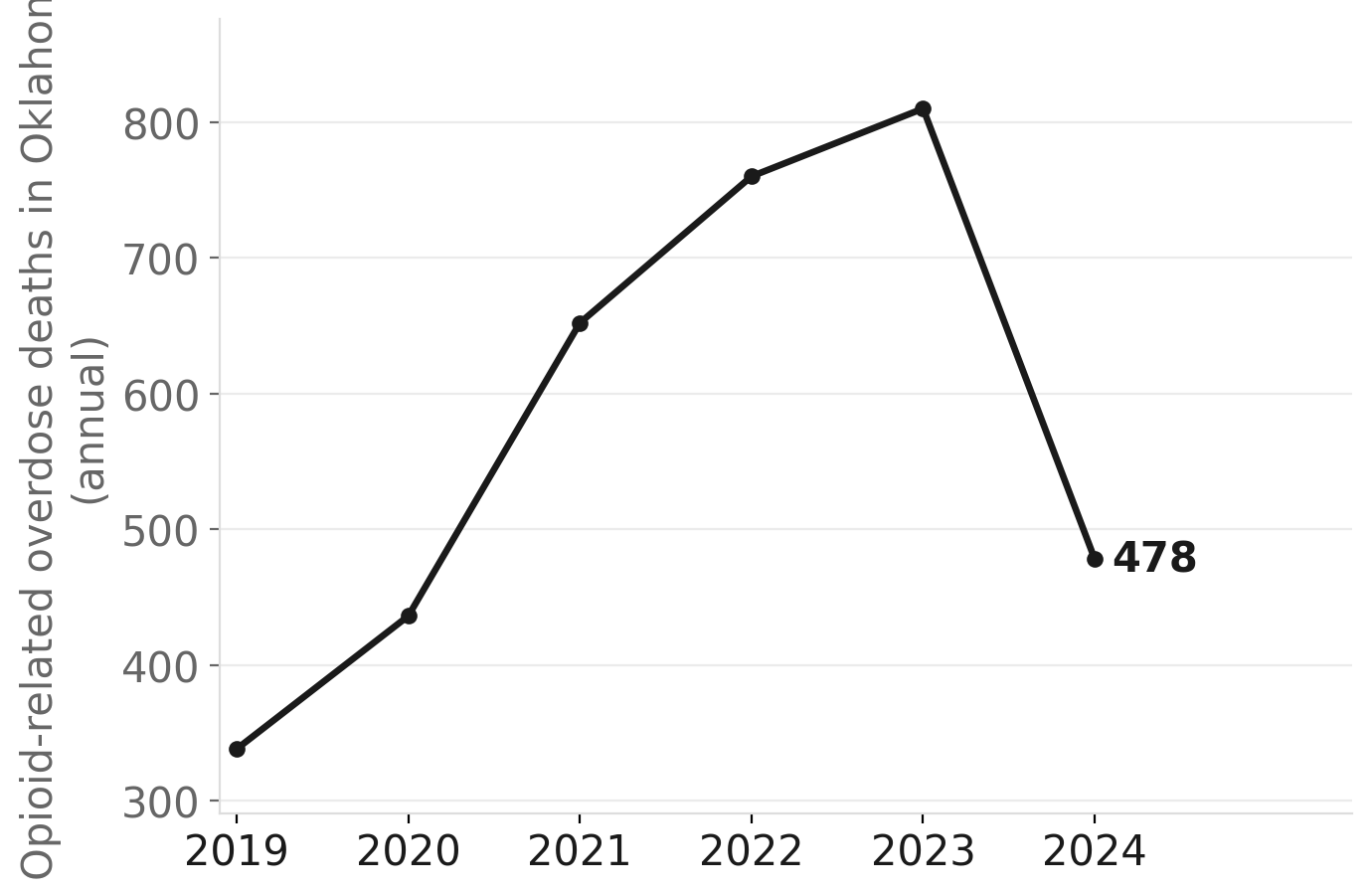
The urgency behind all of this spending is not abstract. Oklahoma recorded 810 opioid overdose deaths at the 2023 peak. The overdose rate has since declined 41 to 43 percent, a drop that public health officials credit partly to naloxone distribution and treatment expansion funded by earlier grant rounds. Whether this new $10.69 million sustains that trajectory, or whether the state can clear the backlog in its settlement fund before the next reporting cycle, are the near-term questions that matter.
SAMHSA's July 2026 announcement of more than $281 million in new grant opportunities, framed under the Trump administration's Great American Recovery Initiative, signals that the federal side of this equation is not contracting. The question for Oklahoma is whether its two-track infrastructure, one federal, one litigated, can spend money as fast as it is being awarded.