Federal mental health grants flowing into North Carolina reached $121.4 million in the 90 days ending October 2026, up 73% from $70.1 million in the same window last year, the largest such surge the state has recorded, and more than double what any neighboring Southeast state received in the same period.
The money is arriving through three distinct federal mechanisms, and understanding which is which matters for understanding what gets built. The largest structural driver is the CMS Rural Health Transformation Program, a five-year cooperative agreement that awarded North Carolina $213 million in December 2025 for fiscal year 2026-27, with the state eligible for up to $1 billion through 2031 if the program performs. SAMHSA block grants, the Community Mental Health Services Block Grant ($9.5 million) and the Substance Use Block Grant ($13.1 million), flow separately, on a formula basis, and fund community services independent of the RHTP. On top of those, Duke University and UNC-Chapel Hill are running through their annual NIH and SAMHSA research grant renewal cycles: Duke pulled in $56.5 million across 54 grants in the trailing 90 days alone, and UNC added $35.4 million across 48 grants. These are not service dollars; they fund the research pipelines that feed the clinics.
The geographic logic of the surge is as important as the dollar figures. North Carolina has the second-largest rural population in the country, more than 3.5 million residents, and has historically ranked near the bottom nationally in access to mental health providers. The RHTP was structured specifically to address that gap. On October 7, NCDHHS and Governor Josh Stein announced $17 million in RHTP-funded deployments: $4 million for Certified Community Behavioral Health Clinics, $4 million for Mobile Outreach teams expanding to six additional counties, $3 million for First-Episode Psychosis response, and $2.9 million for Rural Crisis Partnerships. These are not grants to existing institutions; they are the first infrastructure deployments in counties that have not had consistent behavioral health services.
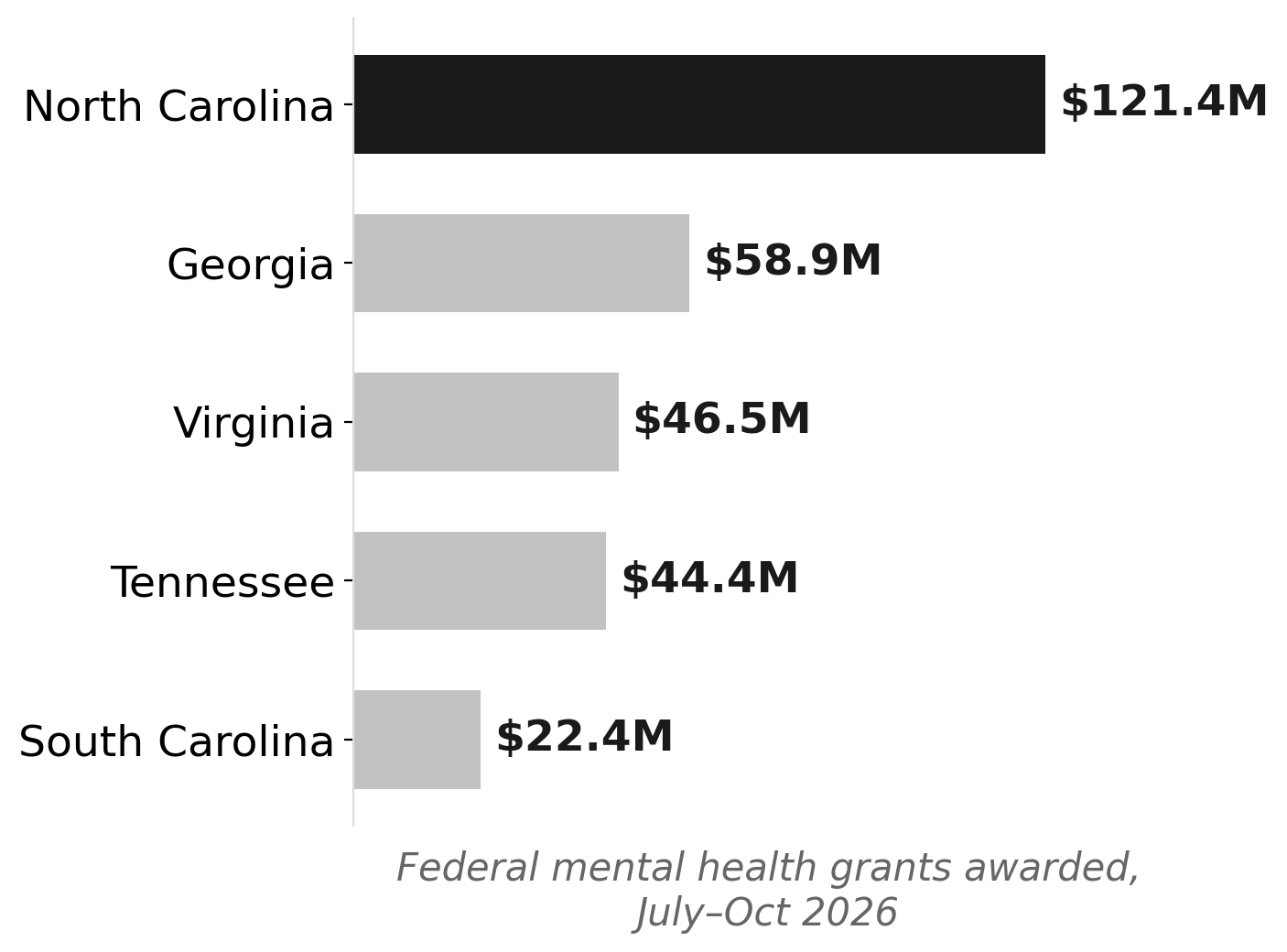
Source: NationGraph.
Separately, SAMHSA awarded NCDHHS three grants totaling nearly $7 million in September 2026 to strengthen the 988 Suicide and Crisis Lifeline ($5.2 million), expand mobile crisis teams to Bertie, Halifax, Hertford, and Northampton counties ($750,000), and support maternal SUD treatment ($1.08 million). Robeson County, one of the state's poorest and majority-Indigenous counties, received a $3 million SAMHSA regional significance grant. The NC Department of Public Instruction received $1.5 million for school-based mental health. The money is concentrating in the places farthest from a provider.
Governor Stein's Executive Order 33, signed February 5, 2026, is the connective tissue. The order directed NCDHHS, the Department of Adult Correction, and the Department of Public Safety to coordinate behavioral health and criminal justice systems, a state administrative directive that does not appropriate funds but did align agency priorities with the incoming federal dollars before they arrived. NCDHHS Secretary Dev Sangvai called the RHTP award 'a once-in-a-lifetime opportunity to transform health care in North Carolina.' The executive order gave that phrase an operational deadline.
The RHTP's structural design amplifies all of this. CMS designated NCDHHS, UNC, and Duke as the program's collaborative implementation partners, which means the same institutions processing tens of millions in research grant renewals are also the delivery infrastructure for the service dollars. That alignment is not statutory; it is administrative. But it helps explain why research renewals and service grants are moving in tandem in the same 90-day window, producing a spike that looks, on its face, like a single coordinated push.
For a North Carolinian living in a county that has never had a mobile crisis team, the most immediate change is the arrival of one. Six counties are being added to the mobile outreach network through the October RHTP deployment. For someone in Bertie or Northampton, the September SAMHSA awards extend the 988 lifeline's on-the-ground capacity into communities where a crisis call previously meant a long wait or a long drive.
The open question is whether the state can build durable institutional capacity before the RHTP funding window narrows. The program runs through 2031, but annual awards are contingent on performance benchmarks CMS has not yet fully published. North Carolina is eligible for up to $1 billion over five years; it has secured $213 million for the first year. The next signal to watch is whether NCDHHS's October deployment announcements translate into staffed, credentialed clinics by the time CMS reviews year-one performance, and whether the research infrastructure at Duke and UNC produces the outcome data the federal program will eventually require to justify continuing the investment.