Torbay, Newfoundland is moving to remove cancer-linked 'forever chemicals' from its municipal drinking water, a project that could cost millions and whose origins may trace back to decades of military firefighting operations next door.
The town of roughly 8,000, a fast-growing commuter community just north of St. John's, has posted a request for proposals on the federal procurement portal to design and build PFAS treatment for its water supply. The system draws from the Tapper's Cove and Torbay Pond watershed, which sits downhill from one of the most common PFAS sources in Canada: a former military airbase.
CFB Torbay operated as a Second World War-era air station before becoming St. John's International Airport. For decades, military and airport fire crews used aqueous film-forming foam, known as AFFF, in training exercises and emergency response. That foam contained PFAS compounds, a class of thousands of synthetic chemicals that don't break down in soil or water and accumulate in human tissue. Exposure has been linked to kidney and testicular cancers, thyroid disease, immune suppression and developmental problems in children.
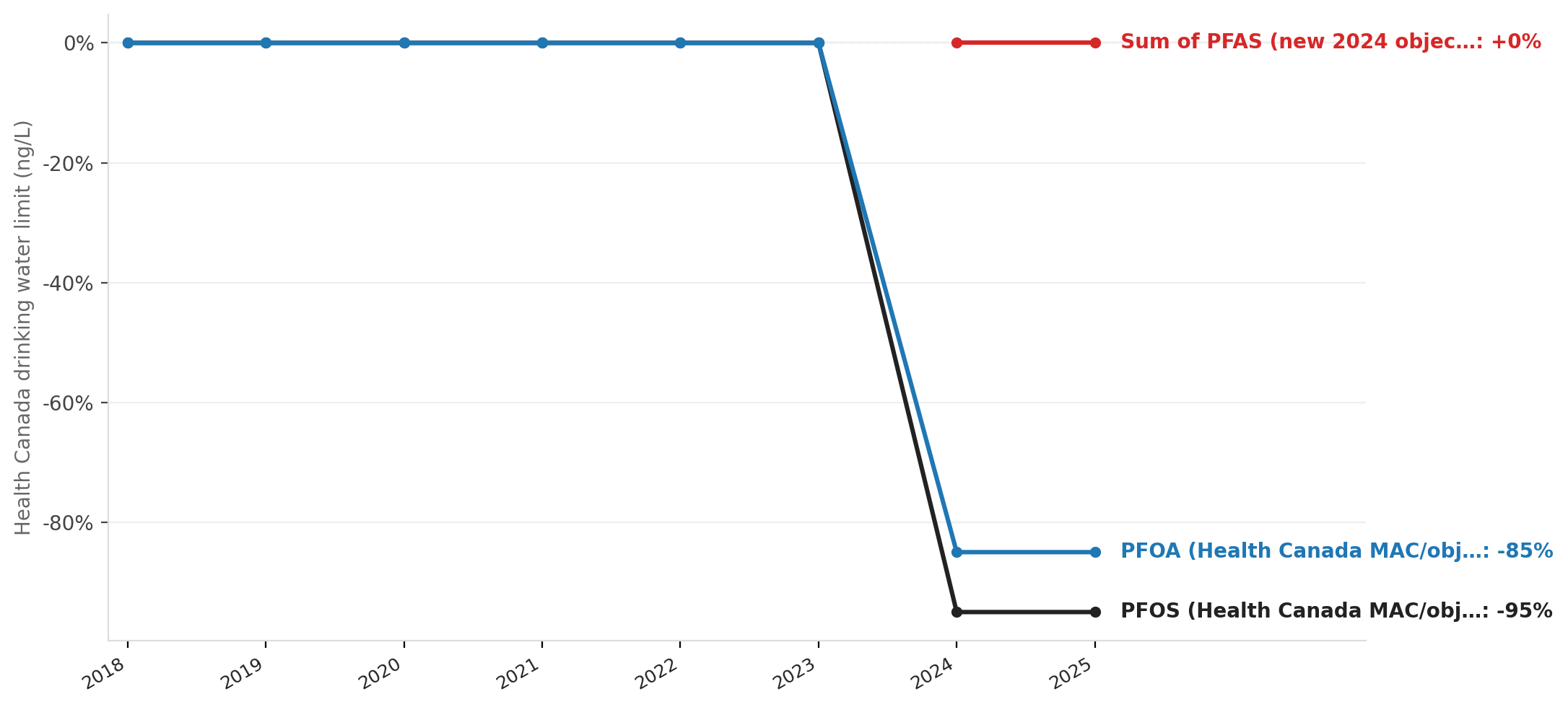
Source: NationGraph.
Health Canada tightened its drinking water guidance for PFAS in August 2024, setting a combined threshold of 30 nanograms per liter across the full class of chemicals, a significant shift from earlier rules that addressed only two specific compounds. The federal government followed up in March 2025 by announcing plans to list PFAS as toxic substances under the Canadian Environmental Protection Act. For small municipalities that had been treating PFAS as an emerging issue to watch, those moves turned it into a compliance problem to solve.
Torbay is now working to solve it. The town's rapid growth has already strained water infrastructure built for a much smaller rural population, and a PFAS treatment system represents the kind of capital project that would be extraordinarily difficult for a community this size to fund on its own. The RFP appearing on a federal procurement portal suggests Ottawa may be involved in financing, though specific cost-sharing arrangements and the total project budget are not publicly confirmed.
The deeper question the project raises is who bears responsibility for the contamination itself. Canada's Department of National Defence has been conducting PFAS assessments at legacy bases across the country after similar contamination was found near CFB Bagotville, CFB Gander and other former military sites. If Torbay's water problems can be traced to airbase operations, a federal liability question follows close behind.
The town is now seeking engineering firms to design and build the treatment system. Once a contractor is selected and a system is built, Torbay's 8,000 residents will be able to turn on their taps without worrying about what the former airbase left behind.