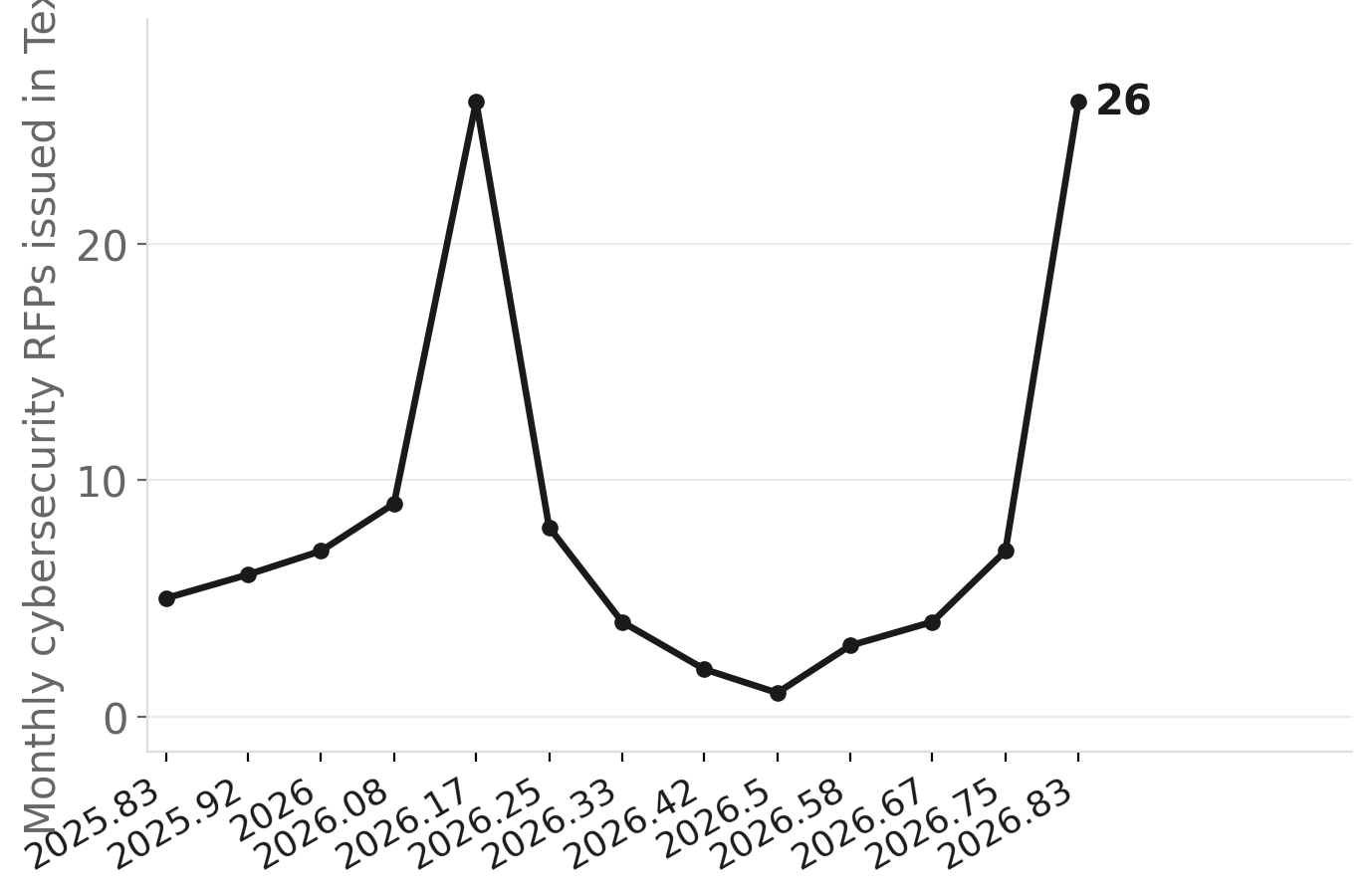
Texas logged 26 cybersecurity RFPs in the past 30 days, 4.7 times the state's 12-month average of roughly 5.5 per month, and more than twice the volume of California, the next closest state at 12. The surge is not spread across state agencies or municipalities. Twenty-one of those 26 RFPs originate from K-12 school districts or regional education service centers, including four from Harlandale ISD in San Antonio alone.
This is not one force at work. It is two separate policy clocks running toward the same window, and Texas school districts are caught in the middle of both.
The first clock is federal. The FCC's $200 million Schools and Libraries Cybersecurity Pilot Program selected more than 700 participants in January 2025 and began releasing funding commitment decision letters in December 2025. By mid-2026, roughly $129 million had been committed across eight waves. But receiving a commitment letter is not the same as receiving money. Before a selected district can draw pilot funds, it must complete a competitive bidding process modeled on the E-Rate Form 470 procedure: post an RFP, collect vendor responses, select a winner, and document the process. That procedural requirement is the direct mechanical trigger for most of the current wave of school-district RFPs. The pilot covers advanced firewalls, endpoint protection, identity and authentication services, and monitoring and detection tools, and Texas districts selected for participation must bid all of it out before they can spend a dollar.
Source: NationGraph.
The second clock is a state statute. Texas HB 150, signed by Governor Abbott on June 2, 2025, at UTSA in San Antonio, created the Texas Cyber Command as the state's centralized cybersecurity authority and set a hard deadline of December 31, 2026, for the full transfer of cybersecurity functions away from the Department of Information Resources. The law also mandates annual cybersecurity training for every government employee and elected official with computer access, certified by August 31 each year. Vice Admiral (Ret.) Timothy "TJ" White was appointed inaugural chief in September 2025. For school districts that are not among the FCC pilot's selected participants, HB 150 is still generating procurement: training platforms, security services contracts, and cyber liability insurance bids are all showing up in the current 30-day window, driven by compliance requirements that now carry a firm deadline.
The Texas Legislature separately approved $42 million in state appropriations for K-12 cybersecurity initiatives in the FY2026/FY2027 biennium, distributed through Regional Education Service Centers. That funding stream is distinct from the federal pilot and is meant to provide technical assistance to districts standing up compliant programs, not just those that won FCC selection.
The concentration in San Antonio is worth noting. UTSA serves as the institutional anchor for the Texas Cyber Command, and the region has developed one of the denser K-12 cybersecurity implementation ecosystems in the state. Harlandale ISD's four simultaneous RFPs are an outlier, but they reflect a dynamic playing out at lower volume across dozens of districts: a single district may need to bid out network security infrastructure, endpoint protection, a training platform, and a security operations monitoring service as four separate procurements, each with its own timeline.
October's surge is also not the first. The monthly time series shows a prior spike of 26 RFPs in March 2026, followed by a summer lull of one to four per month. That bimodal shape is consistent with how FCC funding commitment waves have released: a new wave of letters triggers a new procurement cycle roughly two to three months later. October represents a second wave, not an anomaly, which means the procurement pressure is likely to continue as more commitment letters go out and as the December 2026 HB 150 transition deadline approaches.
For a vendor operating in the K-12 cybersecurity market, Texas is now the dominant procurement environment in the country. For a district administrator, the next 60 days are consequential: any district that has received an FCC commitment letter and has not yet posted an RFP is running short on the time needed to complete competitive bidding, receive responses, and execute a contract before attempting to draw pilot funds. SB 820, a separate 2025 Texas law, adds another layer, requiring districts to designate a cybersecurity coordinator and report breaches of student personally identifiable data to TEA.
The signal to watch is the pace of FCC commitment letter releases through the end of 2026. If a ninth or tenth funding wave releases before December, a third RFP spike is likely to follow in early 2027, by which point the Texas Cyber Command transition will already be complete and compliance scrutiny will only be higher.