
San Rafael, California is moving to put civilian mental health workers on the streets as first responders to certain 911 calls, joining a growing list of Bay Area cities rethinking who shows up when someone is in crisis.
The city is standing up an Alternative Response Team, or ART, a pilot program that would dispatch crisis workers instead of armed officers to behavioral health emergencies, calls involving people experiencing homelessness, and similar situations. The program is outlined in a city RFP seeking a nonprofit or service provider with experience running field-based mental health programs. The initial contract covers three years, with the possibility of extending if the program succeeds.
The effort comes against a charged backdrop for San Rafael's police department. In July 2020, SRPD officers shot Joanna Fitzpatrick, a woman in mental health crisis. Weeks later, body-camera footage surfaced of officers beating Julio Jimenez Lopez, a day laborer from the Canal neighborhood, the densely populated Latino immigrant community on San Rafael's eastern edge. The footage sparked protests and a years-long reform debate. In November 2022, Marin County prosecutors filed criminal assault charges against two officers involved in the Jimenez Lopez beating. An independent review of the department, commissioned by the city and released in 2022, recommended exploring alternative response models.
Source: NationGraph.
The Canal neighborhood has also been the focus of other city investments in recent years, including a $2 million library renovation serving roughly 12,000 residents and new flood resilience planning.
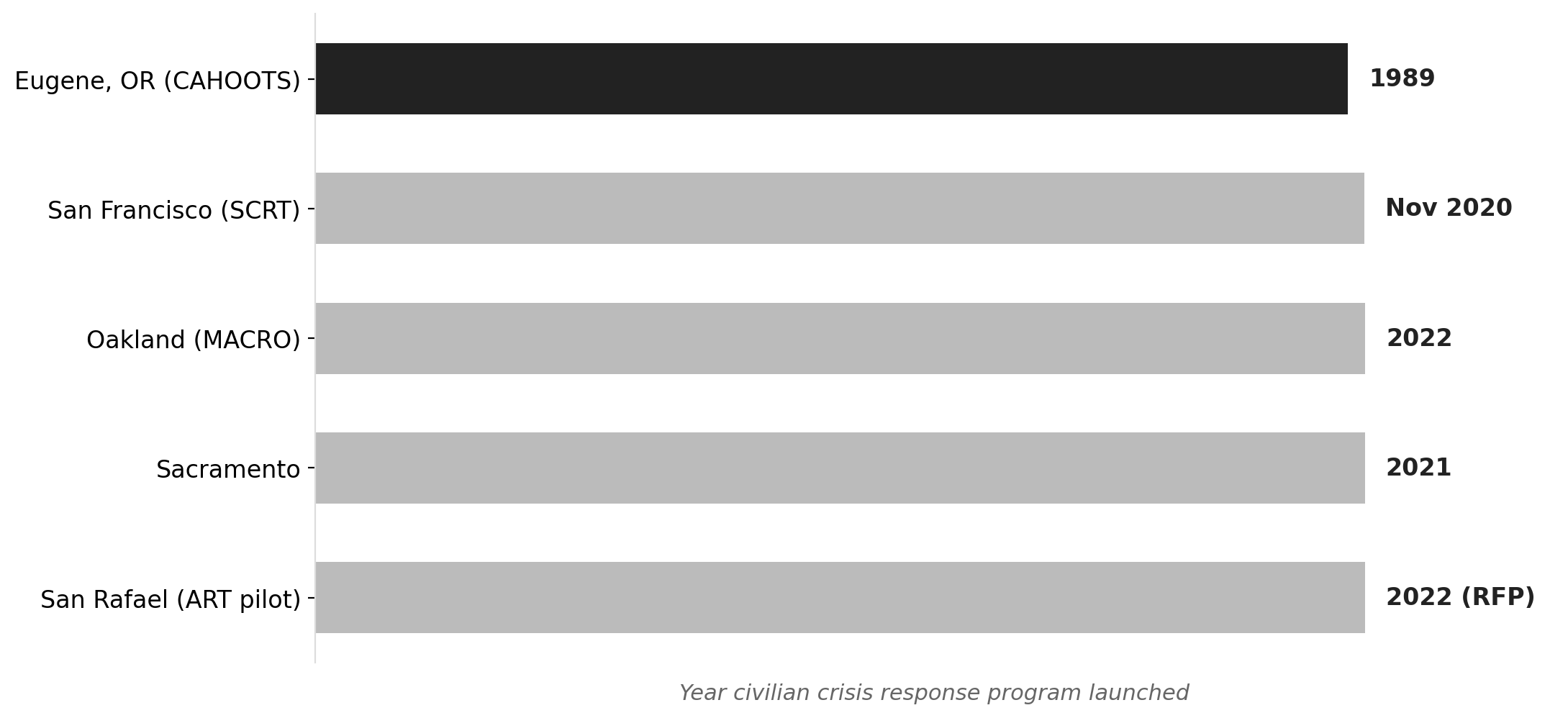
San Rafael's move fits into a statewide push. California's AB 988, passed in 2020, established the 988 mental health crisis line and required counties to build out mobile crisis response infrastructure. Marin County has been developing its own Mobile Crisis Response Team in parallel. The model both programs draw from is CAHOOTS, Eugene, Oregon's decades-old program that sends a medic and a crisis counselor instead of police to roughly 17% of the city's 911 calls.
Nationally, about one in four fatal police shootings involves someone experiencing a mental health crisis, a statistic that has driven cities from Oakland to Denver to experiment with civilian response teams.
San Rafael's pilot is designed to operate on 12-hour daily shifts rather than around the clock, at least initially. The city has not disclosed a budget figure publicly. Mayor Kate Colin and City Manager Cristine Alilovich have both expressed support for the alternative response approach.
The city is expected to select a provider and finalize a contract before the program launches. How quickly the team gets on the street, and which calls it will handle, will become clearer once a provider is chosen.