Maryland is moving to expand access to opioid treatment by bringing together medication, housing referrals, employment support, and harm reduction services in a single location, as the federal government solicits operators to run what are known as Comprehensive Opioid Recovery Centers.
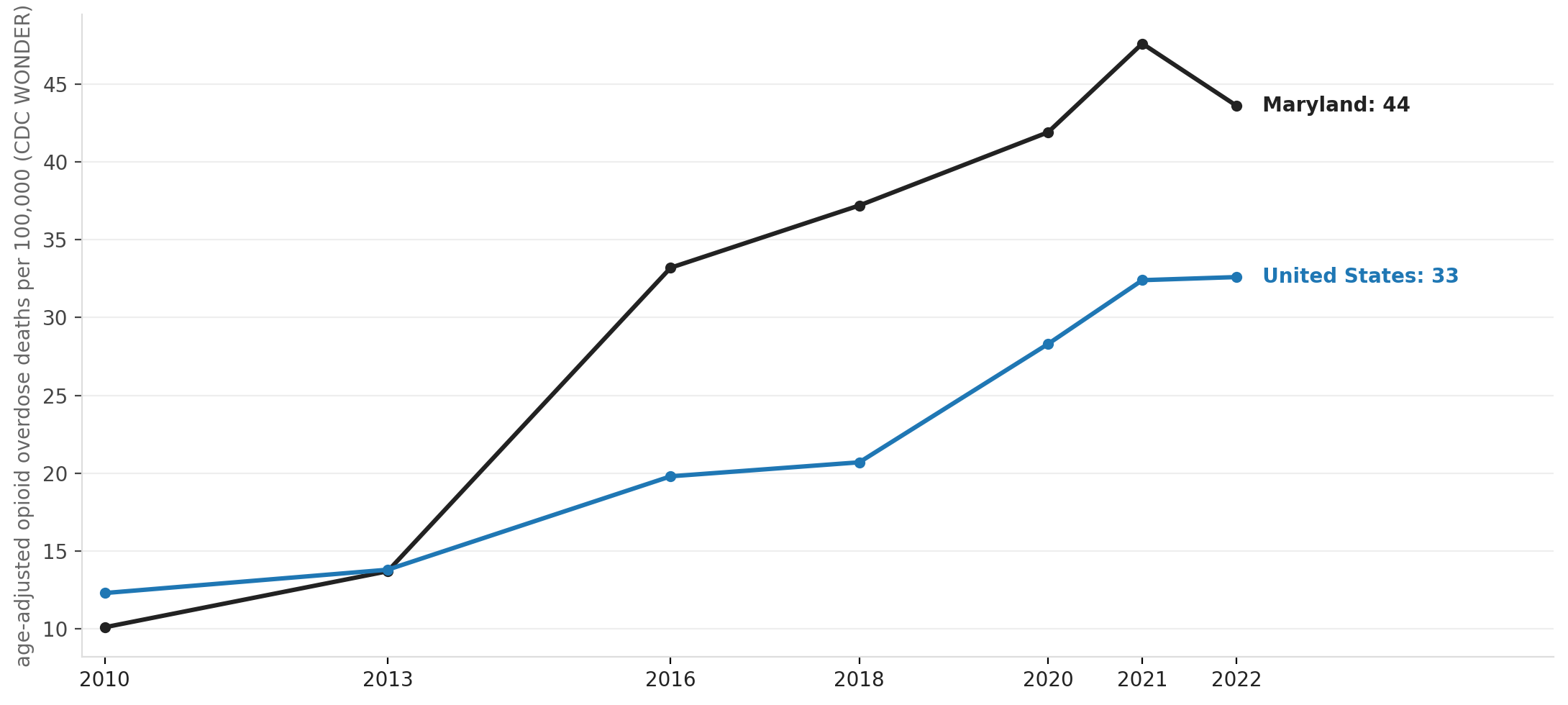
The effort comes as fentanyl continues to drive overdose deaths across the state at rates that rank among the worst in the country. Baltimore has drawn particular attention: a 2024 investigation by the Baltimore Banner and New York Times found the city's overdose death rate was nearly double that of any other large American city. But rural Western Maryland and the Eastern Shore face their own crises, often with far fewer treatment options nearby.
The one-stop model is a deliberate departure from how opioid treatment has historically been delivered in the U.S. For decades, patients seeking help faced a fragmented system: one provider for medication, another for counseling, another for housing assistance, and long waitlists at every stop. The Comprehensive Opioid Recovery Center program, authorized under the 2018 SUPPORT for Patients and Communities Act, requires funded centers to offer all three FDA-approved medications for opioid use disorder, methadone, buprenorphine and naltrexone, alongside peer support, workforce reentry services, and harm reduction programs. The idea is that removing those logistical barriers keeps more people engaged in care.
Source: NationGraph.
The federal push reflects how the opioid crisis itself has shifted. The epidemic's first wave, driven by overprescribed painkillers in the late 1990s, gave way to heroin and then to synthetic fentanyl, which now appears in the overwhelming majority of Maryland overdose deaths. Xylazine, a veterinary sedative increasingly mixed with fentanyl on the street, is adding another layer of clinical complexity that treatment centers are still learning to address.
Maryland has made addiction treatment a stated priority under Governor Wes Moore, who expanded the state's Opioid Operational Command Center. The state also expanded Medicaid under the Affordable Care Act, giving it broader addiction treatment coverage than many states, but capacity for methadone treatment and residential recovery programs remains strained.
Similar federal efforts have already reached pregnant women seeking addiction care in Maryland, but the CORC program aims at a broader population. SAMHSA has funded comparable centers in Kentucky, West Virginia and Ohio, with results that have been praised for integrated care while drawing criticism for uneven reach into rural areas.
Organizations interested in operating a center can find the full grant announcement on SAMHSA's website. How many centers Maryland receives and where they are located will depend on which applicants are selected and funded.