
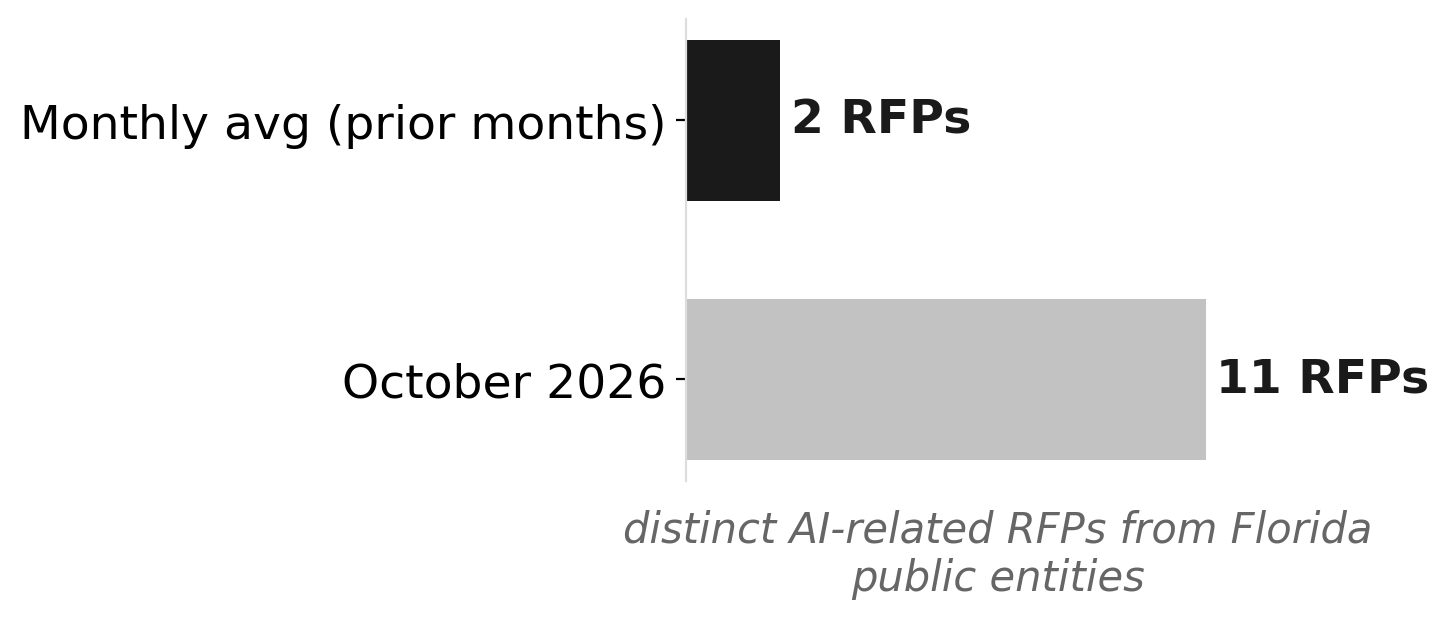
Florida public agencies issued roughly 11 distinct AI-related solicitations in October 2026 alone, against a trailing pace of one to three per month, a genuine fourfold acceleration that has no corresponding state law behind it, because Florida does not have one.
The structural reason is straightforward: Tallahassee refused to act. Florida's AI Bill of Rights (SB 482), a DeSantis administration priority, passed the Florida Senate 37-1 during the April 2026 special session and was then killed by House Speaker Daniel Perez on the session's first day, April 28. Perez cited deference to Trump's Executive Order 14365, a December 2025 federal deregulatory directive aimed at limiting state AI rules that conflict with a national framework. It was the second time the House blocked the bill; it had already died in the regular session on March 13. The result is that Florida, the third-largest state by population, entered the fall of 2026 with no statutory AI governance framework for its public sector.
Into that vacuum stepped a purchasing office at Florida State University.
Source: NationGraph.
On September 10, 2026, FSU issued ITN 6769-4 in collaboration with RFxPremier: a statewide cooperative contract for AI systems and services, explicitly open to every Florida public entity, state agencies, county governments, school districts, hospital districts, nonprofits. Any qualifying entity can ride the contract without conducting its own full solicitation. The vehicle closes January 8, 2027. It is, in practical terms, the closest thing Florida has to a unified AI procurement policy.
The October surge shows agencies using that opening. Broward County filed for AI systems and services and separately for AI-enabled employee screening. St. Petersburg issued a request for information on agentic AI for municipal operations. North Miami Beach moved on AI-enabled utility management. North Broward Hospital District solicited stroke imaging AI. The Florida Department of Commerce pursued an AI-enabled workforce platform called WITS. Pinellas County issued an AI strategic roadmap and governance consulting RFP, notably marked a re-bid, meaning a prior procurement attempt had already failed, a signal of how much complexity agencies face without state-level guidance.
As NationGraph documented earlier this year, this procurement-as-governance dynamic was already underway in Q1 2026. What has changed is scale and structure. The earlier wave was a collection of isolated agency decisions. The October acceleration is happening around a formal cooperative vehicle that any Florida public entity can join, which means the terms negotiated inside ITN 6769-4, vendor responsibilities, data handling expectations, performance standards, will effectively become the AI governance baseline for a large share of the state's public sector, written by university procurement officers rather than legislators.
The one genuine governance action that did land in Florida in 2026 came from a different direction: the Florida State Board of Education adopted AI rules for schools on September 16, 2026, covering parental consent requirements, bans on companion AI, and instructional tool disclosure. That framework covers K-12 and higher education; it does not extend to county governments, hospital districts, utilities, or workforce agencies, the entities now flooding the procurement pipeline.
The advisory Government Technology Modernization Council created by SB 1680 in 2024 operates within the Department of Management Services but carries no procurement or enforcement authority. It can study AI policy; it cannot set the terms under which the state buys AI.
For Florida residents, the practical consequence is heterogeneity. A stroke imaging AI deployed by North Broward Hospital District will be governed by whatever standards that district negotiated into its contract. An agentic AI handling St. Petersburg municipal services will be governed by that city's RFI process. The FSU cooperative contract will harmonize some of this, but only for entities that choose to use it, and only to the extent the contract's terms are substantive. What vendors agree to in ITN 6769-4 negotiations over the next two months will carry more weight than anything the Legislature produced in 2026.
The next concrete signal to watch is the FSU ITN 6769-4 award, expected sometime after the January 8, 2027 close. If the contract language includes meaningful requirements around algorithmic transparency, data retention, or audit rights, it will function as a de facto state standard. If it does not, the patchwork continues, county by county, hospital district by hospital district, purchasing office by purchasing office.