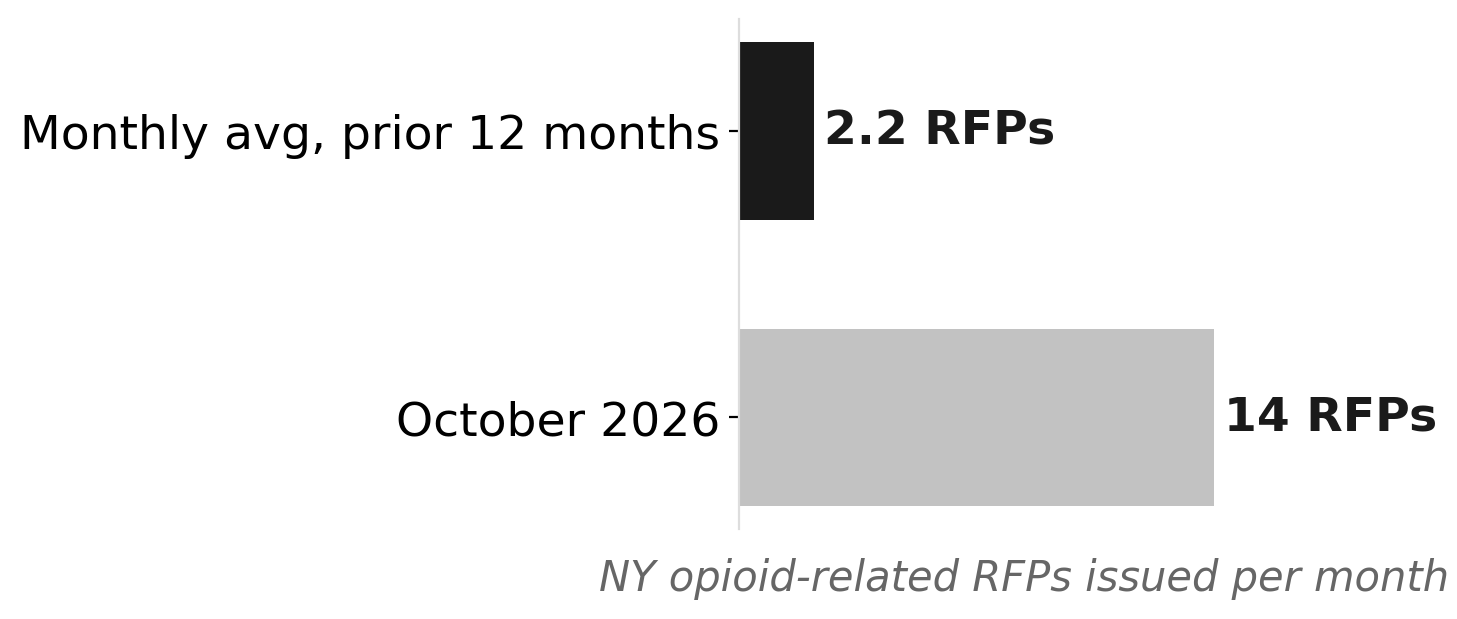
New York counties issued 14 opioid-related RFPs in October 2026 alone, against a 12-month monthly average of roughly 2.2, a sixfold spike, spread across eight counties and multiple state agencies, all converging on the same calendar pressure point: November 1, 2026, the first annual reporting deadline under a newly amended state law.
The law in question is Mental Hygiene Law §25.18, amended in New York's FY2025-26 State Budget and effective May 8, 2025. It requires every county and city that directly receives opioid settlement funds to publicly post a spending summary and submit documentation to the state Office of Addiction Services and Supports by November 1 each year. The statute contains no exemption for recipients who spent nothing, counties must file even if the money sat untouched. That provision is doing most of the behavioral work this fall.
The result is a bureaucratic inversion: a transparency law designed to show how settlement money is being spent is functioning, in its first year, as the mechanism that causes the money to be spent. Counties that received checks from the state's $3 billion-plus litigation settlement, secured by Attorney General Letitia James through agreements with McKesson, Cardinal Health, AmerisourceBergen, Johnson & Johnson, and others, and held them in reserve are now scrambling to issue RFPs so they have disbursements to report. As OASAS explains in its guidance for local settlement fund recipients, counties are responsible for documenting that spending aligns with approved abatement purposes, treatment, prevention, harm reduction, and recovery services.
Source: NationGraph.
The October filings are geographically scattered in a way that rules out a single batch upload or coordinated agency action. Westchester County's Department of Mental Health posted three separate RFPs under its Opioid Response Initiative. Sullivan County issued two contracts tied explicitly to its settlement-funded task force. Albany County opened a settlement-funded treatment mini-grant round. Cortland County reissued a bid for settlement fund utilization that had lapsed. Wayne County, Ulster County, and Monroe County (through the Rochester City School District's pharmaceutical-settlement claims process) each added filings of their own. NYS OASAS and NYS DOH contributed procurements at the state level, including mobile medication units and naloxone procurement.
Those settlement funds are distinct from the federal opioid grant dollars also flowing through New York. SAMHSA's State Opioid Response program has obligated $414 million across 139 active NY grants, of which only $179 million has been disbursed, a separate underspend problem that runs on federal award cycles and is not subject to the November 1 state deadline. The October RFP spike is driven by settlement funds, not federal grants, even though some of the services being procured overlap.
New York's decentralized structure amplifies the deadline's leverage. OASAS, as an Investigative Post analysis found, has no enforcement mandate over how counties actually spend settlement money, the agency has acknowledged it has no plans to review the submissions it will receive November 1. Critics, including drug policy advocates, have called that a missed opportunity for real accountability. But the absence of enforcement doesn't neutralize the political exposure: a county official whose report shows two years of unspent settlement funds faces a different kind of scrutiny than one whose filing lists active contracts.
That political calculus is visible in the numbers. New York counties have collectively received over $330 million from opioid settlements to date, out of the $3 billion-plus secured through 2040. NYC alone plans to dispense $48 million in FY2026, rising to $50 million in FY2027, as annual payouts climb under the settlement schedule. Smaller counties receiving five- and six-figure annual shares have had less institutional capacity to move money quickly, and, until this year, less formal pressure to do so. The Wyoming County reporting amendment filed this fall is one visible example of smaller recipients updating their paperwork to get into compliance.
For people living in counties that have been slow to deploy funds, the October procurement wave is the first concrete signal that services, treatment slots, harm reduction programs, recovery supports, may actually materialize in the near term. Whether the speed of procurement translates into quality contracting is a different question. RFPs issued under deadline pressure are not the same as RFPs issued through deliberate program planning.
The November 1 deadline has now passed for the first time. The next signal worth watching is what OASAS does with the submissions it receives: whether the agency publishes them in a searchable form, whether legislators request audits of counties that show minimal disbursements, and whether the FY2026-27 budget adds any enforcement teeth to a statute that currently relies entirely on public disclosure to drive behavior. If the spike in October RFPs produced real, deployed services, the law will have worked obliquely. If the contracts sit unsigned or the funds get reprogrammed, the November 1 deadline will have produced paperwork, not outcomes.