Massachusetts water districts issued 24 PFAS-related procurement requests in the last 30 days, three times the 12-month monthly average of about eight, according to NationGraph's RFP database. That spike puts Massachusetts ahead of every other Northeast state in the same window: New Jersey followed with 19 and New York with 14. The surge is not a reaction to new contamination data alone. It is a direct response to Washington's retreat.
In May 2026, the EPA proposed rescinding drinking-water standards for four of the six PFAS chemicals it regulated under the Biden-era 2024 National Primary Drinking Water Regulation, while pushing the PFOA and PFOS compliance deadline to 2031. As of late November, that proposal has not been finalized, and all six maximum contaminant levels remain legally in force. But the uncertainty is real enough for water system engineers and finance directors to act as though the federal floor is already gone. Massachusetts Attorney General Andrea Joy Campbell made the same calculation, leading a 19-state coalition to sue the EPA in July 2026, arguing the rollback violates the Safe Drinking Water Act.
What the federal uncertainty has clarified, for Massachusetts at least, is that the state's own PFAS6 standard is the only mandate local systems can build a capital plan around. Massachusetts has enforced a 20-parts-per-trillion combined limit for six PFAS since 2020, years before the federal rule existed and independent of whatever the EPA finalizes. That standard does not go away if Washington retreats. More than 170 public water systems in the state already exceed it. The procurement surge reflects systems that have exhausted the waiting option.
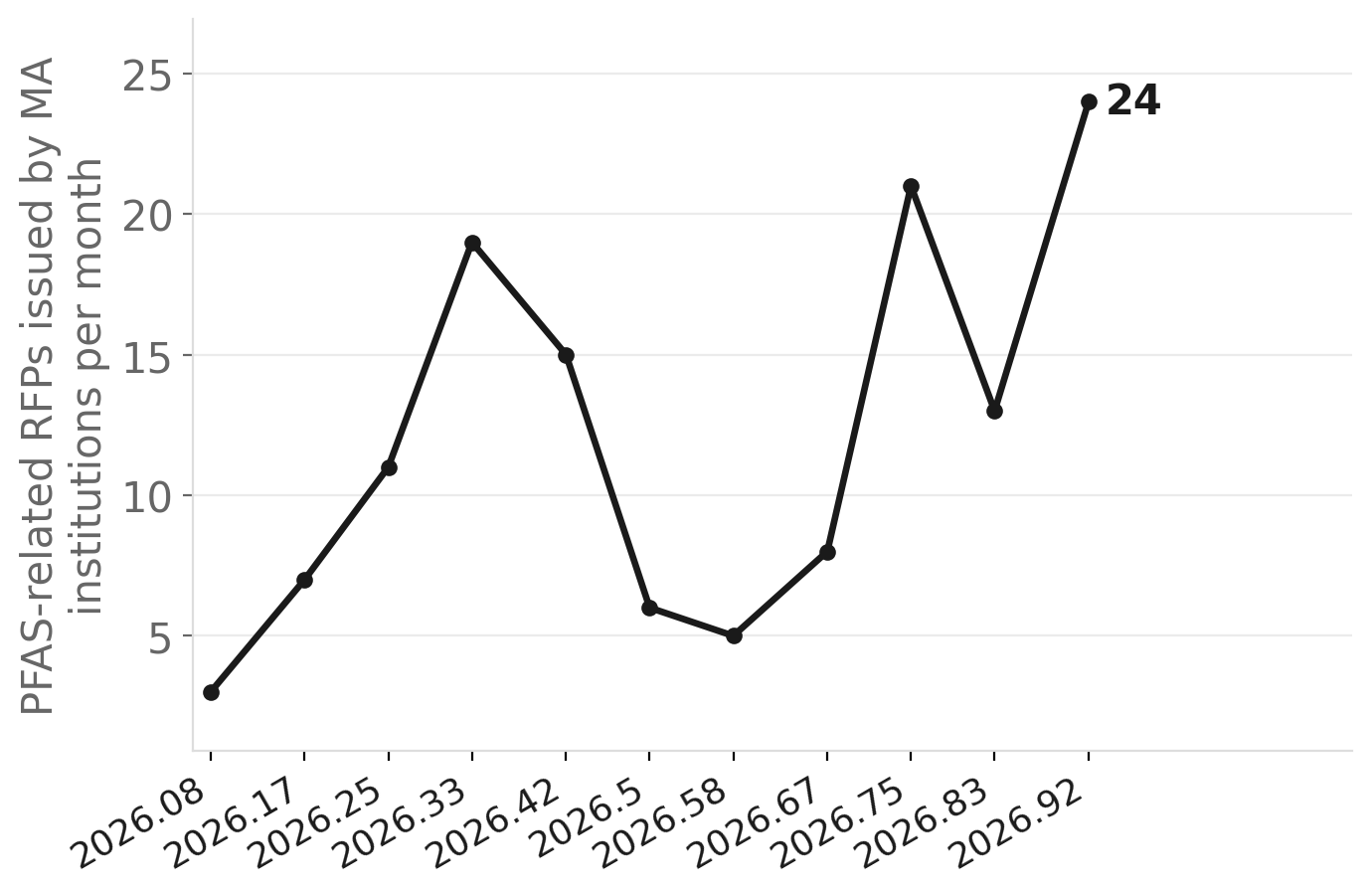
Source: NationGraph.
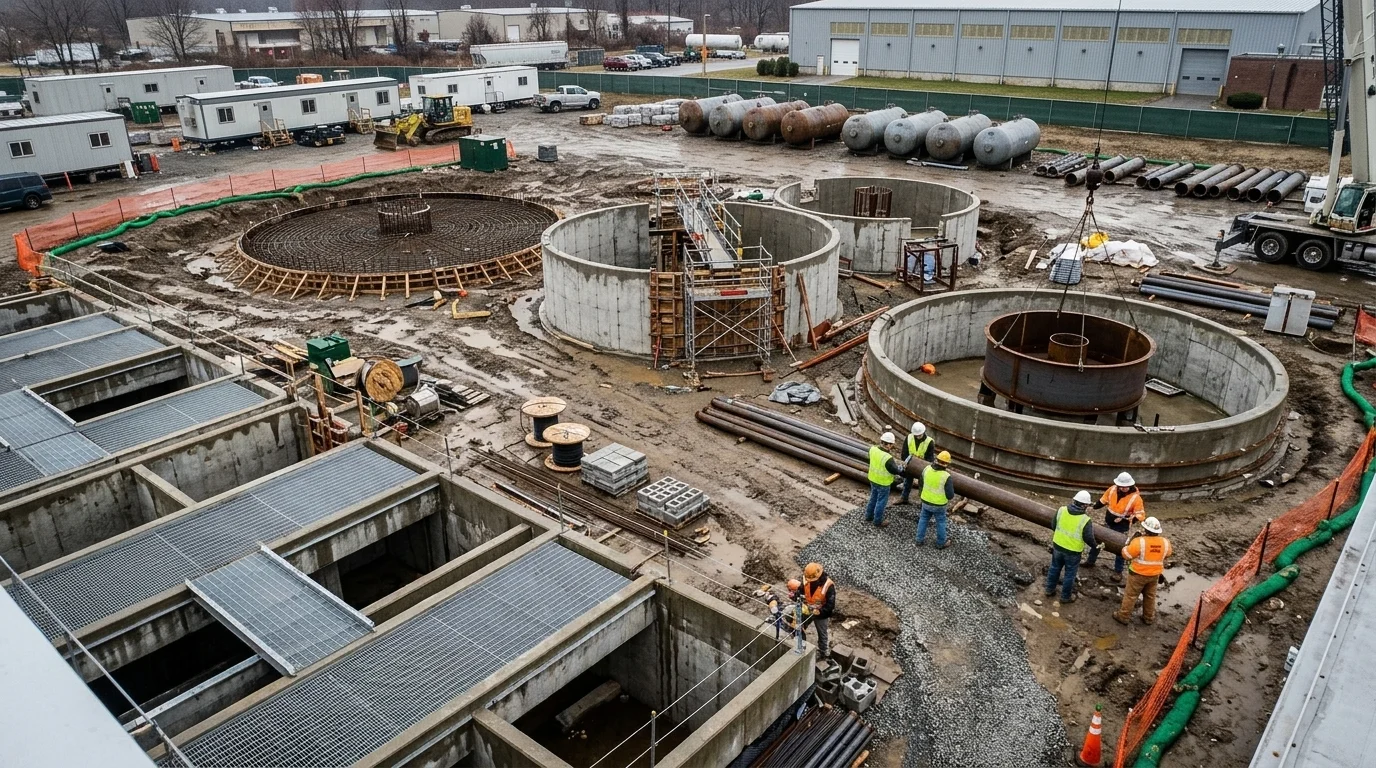
The RFPs themselves reveal where in the project lifecycle that urgency is concentrated. Chelmsford Water District issued three RFPs in the last 30 days covering water treatment plant PFAS improvements. Auburn Water District issued two, focused on treatment plant construction. MassDEP issued three of its own, including solicitations for two FY27 Ipswich Basin PFAS grant programs. Taken together, the mix spans design qualifications, general contractor prequalification, lab analysis, filter media procurement, and construction management. That is not early-stage planning activity; it is a build queue.
A second shock accelerated the October and November surge. On October 14, MassPIRG and Environment Massachusetts released a report finding PFAS in 87 percent of Massachusetts waterways sampled between 2022 and 2024. The contamination picture that report documented extends well beyond drinking-water intake points; Ashumet Pond on Cape Cod tested at 97 nanograms per liter, nearly five times the state MCL. For water district managers already watching the federal regulatory floor wobble, the report reframed PFAS not as a compliance problem for specific systems but as a statewide infrastructure problem without a defined perimeter.
Federal money is still flowing into Massachusetts, though unevenly. Thirty active federal PFAS grants to Massachusetts awardees carry $150 million in obligated funding, running primarily through 2029 and 2032. The largest single commitment is MassDEP's allocation under the EPA WIIN Act Emerging Contaminants in Small and Disadvantaged Communities Grant Program: $38 million covering 2023 through 2029, plus a second tranche of $19.5 million running to 2031. The Massachusetts Clean Water Trust holds two tranches of EPA Drinking Water State Revolving Fund money, $21.8 million and $16.9 million, structured as low-interest loans and grants for water infrastructure including PFAS treatment. These are real dollars. But only $23 million of the $150 million obligated has been outlayed, meaning the bulk of the construction funding is still moving through the pipeline while local water districts are already soliciting contractors.
The cost gap is structural. New York has $172 million in federal PFAS grants obligated; California and Texas each have $127 million; Pennsylvania has $103 million. Massachusetts, at $150 million, is not dramatically behind, but its per-system burden is steeper given the number of systems already in violation of the state standard. Jennifer Pederson, executive director of the Massachusetts Water Works Association, has said publicly that proposed community remediation funds would not cover the actual cost of cleaning up drinking water supplies. The state bills that could change that arithmetic, H.4870/S.1504 and H.5598, which would ban PFAS in consumer products, restrict biosolids, and create a statewide remediation fund, advanced through the 2026 legislative session but have not passed.
The next signals to watch are layered. Any final EPA rule rescinding PFAS limits for four chemicals would not change Massachusetts's enforcement posture, but it would likely redirect federal grant eligibility criteria in ways that affect pass-through funding to MassDEP. The D.C. Circuit litigation, still live after the court denied EPA's January 2026 motion to summarily vacate the 2024 MCLs, could resolve that question before the end of the year. And on Beacon Hill, whether H.5598 or its companion clears the legislature before the session closes will determine whether the statewide remediation fund materializes before the next wave of construction contracts comes due.