Washington counties issued 25 homelessness-related RFPs in October 2026, nearly three times the trailing 12-month average of about 8.6 per month. The surge is not concentrated in Seattle or King County. At least 15 distinct county and city agencies put out procurements this month, stretching from Okanogan County on the eastern slope of the Cascades to Kitsap County on the Puget Sound to Walla Walla in the southeast corner of the state. Oregon, the closest peer state on the Pacific Coast, issued 11 homelessness RFPs over the same period with no comparable spike, isolating what is happening in Washington as state-specific.
Two separate policy levers are driving this, and they work through entirely different mechanisms. The first is HB 2266, signed by Governor Bob Ferguson on March 27, 2026 in Everett and effective June 11, 2026. The law, sponsored by Rep. Strom Peterson (D-Edmonds), requires every Washington city and county to allow transitional housing, permanent supportive housing, indoor emergency shelters, and emergency housing in any zone not designated for industrial use. The legislation does not appropriate money. It removes the discretionary local permitting authority that had stalled shelter siting for years. Governor Ferguson described it as a measure that "ensures that STEP housing can be built more quickly and predictably." Rep. Peterson said the previous system had produced "higher costs, prolonged timelines, and lost opportunities." HB 2266 fixes the legal foundation; it does not pay for the services on top of it.
The second lever is the Washington Department of Commerce's Consolidated Homeless Grant, the state funding program that actually pays for those services. The CHG, authorized under RCW 43.185C and funded through state document recording fees and the state general fund, entered its SFY 2026-2027 biennial contract cycle in July 2026. Commerce's performance monitoring window runs through the fall of 2026, creating a hard procurement deadline: counties that have not executed contracts against their CHG allocations risk forfeiting them. That deadline, landing just months after HB 2266 cleared the siting barriers, is what appears to be forcing the volume and speed of October's procurements.
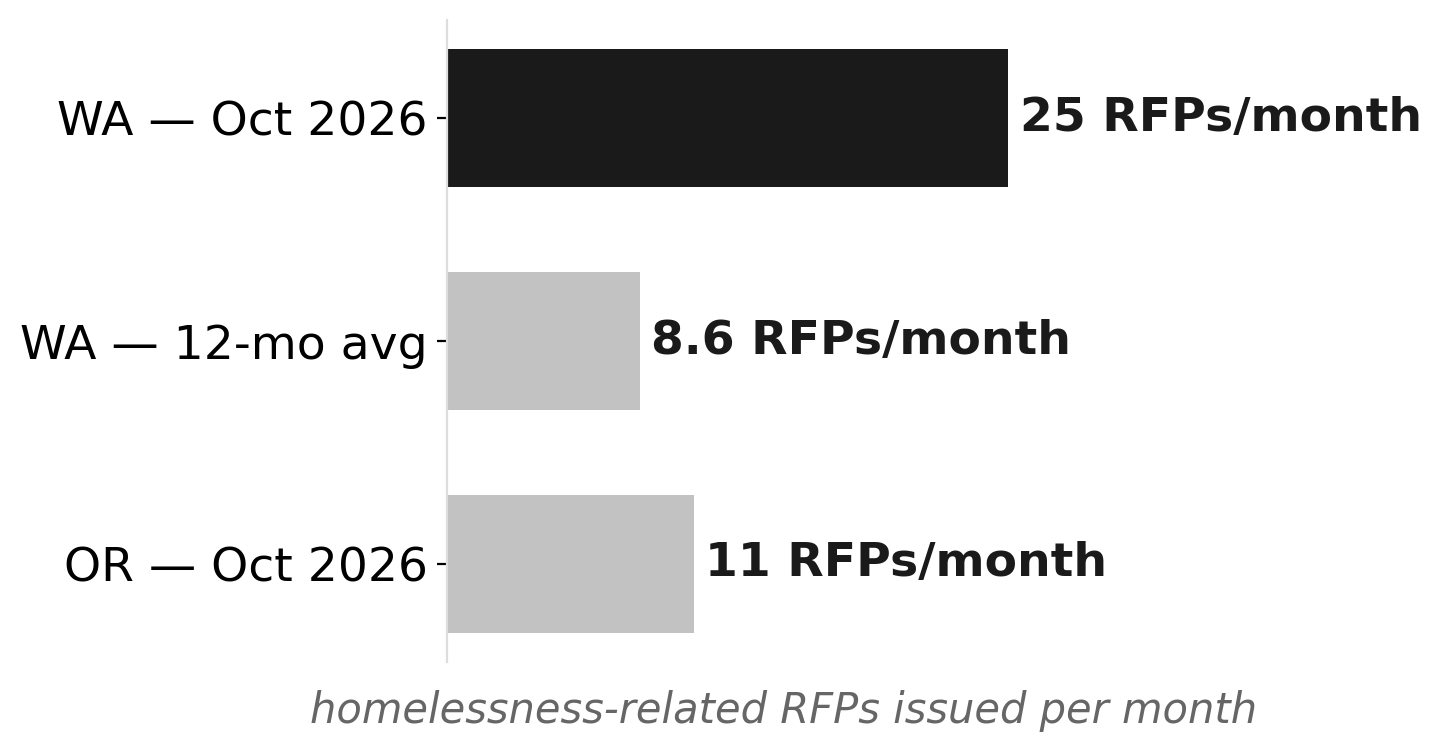
Source: NationGraph.
The service types being procured trace the full response continuum. Counties are going to market for hotel and motel voucher programs, coordinated entry systems, rapid re-housing for youth, cold-weather shelters, lived-experience steering facilitation, and system coordination contracts. Multiple RFPs name the CHG explicitly or reference "state funding" directly. Kitsap County, which issued three RFPs in October, is procuring against a Coordinated Re-Entry Program allocation of roughly $320,000 per year from the CHG and the state Homeless Housing Grant Program. The specificity matters: these are state dollars, not federal grants, and the distinction is reflected in how counties are describing their funding sources in procurement documents.
Federal funding provides a separate and parallel base beneath this state activity. HUD's Continuum of Care program holds active awards in Washington exceeding $60 million in current-period obligations, including a $14.8 million award to Snohomish County running through June 2027 and multiple awards to King County DCHS and the King County Regional Homelessness Authority. HUD's Emergency Solutions Grant program carries roughly $5.4 million in active obligations through the Commerce Department. Those federal streams were not created by HB 2266 and are not on the same contract deadline, but they form the foundation on which state CHG contracting sits.
What makes the October spike notable is its geography. Washington has a documented history of local governments using permitting and zoning rules to slow or block shelter siting, and the jurisdictions most affected by that dynamic were often smaller counties without the administrative and legal resources to push back. The fact that Lewis County, Mason County, Jefferson County, Grays Harbor County, and Okanogan County are all in this month's RFP wave alongside larger jurisdictions like Pierce, Thurston, and Whatcom suggests the combination of HB 2266's mandate and the CHG deadline is reaching places that previously lacked both the legal authority and the procurement bandwidth to move.
For residents in those counties, the near-term signal is a wave of contract awards to shelter operators, coordinated entry administrators, and rapid re-housing providers. Services procured this fall will be operational during the winter months, which is when cold-weather demand peaks. Kitsap, Lewis, and Okanogan are likely to announce awards first given their lead in RFP volume.
The longer question is whether the siting mandate holds. HB 2266 is the state's most direct legislative override of local permitting obstruction in the homelessness space, and some local governments are likely to test its limits. The first legal challenges, if any come, will shape how much of the new procurement infrastructure actually translates into built or leased capacity on the ground.