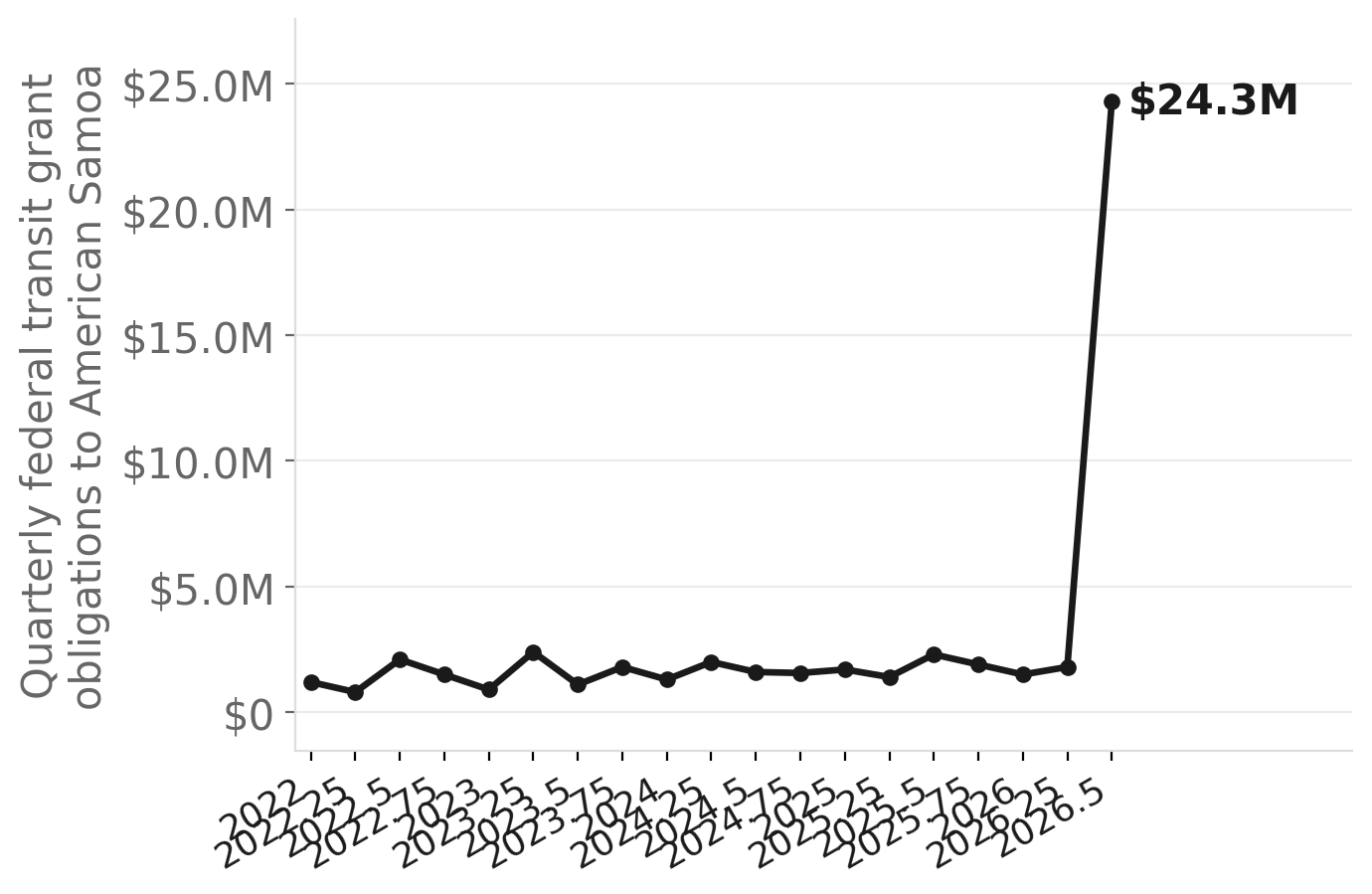
Federal transit grants to American Samoa reached $24.3 million in the last 90 days, up from $1.6 million in the same window a year ago, a 1,455 percent jump driven almost entirely by a single capital grant that was announced nearly three years before it counted as a dollar spent.
The grant in question is a $21.25 million FTA Passenger Ferry award to the American Samoa Department of Public Works, authorized under the Infrastructure Investment and Jobs Act and announced in November 2023 by Congresswoman Uifa'atali Amata. It formally entered its period of performance on September 9, 2026. That administrative start date is what made the quarterly transit numbers for American Samoa look, on paper, like a sudden policy breakthrough. It is less a breakthrough than a billing cycle finally catching up to a commitment already three years old.
The $21.25 million accounts for 87 percent of the 90-day total. The balance comes from a $1.44 million Formula Grants for Rural Areas award under 49 U.S.C. 5311, which provides operating and capital support for rural public transit and entered performance on September 1, 2026. No outlayed amounts have been recorded on either grant yet, consistent with a project still at the procurement and design stage. The money is obligated, not spent.
Source: NationGraph.
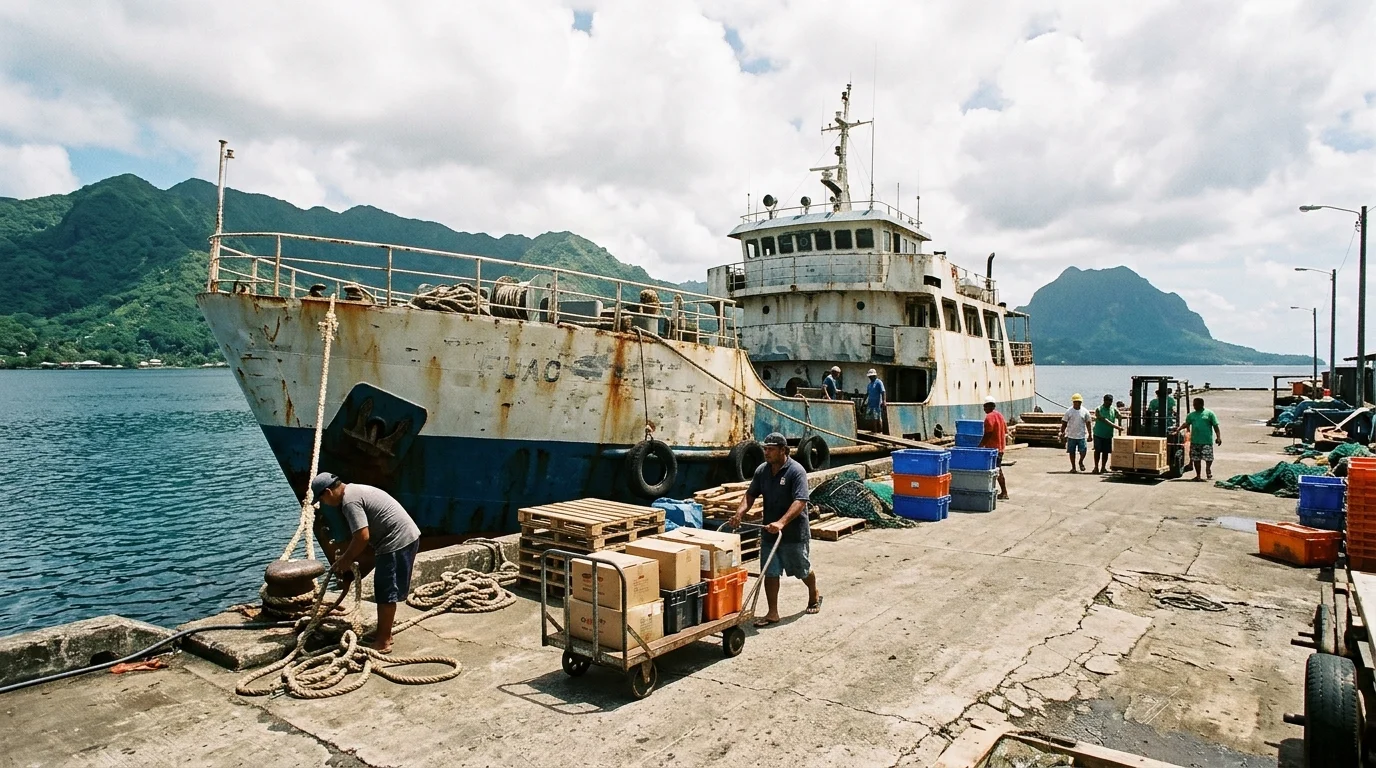
For most of the United States, a ferry grant is a niche infrastructure item. For American Samoa, it is closer to the whole of public transportation. The territory has roughly 55,000 residents spread across Tutuila, the main island, home to the capital Pago Pago, and the remote Manu'a Islands, a group that includes Ta'u, Ofu, and Olosega, located more than 50 miles to the east. There is no reliable commercial air service between them. The fortnightly government ferry is the primary means of moving people, cargo, medical patients, and fuel between the two island groups.
Right now, that connection runs on a single vessel: the MV Manu'atele. The MV Sili, the territory's other inter-island ferry, has been out of service since 2018. The MV Manu'atele itself suspended service for a period before resuming in April 2026, according to an American Samoa Government press release. A schedule that runs every two weeks, on a good week, means a medical emergency on Ta'u can mean days of waiting for transport that no amount of urgency can accelerate.
Governor Pulaali'i made the point explicitly in his April 2026 State of the Territory address, naming faster inter-island transit to Manu'a as a top infrastructure priority. The FTA grant is designed to address exactly that gap: it finances the acquisition of two low-emission ferry vessels to operate on the Tutuila-to-Manu'a route, with a performance window running through April 2029.
A second, separate federal program is also contributing to the same route. The Federal Highway Administration's Ferry Boat Program, a distinct competitive grant administered by a different DOT modal agency under different statutory authority, awarded $2.44 million in August 2025 for the design and construction of a new Manu'a inter-island ferry. That award does not fall within the 90-day window driving the headline metric, and it is not the same program as the FTA capital grant, but it targets the same operator and the same route. The two awards, taken together, represent a federal commitment to rebuilding Manu'a connectivity from both the vessel-acquisition side and the construction side simultaneously.
Federally, appetite for island ferry investment appears durable. The FTA's FY2026 notice of funding opportunity for the Passenger Ferry and Electric or Low-Emitting Ferry Pilot programs opened in April 2026, making $657 million available nationally. American Samoa's DPW could theoretically compete for additional rounds, though the active grants will absorb the department's administrative bandwidth for years.
For the roughly 3,000 residents of the Manu'a Islands, what matters is not the grant accounting calendar but whether two new vessels are in the water before the MV Manu'atele needs its next extended drydock. The performance period runs to April 2029. Vessel procurement and delivery for custom low-emission ferries typically takes 18 to 30 months after contract award. That math leaves almost no margin.
The next signal to watch is a procurement announcement from the American Samoa Department of Public Works for the vessel acquisition contract. When that contract is awarded, the $21.25 million will begin moving from obligated to outlayed, and Manu'a will have its first confirmed delivery timeline.