Florida holds $1,169,947,393 in federal broadband deployment grants and has disbursed exactly zero dollars of it. That figure, committed to the Florida Department of Commerce by the National Telecommunications and Information Administration in December 2022, sits entirely unoutlayed as of the last federal data update in November 2024, the largest undeployed infrastructure grant in the state's history, and roughly 310,000 unserved homes are waiting on the other side of its procedural machinery.
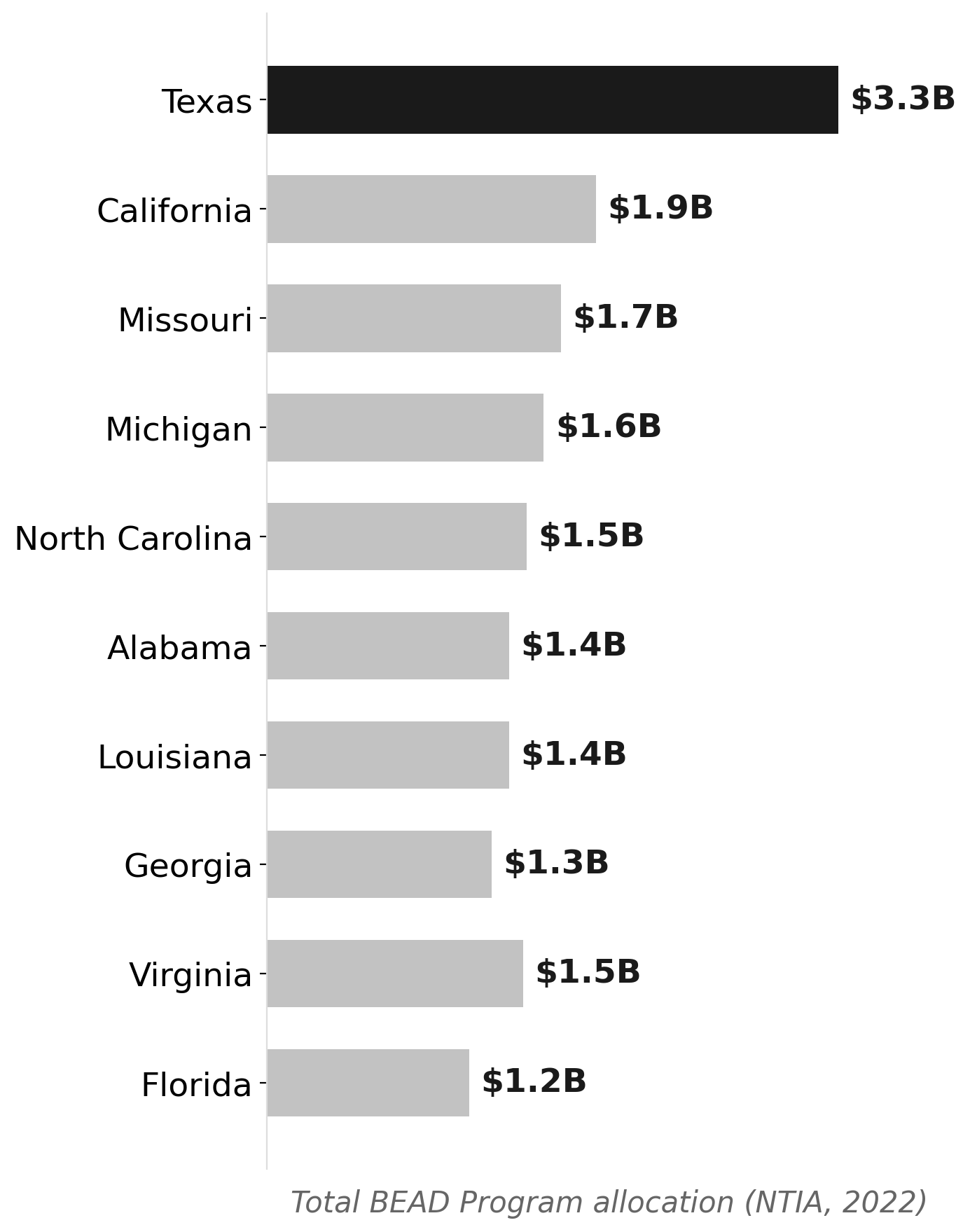
The program is BEAD: the Broadband Equity, Access, and Deployment Program, funded by the Bipartisan Infrastructure Law and administered through NTIA. Florida's share ranks ninth nationally, behind Texas ($3.3B) and California ($1.9B) but ahead of most of the South. The reason none of it has moved is structural, not political. BEAD requires states to advance through a mandatory sequence: initial proposal, final proposal, federal acceptance, NIST cybersecurity review, grant agreement execution, and only then subgrant award to the ISPs who will actually build the networks. Florida cleared the second-most critical gate on January 7, 2026, when NTIA formally accepted its Final Proposal, the milestone that unlocks the remaining 80 percent of subgrant disbursements. But acceptance is not the same as a check. No subgrant funds have been issued.
That distinction matters because of a deadline the Bipartisan Infrastructure Law makes non-negotiable. The four-year construction-and-service clock NTIA requires cannot start until subgrant funds are actually disbursed. As long as the money sits obligated but unoutlayed, the clock is not running, which means Florida's window to build has not formally opened, even as the calendar advances. A GAO report released in February 2026 confirmed that BEAD subrecipients nationally are projecting project completion dates in 2030 and beyond, a timeline that reflects how late most states entered the construction phase.
Source: NationGraph.
Florida allocated $970 million of its BEAD total toward physical deployment and $110 million toward broadband workforce development. The workforce program is currently paused pending additional federal guidance, adding another layer of uncertainty to an already sequenced timeline. A separate companion award, a $41,748,794 Digital Equity capacity grant committed in January 2025, is also at zero outlays. That grant funds digital literacy, device access, and adoption programs for underserved populations, it does not fund construction, and should not be confused with the deployment dollars, though both flow from the same federal statute and administering agency.
The state has provisional BEAD awardees on paper. Amazon's Kuiper Commercial Services is slated to serve 17,638 locations for $12.4 million in subsidy; Central Florida Broadband is provisionally awarded $5.1 million for 1,526 locations. Neither has received subgrant funds. The selection itself was complicated by a mid-program federal restructuring: NTIA's "Benefit of the Bargain" policy changes forced states to revisit subgrantee selection criteria after many had already advanced through earlier rounds, adding months to the sequencing.
The geography of what BEAD is trying to reach explains why this last tranche is the hardest. Florida's Office of Broadband has spent years ahead of BEAD deploying smaller state grants through its own Florida Broadband Opportunity Program, reducing the unserved and underserved count from more than 400,000 locations to a projected under 170,000 after current state projects complete. What remains for BEAD is the tier that commercial ISPs skipped: rural communities scattered across swampland, barrier islands, and unincorporated exurbs where last-mile infrastructure costs are highest and return on investment lowest. As the previously published NationGraph investigation documented, state officials have explicitly framed BEAD as the instrument for this final, most expensive tier precisely because no prior program reached it.
NTIA approved all 56 state and territory Final Proposals nationally by late August 2026. Florida's approval, arriving in January, was among the earlier ones. That sequencing gives Florida a theoretical head start on states still awaiting acceptance, but the advantage only materializes if the remaining gates clear quickly. The NIST cybersecurity framework review and grant agreement execution still stand between Florida and the moment it can issue subgrant contracts.
The number to watch now is not the BEAD total but the first subgrant execution date. When Florida issues its first subgrant to an ISP, two things happen simultaneously: a household in a rural county moves from the unserved list to a construction queue, and a four-year federal clock begins ticking toward a deadline the state cannot extend. Until that date, $1.17 billion remains a commitment on a ledger, and the 310,000 locations it is meant to reach stay on the wrong side of a very expensive last mile.