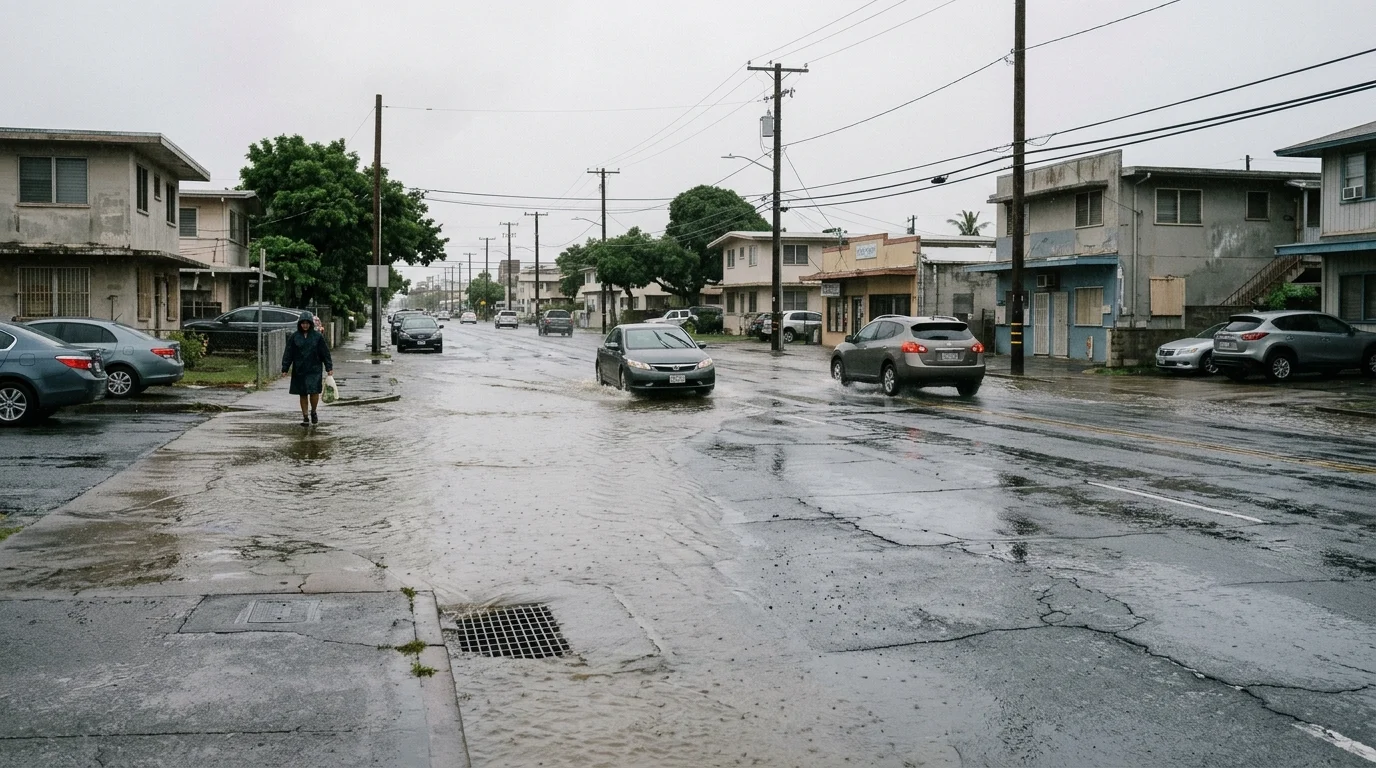
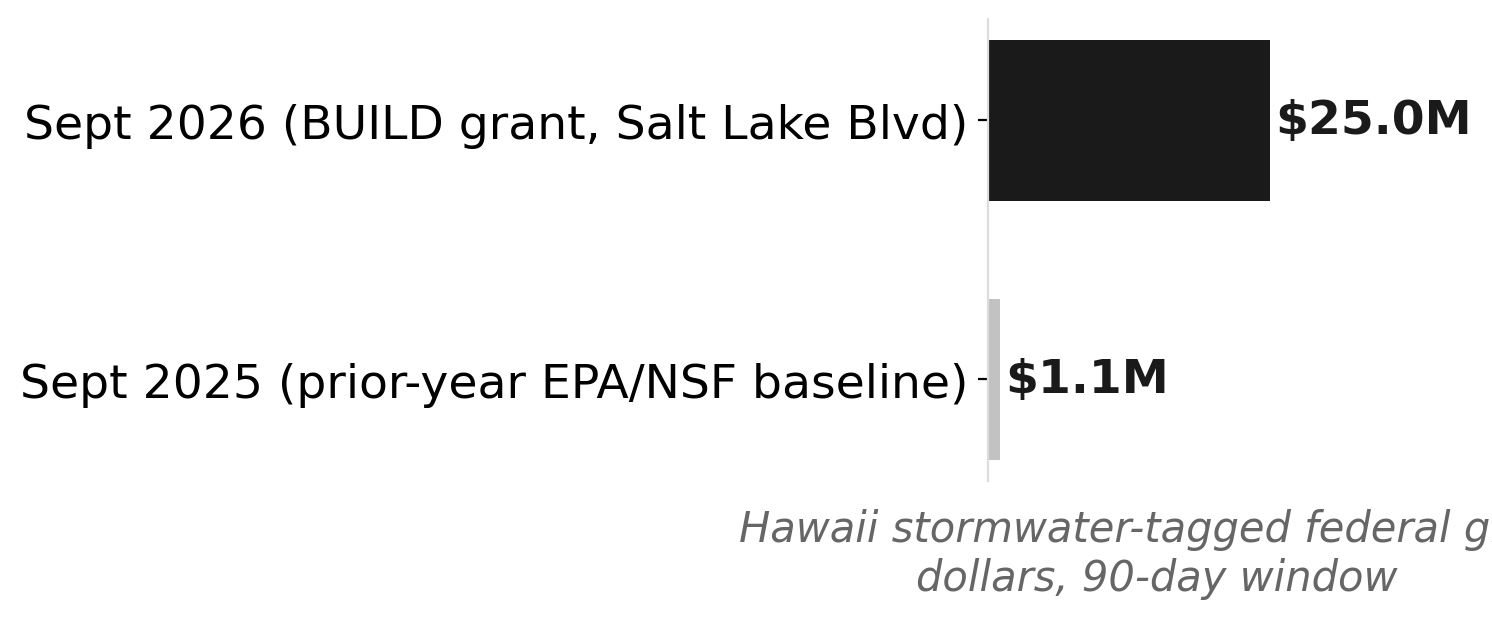
Federal stormwater-tagged grants for Hawaii have reached $25 million in the past 90 days, a 2,270% jump over the same window a year ago, and the entire surge comes from a single U.S. Department of Transportation award to a street that Oʻahu's Salt Lake community has been trying to fix since the 1970s.
The award, a BUILD grant obligated September 3, 2026, is the maximum allowed under the Infrastructure Investment and Jobs Act's National Infrastructure Investments program: $25 million, against a prior-year baseline of $1.05 million across two small EPA and NSF awards. That baseline figure is not a typo. The BUILD grant is 24 times larger than everything Hawaii received in stormwater-tagged federal grants during the same period last year. It puts Hawaii third nationally in stormwater grant dollars over this 90-day window, behind only Pennsylvania and Washington state.
The project it funds is the Salt Lake Boulevard Complete Streets corridor, a 2.8-mile stretch on Oʻahu running from Maluna Street to Ala Lilikoi Street through one of the island's most flood-vulnerable and densely developed neighborhoods. The upgrade includes a new stormwater drainage system, a bioswale, four travel lanes, protected bike lanes, and ADA-compliant sidewalks. Completion is projected for 2031. Planning for a full corridor overhaul began in the 1970s. The community waited through decades of budget cycles and partial fixes before the City and County of Honolulu finally committed $76 million for the widening and a separate $6 million for stormwater best management practices in the Salt Lake Drainage System in its FY2026 budget, a local co-investment that predated, and likely strengthened the case for, the federal award.
Source: NationGraph.
What changed the federal calculus was not planning documents. It was water.
Between March 10 and March 24, 2026, two back-to-back Kona Low storm systems, the worst Hawaii had seen in over 20 years, caused an estimated $1 billion or more in statewide damage across Oʻahu, Maui, Molokai, and Lanai. Governor Josh Green estimated $300 million in tourism losses alone. Green formally requested a Major Disaster Declaration on March 24; President Trump approved it April 7, designating the event DR-4909-HI. Senator Brian Schatz credited FEMA as "a supportive partner" in securing the declaration. The disaster exposed, at scale and in real time, what drainage engineers had been documenting for years: Hawaii's stormwater infrastructure cannot handle the rainfall events its geography now reliably produces.
The BUILD grant and the disaster declaration are legally separate programs doing separate things, and it matters to keep them distinct. The BUILD grant is a competitive multimodal transportation award administered by USDOT under the IIJA; stormwater drainage is one component of a broader streets project, not its sole purpose. The FEMA Hazard Mitigation Grant Program awards triggered by DR-4909-HI are a different instrument entirely, targeting disaster-mitigation infrastructure in Maui and Hawaiʻi Counties: in October 2026, FEMA announced $28.7 million in HMGP funding for emergency generators at 32 critical water facilities, plus $1.8 million for permanent repairs to the Nāʻālehu Flood Channel. Those dollars flow to different agencies, different islands, and different infrastructure types than the Salt Lake BUILD award. Together, though, they sketch the breadth of the post-Kona Low federal commitment: one program rebuilding a transit corridor for the long term, another hardening utilities against the next storm.
A third thread is moving through Congress. The House passed WRDA 2026 (H.R. 9497) on September 17 by a 415-9 vote, with provisions secured by Representative Ed Case authorizing federal feasibility studies on flood and coastal storm risk management in Waikīkī. Feasibility studies are early-stage, but they are the prerequisite for Army Corps of Engineers projects, and the Waikīkī authorization signals that lawmakers see the Kona Low as a prompt for systematic, not just reactive, flood planning.
For residents of Salt Lake, the most immediate change is construction: the corridor project is expected to begin procurement in the coming months, with a 2031 completion target. For the rest of Oʻahu, the signal is that the disaster declaration did what five decades of local advocacy could not fully accomplish on its own, it created the political and budgetary conditions for federal infrastructure dollars to meet local co-investment at the same moment.
The open question is what happens next in the procurement pipeline. NationGraph's database shows no active stormwater RFPs for Hawaii, meaning the contracts that will actually move dirt on the Salt Lake corridor have not yet been issued. The gap between a federal obligation date and a construction start date is where infrastructure promises have historically stalled. Whether this one does will be visible in the bidding records over the next several months.