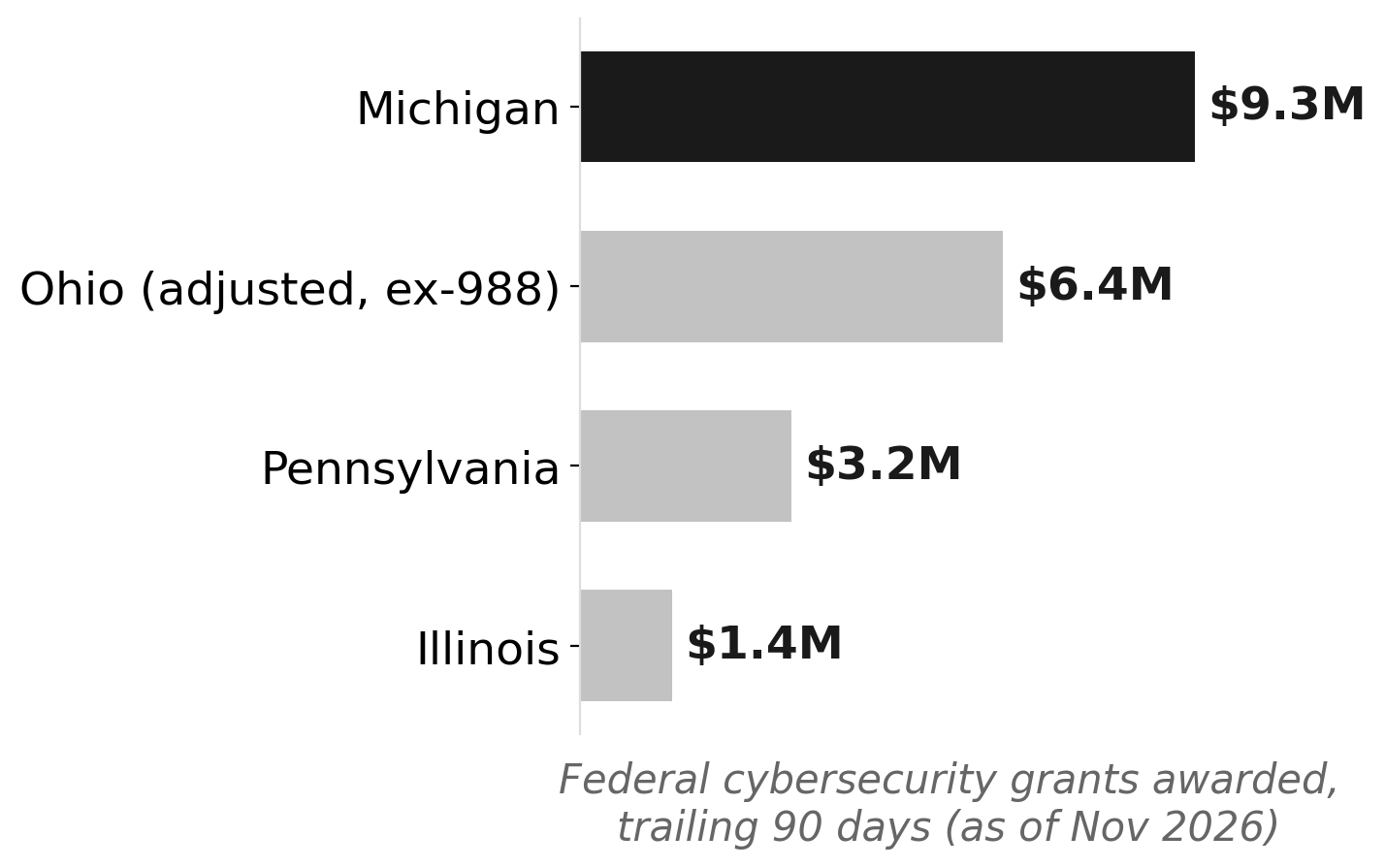
About $6.4 million in genuinely cybersecurity-focused federal grants landed in Ohio in the past 90 days, more than double the same window a year ago and the highest total among seven Midwest peer states. The number requires a caveat up front: the raw 90-day figure that surfaces in federal award data is $13.7 million, a 373 percent year-over-year jump, but $7.29 million of that is a 988 crisis-line mental health grant that mentions cybersecurity only incidentally in its project description. Strip that out and the adjusted total is still a meaningful surge. The more important story is where the money is going and where it is not.
Virtually all of the legitimate new awards flow to universities and community colleges, not to the county emergency management offices or municipal IT departments that actually defend Ohio's public infrastructure day to day. Kent State received $2.59 million for aviation-security research equipment. Sinclair Community College in Dayton received a $1.14 million Commerce Department earmark to build out an Integrated Technology Education Center. Ohio State, Case Western Reserve, Cleveland State, and the University of Cincinnati each received between $500,000 and $634,000 in National Science Foundation grants for work spanning anomaly detection to secure hospital robotics. Wright State University and the Strategic Ohio Council for Higher Education each received roughly $200,000 from NIST's RAMPS program, the Regional Alliances and Multistakeholder Partnerships to Stimulate Cybersecurity Education and Workforce Development, making Ohio the only state to land two awards in a round that covered nine recipients across eight states.
That NIST distinction matters because it reflects genuine competitive strength. Wright State was redesignated as an NSA National Center of Academic Excellence in Cyber Defense through 2031 in May 2026, a credential that explicitly boosts its odds in federal grant competitions. The Dayton corridor, anchored by Wright-Patterson Air Force Base and the Air Force Institute of Technology, has built the kind of federal-research gravity that makes Southwest Ohio a consistent winner when Washington is handing out workforce and research dollars.
Source: NationGraph.
The problem is that workforce pipelines and defensive infrastructure are different things, funded by different mechanisms, and the mechanism for the latter is now supply-constrained. The DHS State and Local Cybersecurity Grant Program, known as SLCGP, was the main vehicle for getting cybersecurity money to Ohio's 88 counties, townships, and municipalities. Congress reauthorized the program through September 30, 2026, but did not attach new FY2026 appropriations to that extension. As of October 2026, no new national notice of funding opportunity has been posted. Ohio EMA still holds approximately $10.3 million in active SLCGP dollars across two grants running through 2028 and 2029, funded from prior congressional cycles. But the pipeline feeding the next round is dry.
Governor DeWine's CyberOhio initiative was designed precisely to bridge university capacity and local government need. Using SLCGP pass-through funds, CyberOhio disbursed $7 million in local government cybersecurity software grants to Ohio jurisdictions in August 2024 and launched TechGuard, a statewide simulated-attack training platform for K-12 schools, in May 2025. DeWine has described the cybersecurity workforce gap as a named budget priority, and the Ohio Digital Academy carries a dedicated line in the FY2026-2027 executive budget. The architecture is real. The question is what happens to it if the federal pipeline it was built on does not get refilled.
This is the structural tension the grant surge obscures. When you see Ohio leading the Midwest in cybersecurity award volume, the natural read is that the state is investing heavily in its defenses. The more precise read is that Ohio's universities are very good at winning competitive federal research and workforce grants, which are funded and active, while the formula-based defensive grants that flow to local governments are caught in a congressional appropriations gap that has nothing to do with Ohio's competitiveness or need.
For a resident of one of Ohio's smaller counties, the distinction is not abstract. The local emergency management office's ability to harden its networks, assess its vulnerabilities, and train its staff depends on SLCGP dollars reaching Ohio EMA and moving down the subgrant chain. Dayton winning another RAMPS award does not substitute for that. The talent pipeline and the defensive infrastructure are complements, not replacements.
The next signal to watch is whether Congress attaches a new SLCGP appropriation to any continuing resolution or FY2027 spending package before the current EMA grants begin winding down. DeWine's office has not publicly indicated whether CyberOhio has a contingency plan if no new federal dollars arrive. What Ohio has built over two terms is a whole-of-state coordination structure that works well when federal money flows through it. How well it holds up when that flow stops is the question the next budget cycle will answer.