
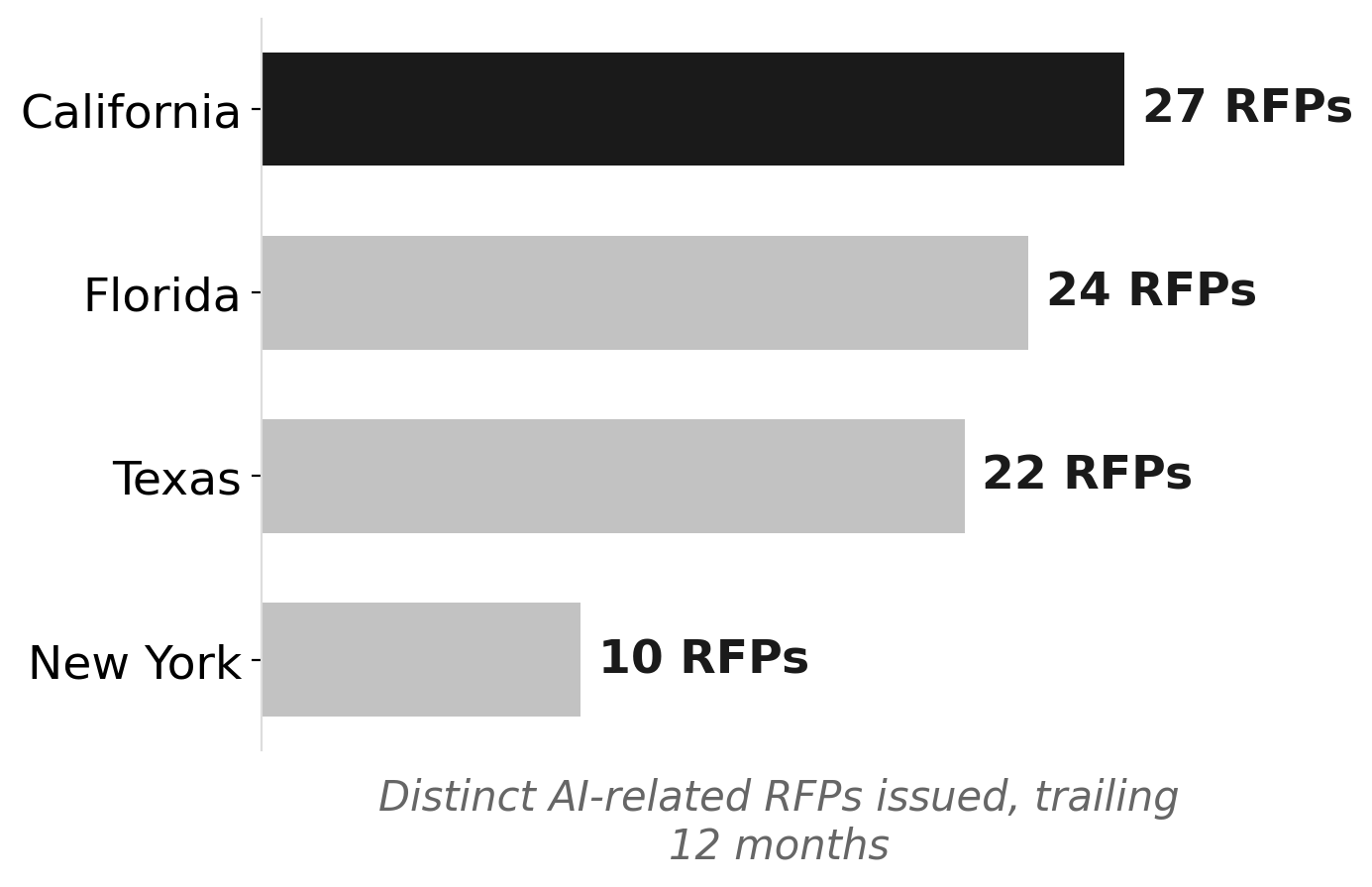
California public agencies issued 27 distinct AI-related solicitations in the past 12 months, more than Florida (24), Texas (22), and New York (10) combined, and the timing of those solicitations reveals something the raw count doesn't: a significant share landed in the weeks immediately surrounding a July 28, 2026 compliance deadline set by Governor Newsom's executive order on AI procurement.
The order, EO N-5-26, signed March 30, 2026, directed the state's Department of General Services and Department of Technology to build new vendor certification requirements into all state AI contracting within 120 days. That clock ran out on July 28. Agencies that issued solicitations before that date could still negotiate with vendors under existing rules. Agencies that waited would be working under a stricter, not-yet-finalized certification framework, one that legal analysts at Ropes & Gray described as part of "an intensifying contest between California and the federal government over the future of AI regulation."
The result is a procurement calendar that looks less like an organic adoption curve and more like a deadline sprint.
Source: NationGraph.
The breadth of use cases makes the pattern harder to dismiss as a single agency's initiative. San Diego's police department issued a solicitation for AI-assisted report writing. The Los Angeles Department of Building and Safety moved on AI-powered permit pre-checks. LA County Sanitation Districts put out an RFP for machine-learning analysis of sewer infrastructure. Alameda City Housing Authority sought an AI advisory vendor. Pasadena solicited a wildfire early-detection system. These agencies share no common budget, no common mission, and no common technology stack. What they share is the same regulatory calendar.
The compliance picture California agencies are navigating has two distinct layers, and collapsing them misreads the pressure. The Transparency in Frontier AI Act (SB 53), which took effect January 1, 2026, regulates AI developers directly: large model developers must publish safety frameworks, conduct risk assessments, and report critical incidents. That law functions as a market-entry floor, a vendor that hasn't satisfied SB 53's transparency requirements is already operating outside California norms before a single procurement conversation begins. EO N-5-26 then adds a second layer on top, governing not developers but the agencies buying from them. DGS and CDT were directed to build bias-mitigation requirements, anti-discrimination governance standards, and supply-chain risk criteria into contract templates. The two instruments are sequential, not unified: SB 53 governs disclosure; the executive order governs contracting.
The order's most pointed provision goes further than procurement process. It authorizes California's Chief Information Security Officer to independently assess and potentially override federal AI supply-chain risk designations, creating a distinct state vendor evaluation track that diverges from federal procurement norms. As DLA Piper noted shortly after the order was signed, that provision gives California independent authority it has not previously claimed in technology contracting. Companies already doing business with state agencies were advised to conduct privileged AI tool inventories and prepare compliance frameworks, a process that takes months and costs money, and that smaller vendors may not be able to absorb quickly.
That cost asymmetry is part of what the procurement surge reflects. Agencies that had already identified vendors they wanted to work with had a structural incentive to issue solicitations before the new certification criteria were finalized, locking in procurement relationships under rules both sides understood. Waiting meant risking a process reset under tighter standards that could disqualify a preferred vendor on grounds that didn't exist when the relationship began.
The state's position in the national AI ecosystem amplifies the stakes of that dynamic. California is home to the largest concentration of AI vendors and researchers in the country, and federal research grants to California universities in the past 18 months have exceeded $100 million, led by UCSD, UCSB, Stanford, and UCLA. Procurement standards that California embeds in its contracts tend to travel: companies that restructure their compliance posture to access California government contracts carry those structures into other markets. If DGS and CDT's certification criteria become a de facto national floor, the beat-the-clock dynamic playing out in California agencies now will look, in retrospect, like the last moment before a significant barrier hardened.
The July 28 deadline has passed. The next signal to watch is whether DGS and CDT publish finalized certification criteria on schedule, and whether the pace of new AI solicitations slows sharply in the months that follow, which would confirm that the surge was driven by the deadline rather than by underlying demand.