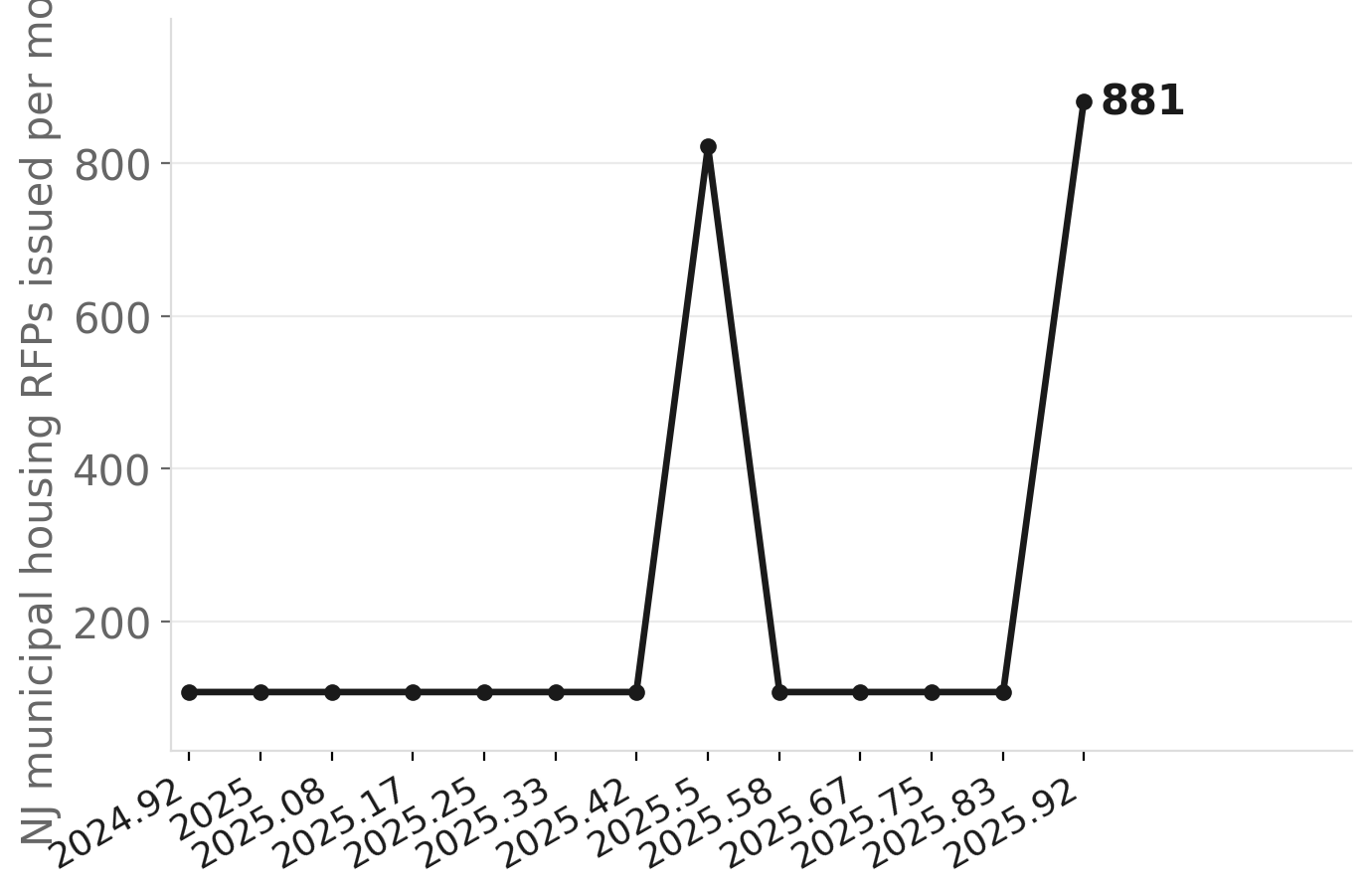
New Jersey municipalities issued 881 housing-related RFPs in the last 30 days, 8.2 times the 12-month monthly average of about 107, and almost none of them are for construction. They are for lawyers, planners, administrative agents, and compliance consultants, hired at a pace that has no precedent in state procurement records.
The procurement wave spans 315 distinct agencies across all 21 New Jersey counties. In the same 30-day window a year ago, 14 agencies in 12 counties filed comparable RFPs. That transformation, from a cluster of active municipalities to a near-universal mobilization, is the clearest measure of what a hard statutory deadline looks like in procurement data.
The deadline is March 15, 2026. Under NJ A4/S50, the affordable housing law signed in March 2024, every one of New Jersey's 564 municipalities must adopt implementing ordinances and complete all required rezoning by that date. Towns that miss it lose their immunity from "builder's remedy" lawsuits, a legal mechanism under the Mount Laurel Doctrine that allows developers to sue municipalities and effectively override local zoning to build affordable housing. The choice facing town councils is stark: hire the professionals, complete the compliance process, and retain local land-use authority, or face a court-supervised override of the zoning code they spent decades writing.
Source: NationGraph.
The RFP titles arriving in procurement systems make the nature of this rush unmistakable. Municipalities from Parsippany-Troy Hills to Chatham to Perth Amboy are posting solicitations for "Affordable Housing Administrative Agent Services," "Affordable Housing Planner," "Affordable Housing Attorney," and "Affordable Housing Consultant Services." These are not contracts to break ground. They are contracts to get legally compliant before a court holds the municipality exposed.
This is the second time in 18 months the procurement data has shown a spike of this magnitude. In July 2025, NJ housing RFPs hit 822 in a single month, almost exactly matching the current surge. That wave aligned with the June 30, 2025 deadline for municipalities to file Housing Elements and Fair Share Plans. The pattern is now legible: each hard deadline in A4/S50's cascade triggers a procurement surge as towns assemble the professional teams needed to clear that particular bar. The current wave is the largest because the March 2026 ordinance deadline is the final, most consequential one.
A4/S50 abolished the Council on Affordable Housing, which had governed the process for decades, and shifted enforcement to the courts. The law requires municipalities to collectively plan for 150,000 new affordable units across 2025 to 2035, with each town's obligation calculated individually by the Department of Community Affairs. The Mount Laurel Doctrine, rooted in New Jersey Supreme Court decisions from 1975 and 1983, is unique in American law: no other state has an equivalent court-enforced mandate requiring municipalities to affirmatively provide affordable housing. That legal architecture is what gives the March deadline its teeth.
Governor Sherrill's Executive Order 17, signed in April 2026, reinforced the signal. It created a Housing Governing Council and required all state agencies to submit housing affordability reports, making clear that the administration intends to enforce rather than accommodate delays. As of early 2026, NJ Spotlight News reported that roughly 20 municipalities were still not moving forward on compliance and had asked the New Jersey Supreme Court to pause implementation, a small fraction of 564, and one that underscores how thoroughly the rest of the state has concluded that resistance is not a viable strategy.
Running in parallel, though distinct from the compliance procurement wave, are two state-funded competitive programs offering capital once municipalities have plans in place. The DCA's FY2026 Affordable Housing Trust Fund allows up to $3 million per project, with awards anticipated in November 2025. The Healthy Homes Initiative, a $90 million program administered through a DCA and DHS partnership, targets affordable permanent housing for Medicaid members, with a fund manager selected to distribute capital to developers. These programs reward municipalities that complete the compliance process, but the RFP surge is not a rush to capture those grants. Towns are hiring lawyers because the alternative is losing zoning control, not because they are chasing subsidies.
For residents, the immediate consequence is a statewide rezoning process unfolding on a compressed timeline. By March 15, the ordinances and zoning changes required to accommodate Fourth Round obligations must be in place across nearly every municipality in New Jersey. What happens after that depends heavily on how quickly developers respond to newly compliant zoning, how courts handle the small group of holdouts, and whether the state's parallel funding mechanisms can accelerate actual construction. The procurement wave confirms that the professional services are being hired. Whether the housing follows is the question the data cannot yet answer.