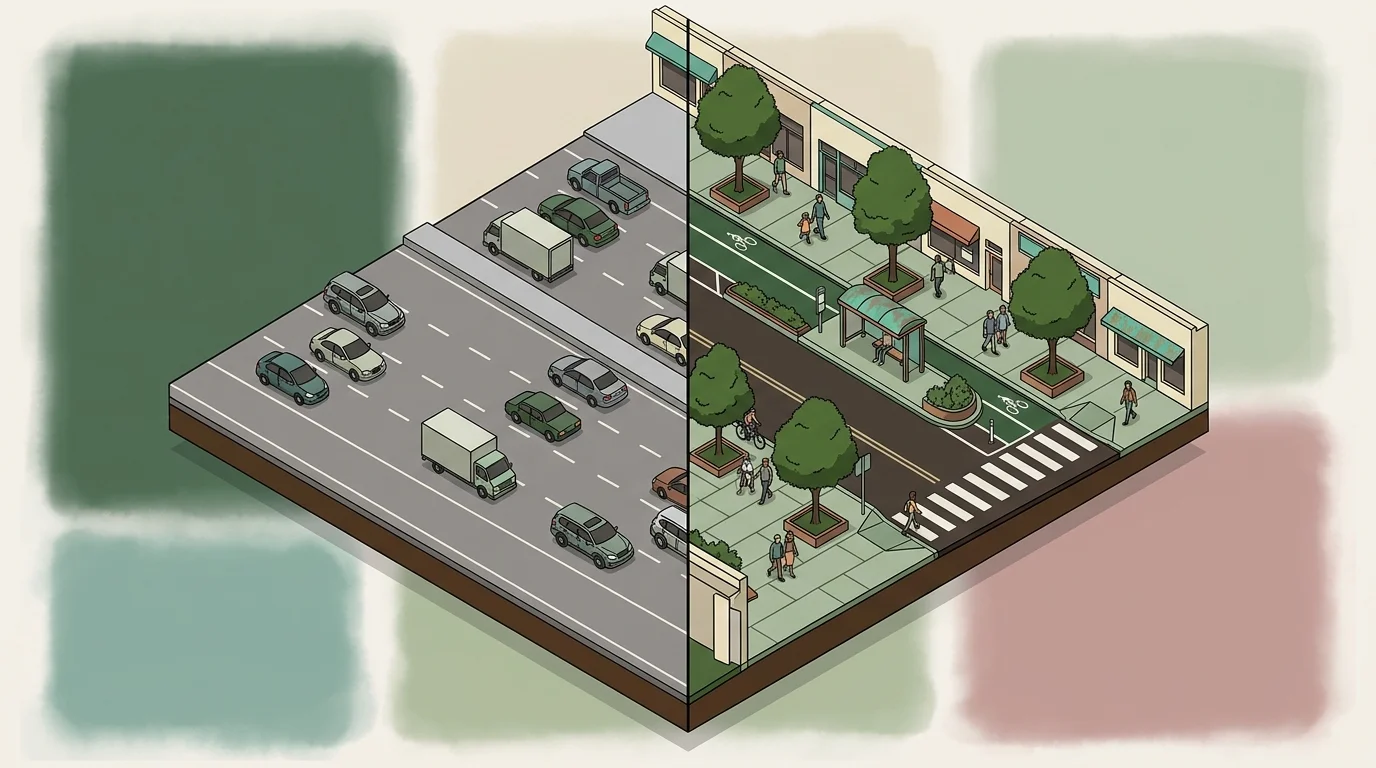
Seaside, California is moving to redesign Broadway Avenue, the working-class Monterey Peninsula city's main commercial spine, to make it safer and more navigable for pedestrians, cyclists, and transit riders who share the road with fast-moving car traffic.
The project reflects a broader shift in how California and the federal government think about urban streets. Broadway was built in an era when Seaside's economy revolved around nearby Fort Ord, and the road was engineered for throughput, not for the small businesses, apartment residents, and transit-dependent commuters who use it today. Fort Ord closed in 1994, and Seaside has spent three decades trying to reinvent itself. A redesigned Broadway, city leaders believe, is central to that effort.
The full scope of planned changes, which could include sidewalk improvements, bike infrastructure, lighting, and lane reconfiguration, isn't publicly detailed in the bid documents posted to the city's procurement portal, so the total cost and timeline remain unclear. What is known is that the city is now actively seeking contractors to carry out the work.

Source: NationGraph.
The timing reflects pressure from multiple directions. California accounts for roughly a quarter of all U.S. pedestrian deaths despite having about 12 percent of the population, a crisis that has pushed cities statewide to rethink arterial road design. Federal funding through the Bipartisan Infrastructure Law's Safe Streets and Roads for All program, combined with California's Active Transportation Program and state road funding created by SB 1, have made projects like this more financially viable for smaller cities.
Seaside is a city of about 34,000 people, one of the more diverse and affordable communities on the Central Coast, with a median household income around $65,000. Broadway runs through the heart of it, connecting residential neighborhoods to retail and services and serving a transit-dependent population that includes many residents without cars. Pedestrian activity on the corridor is high relative to its current design.
The project enters a public bid process now. How much it will cost, when construction might begin, and exactly what Broadway will look like when it's done are questions that won't have full answers until a contractor is selected and a construction timeline is set.