
Oklahoma public institutions are entering a roughly 15-month window in which informal cybersecurity practices will no longer satisfy the law, and the scramble to hire managed security vendors has already started. Procurement data shows a sudden spike in cybersecurity solicitations from Oklahoma public entities in September 2026, concentrated in institutions that now face simultaneous obligations under three separate state statutes, each carrying its own compliance deadline and its own liability consequence.
The most visible signal is Oklahoma State University Center for Health Sciences in Tulsa, which is soliciting a vendor for "24/7/365 monitoring, detection, investigation and response to cybersecurity threats", a Security Operations Center delivered as a managed service. OSU-CHS handles HIPAA-covered patient data, which means the procurement sits at the intersection of federal health privacy rules and two new state laws that now require documented safeguards for any institution touching Oklahomans' personal information. Independently, Edmond Public Schools and the City of Coweta both issued cybersecurity and managed-IT solicitations in the same 30-day window. No neighboring state, not Texas, Kansas, Missouri, Arkansas, Colorado, New Mexico, or Nebraska, produced more than one comparable solicitation in that period, suggesting the activity is Oklahoma-specific rather than a regional or national procurement cycle.
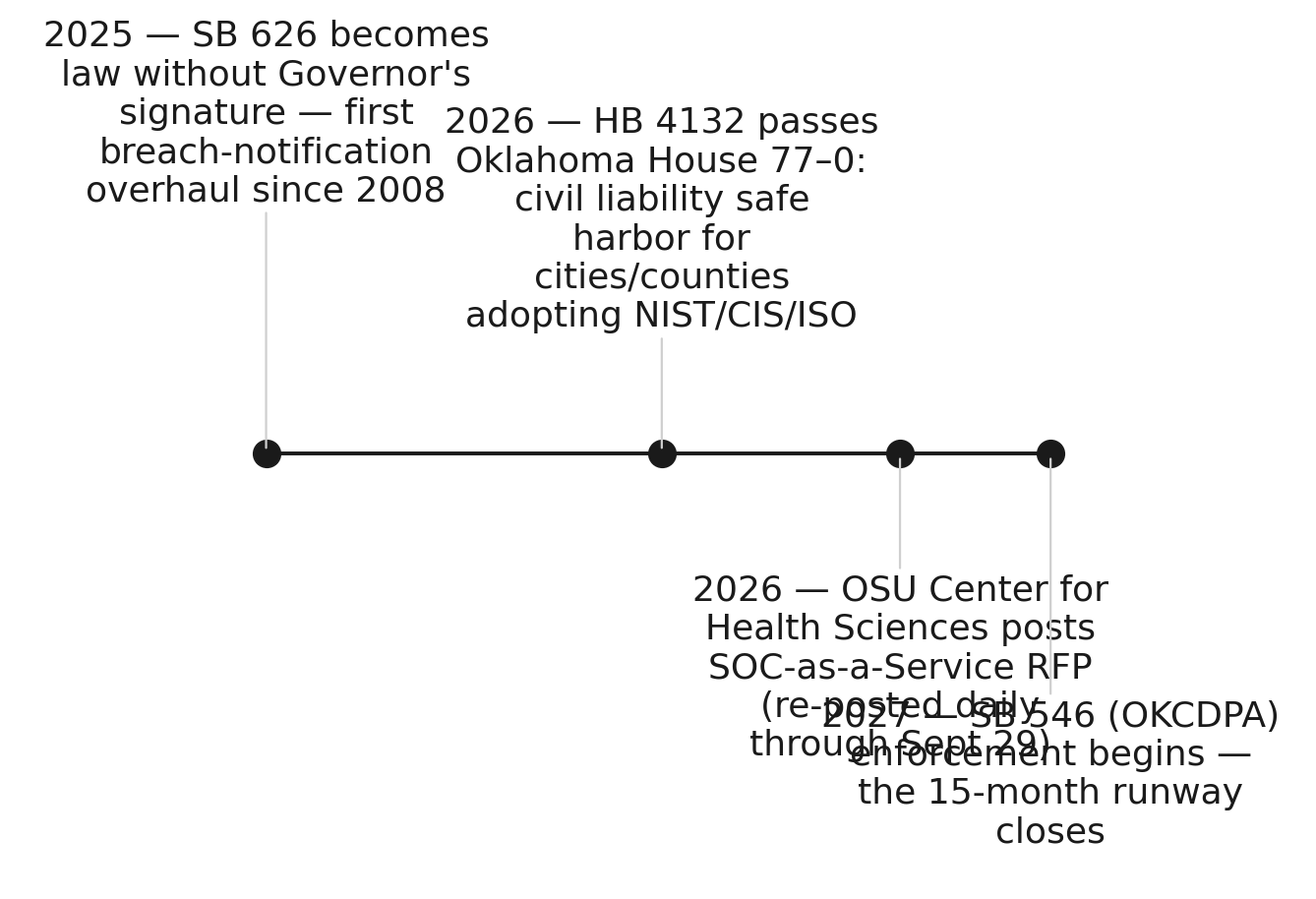
The force behind this is three distinct Oklahoma statutes converging on a narrow compliance window. They are not the same law and do not share a single mechanism, but their effects stack.
Source: NationGraph.
The first is SB 626, which took effect January 1, 2026, and represents the first major overhaul of Oklahoma's breach notification law since 2008. Under the updated statute, any covered entity suffering a breach affecting 500 or more Oklahoma residents must notify the Attorney General within 60 days. More consequentially, the law creates an affirmative defense, a legal safe harbor, for entities that can demonstrate "reasonable safeguards." That language converts cybersecurity from an IT budget line into documented evidence an institution may one day need to produce in an AG proceeding.
The second is HB 4132, which passed the Oklahoma House 77-0 on March 17, 2026. Authored by Representatives Steagall and Fetgatter, it targets a different population, counties and municipalities specifically, and offers civil lawsuit protection contingent on formally adopting a recognized framework (NIST, CIS, or ISO/IEC 27000), annually self-certifying, and submitting to independent expert review every three years. The bill's framework requirement means local governments cannot simply claim good-faith effort; they must hire someone to verify it.
The third is SB 546, the Oklahoma Consumer Data Privacy Act, signed by Governor Kevin Stitt on March 20, 2026, and effective January 1, 2027. Oklahoma becomes the 20th state with a comprehensive consumer privacy law, closely modeled on Virginia's VCDPA. Its controller and processor obligations are separate from SB 626's breach notification regime, but they land on many of the same institutions, public universities, school districts, municipal governments, within months of each other.
For a mid-size public university system like OSU, which spans a main campus, an OKC satellite, and a Tulsa health sciences center, the compliance picture is especially layered. The health sciences center carries HIPAA exposure; HIPAA compliance is one of SB 626's named safe harbors, which means a SOC-as-a-Service contract that satisfies federal health privacy rules simultaneously builds the paper trail SB 626 requires for the affirmative defense. One vendor relationship, multiple compliance boxes checked.
Federal funding is available to help smaller public entities make the same move. The DHS State and Local Cybersecurity Grant Program has awarded Oklahoma's Office of Homeland Security $6.73 million across two tranches (a $5.07 million award in December 2024 and a $1.66 million award in September 2025), both running through 2028 and 2029. Local governments and school districts can draw on that pool to fund managed security contracts or framework adoption projects, the kind of spending HB 4132 effectively requires for liability protection.
What changes for a resident of an Oklahoma city or county is less visible but more durable. When the local municipality or school district contracts with a managed security provider and completes an independent framework audit, it gains civil lawsuit protection under HB 4132, but residents also gain a baseline assurance that someone is watching the network around the clock, and that a breach will generate an AG notification within 60 days rather than being quietly absorbed.
The operative deadline is January 1, 2027, when SB 546 takes effect and completes the three-statute compliance stack. Institutions that have not yet contracted for documented security capabilities have roughly 15 months from SB 546's signing to close that gap. The next signal to watch: whether the Oklahoma Senate advances HB 4132 before the 2026 session closes, its unanimous House passage suggests the safe-harbor framework has broad political support, but municipalities are making procurement decisions now without knowing whether the civil liability protection will actually land.