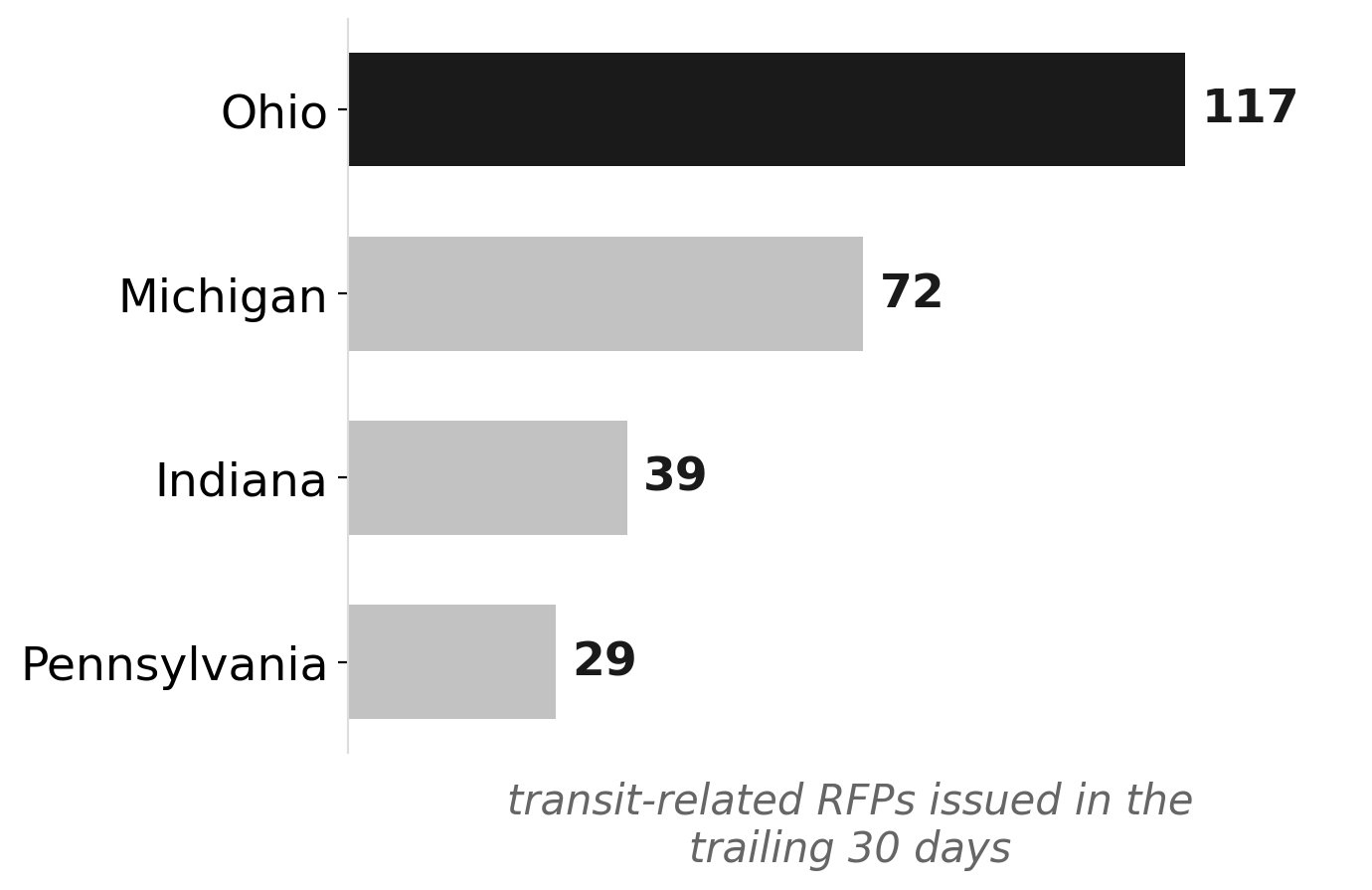
Ohio's transit agencies filed 117 procurement requests in the last 30 days, 2.8 times the 12-month monthly average of about 41, and the number points to a specific, ticking deadline rather than a general uptick in activity.
The state's active federal DOT transit grant portfolio totals roughly $899 million obligated across 60 active grants. Only about $350 million of that, 39 percent, has actually been outlayed. The remaining $550 million is committed on paper but unspent in practice, and much of it is now at risk. The IIJA's surface transportation authorities expire December 11, 2026, after Congress extended the original September 30 deadline via H.R. 6500 (P.L. 119-103), but critically that stopgap did not renew IIJA advance appropriations for transit. Programs funded through those advance appropriations, including the Low or No Emission Program, State of Good Repair grants, and the Buses and Bus Facilities Program, face a harder cliff than highway programs after December 11. Agencies that have not executed contracts by then may lose access to funds already bearing their name.
No agency in Ohio has more riding on the next six weeks than Cleveland RTA. The authority holds roughly $270 million in obligated federal transit grants, the largest undrawn balance in the state, and has outlayed only about $10 million of it, an outlay ratio of approximately 4 percent. That imbalance, the most extreme among Ohio's major urban systems, is what makes Cleveland's procurement calendar so consequential. Among its active grants is a $115.7 million State of Good Repair commitment and a $55.2 million Buses and Bus Facilities award, both of which depend on advance appropriations that the December stopgap did not renew.
Source: NationGraph.
COTA in Columbus is the state's most active RFP issuer right now with 14 requests in the last 30 days, and its position is different from Cleveland's in an instructive way. COTA holds $133 million obligated against $114 million outlayed, meaning it has largely executed on prior grants. The current procurement surge at COTA is being driven in part by a January 2026 FTA Low-No Program award of $19.9 million for zero-emission buses and charging infrastructure, one of three Ohio awards in that competitive round totaling $41.1 million. SORTA in Cincinnati received $11.5 million and Metro RTA in Akron received $9.7 million in the same announcement. All three awards require procurement contracts to execute, and none can wait past December.
Michigan, Indiana, and Pennsylvania are running the same math, but Ohio is moving faster. Ohio's 117-RFP count over the last 30 days is 63 percent higher than Michigan's 72, the nearest comparable, and roughly triple Indiana's 39. Ohio's decentralized structure helps explain the gap: rather than routing FTA funds through a single state DOT, Ohio maintains five independent major transit authorities in Columbus, Cleveland, Akron, Dayton, and Cincinnati, each holding its own federal grant agreements and operating its own procurement calendar. When the same deadline pressure reaches all five at once, the statewide RFP count compounds fast. Metro RTA Akron, Greater Dayton RTA, TARTA Toledo, and SORTA Cincinnati each filed between 8 and 11 requests in the period, adding to COTA's and Cleveland's larger counts.
The procurement push is not confined to capital equipment. RFP content across the five agencies spans bus purchases and elevator additions alongside scheduling software, surveillance contracts, and fuel supply, a full-system procurement push that reflects agencies trying to obligate across every open program simultaneously. Ohio DOT's October 2026 release of a discretionary grants guide cataloguing all open FTA IIJA programs appears to have amplified that urgency by giving agency procurement teams a consolidated map of what still qualifies for spend-down before the deadline.
The stakes are clarified by what the stopgap did not do. As a Union of Concerned Scientists analysis of the continuing resolution noted, the extension cuts enacted transit investment by roughly 20 percent in annualized FY2027 terms, and no successor multi-year reauthorization has been enacted. That means agencies cannot assume a follow-on bill will restore what the December cliff takes away. The national picture is one of widespread RFP acceleration, but Ohio's specific exposure, anchored by Cleveland RTA's $260 million undrawn balance, makes this state's race more consequential than most.
The next signal to watch is whether Cleveland RTA can convert its backlog of obligated grants into executed contracts before December 11. If it cannot, the agency most reliant on IIJA advance appropriations in the state also becomes the one most exposed to losing them.