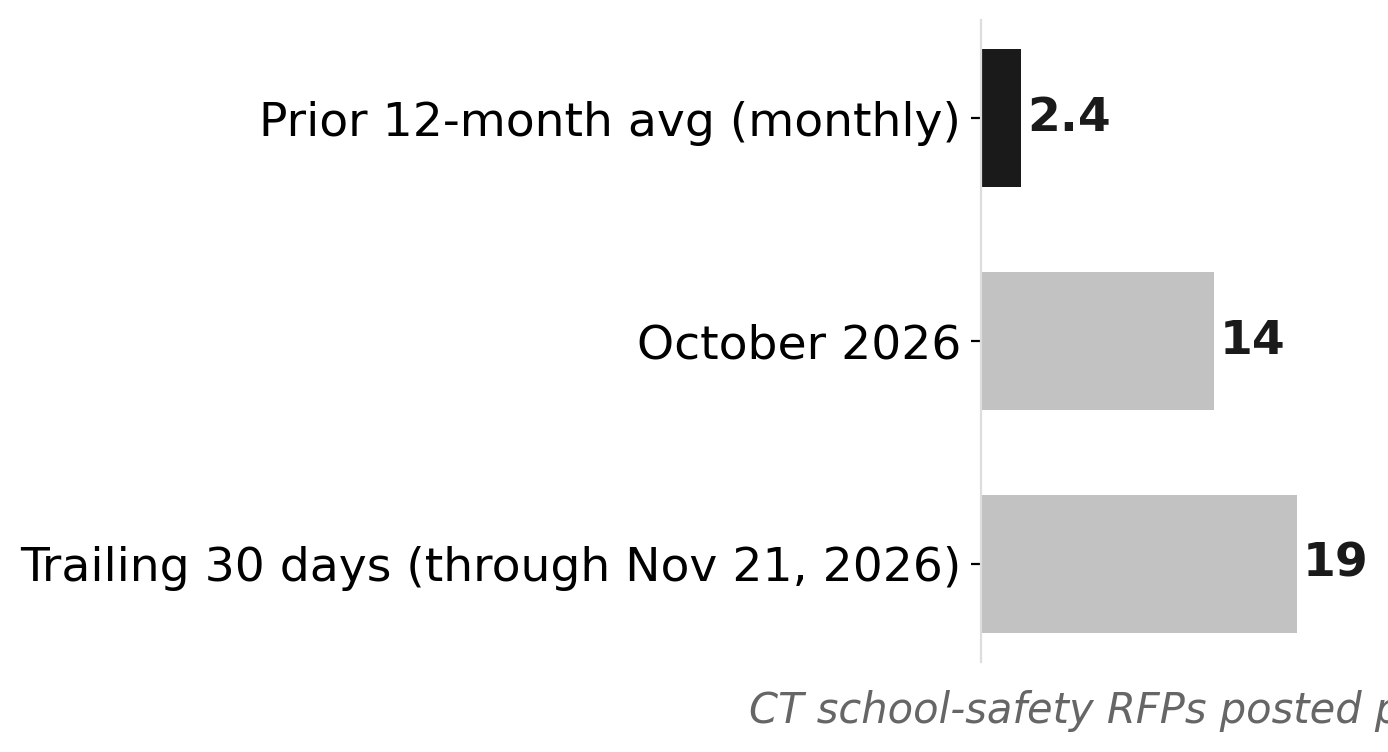
Connecticut school districts issued 19 school safety RFPs in the 30 days ending November 21, 2026, against a monthly average of roughly 2.4 over the prior year. That 7.9x spike is not a reaction to any single incident. It is the product of three separate state laws that share the same enforcement agency, the same October 2026 activation window, and a procurement sequence that forces districts to hire before they can spend.
The mechanics matter here. Under PA 25-157, effective October 1, 2025, any district seeking reimbursement through Connecticut's School Security Infrastructure Competitive Grant program must first complete a DEMHS-guided security assessment. The SSICG carries a $107 million state general obligation bond authorization and reimburses districts for cameras, secure entrances, panic buttons, and emergency communications hardware. But the assessment prerequisite means the grant money is only accessible to districts that have already procured a security consultant. That single rule change turned a reimbursement program into a two-step procurement cycle, and it is the most direct engine behind the fall 2026 rush.
Layered on top of that: PA 26-1, effective July 1, 2026, requires school boards to submit updated safety and security plans to DESPP by fall 2026. And PA 26-116, signed by Governor Lamont on June 4, 2026, required DESPP to post eligibility criteria for a new School Mapping Data Services grant by October 1, 2026, opening a separate state appropriation-funded program that pays municipalities and police departments to build verified school maps for first-responder use. Three distinct mechanisms, three different funding purposes, one overlapping deadline cluster.
Source: NationGraph.
The procurement types showing up in the RFPs track almost exactly with what these programs reimburse or require. Security audits and consultant services dominate, followed by camera system expansions, secure vestibule construction, and intrusion and lockdown alarm monitoring. Fairfield County is the heaviest concentration: Greenwich is procuring a secure entrance upgrade, Fairfield is building security vestibules at multiple schools, and Stamford Public Schools issued a combined RFP for a security consultant and uniforms. New Haven County follows closely, with Wallingford seeking intrusion detection, camera, and lockdown system upgrades and Lebanon expanding its camera network.
The Fairfield County concentration has a longer history behind it. The county sits adjacent to Newtown, where the 2012 Sandy Hook shooting has shaped Connecticut's school safety legislative posture for more than a decade. Fairfield County districts have consistently moved faster and allocated more on school security than peer districts elsewhere in the state, and the county's commercial tax base gives them procurement capacity to respond quickly when deadlines arrive.
No matching federal school-safety-specific grants were found flowing to Connecticut in this window, confirming that the surge is driven by state policy, not Washington. The U.S. Department of Education's $93 million School Safety Enhancement Program closed applications on July 28, 2026, and may have prompted early-fall implementation spending for any Connecticut districts that applied, but Connecticut award status is unconfirmed and the SSEP is a separate federal instrument from any of the three state mechanisms driving the bulk of the RFP activity.
The governance infrastructure reinforcing all of this is also new. PA 26-1 renamed the School Building Projects Advisory Council as the School Safety and Security Infrastructure Advisory Council, a symbolic shift that reflects how completely the legislature has reoriented the state's school construction oversight apparatus toward security compliance. The Connecticut Center for School Safety and Crisis Prevention at Western Connecticut State University was separately tasked under the same law with developing standardized drill terminology in coordination with DESPP, embedding the university into the compliance enforcement chain.
For a district administrator, the sequence is now fixed: complete the DEMHS-guided assessment, file the updated security plan with DESPP, then apply for SSICG reimbursement and separately consider the new mapping grant. Each step requires a vendor or a submission. The October 2026 window did not create new money so much as it created a mandatory on-ramp that every district has to travel before accessing money that already existed.
The next signal to watch is the SSICG application cycle for state fiscal year 2027. If the fall procurement wave produces a corresponding wave of SSICG applications in early 2027, it will confirm that the consultant-first requirement is working as the legislature designed it. If applications lag, it may mean that smaller districts completed assessments but cannot afford the infrastructure investment even with reimbursement available. The gap between RFPs issued and grants eventually awarded will tell that story.