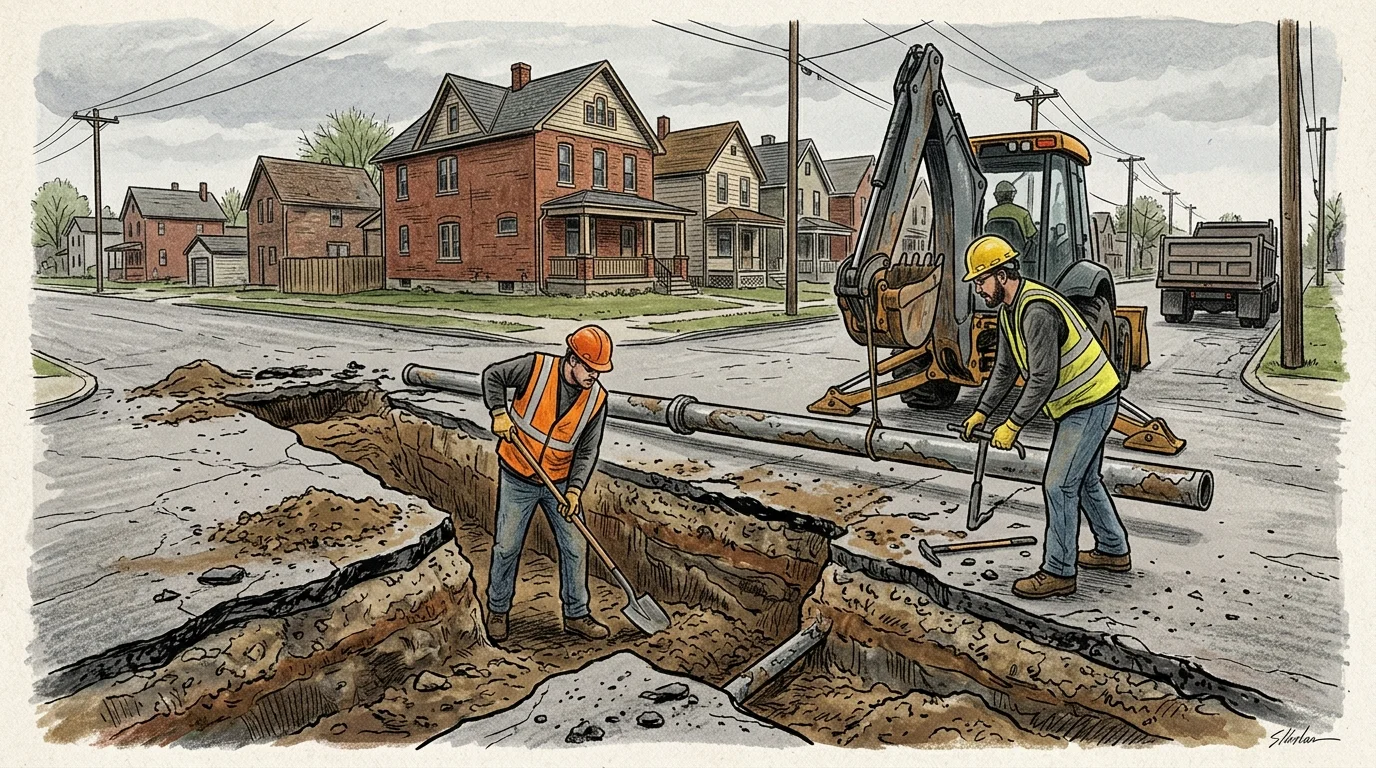
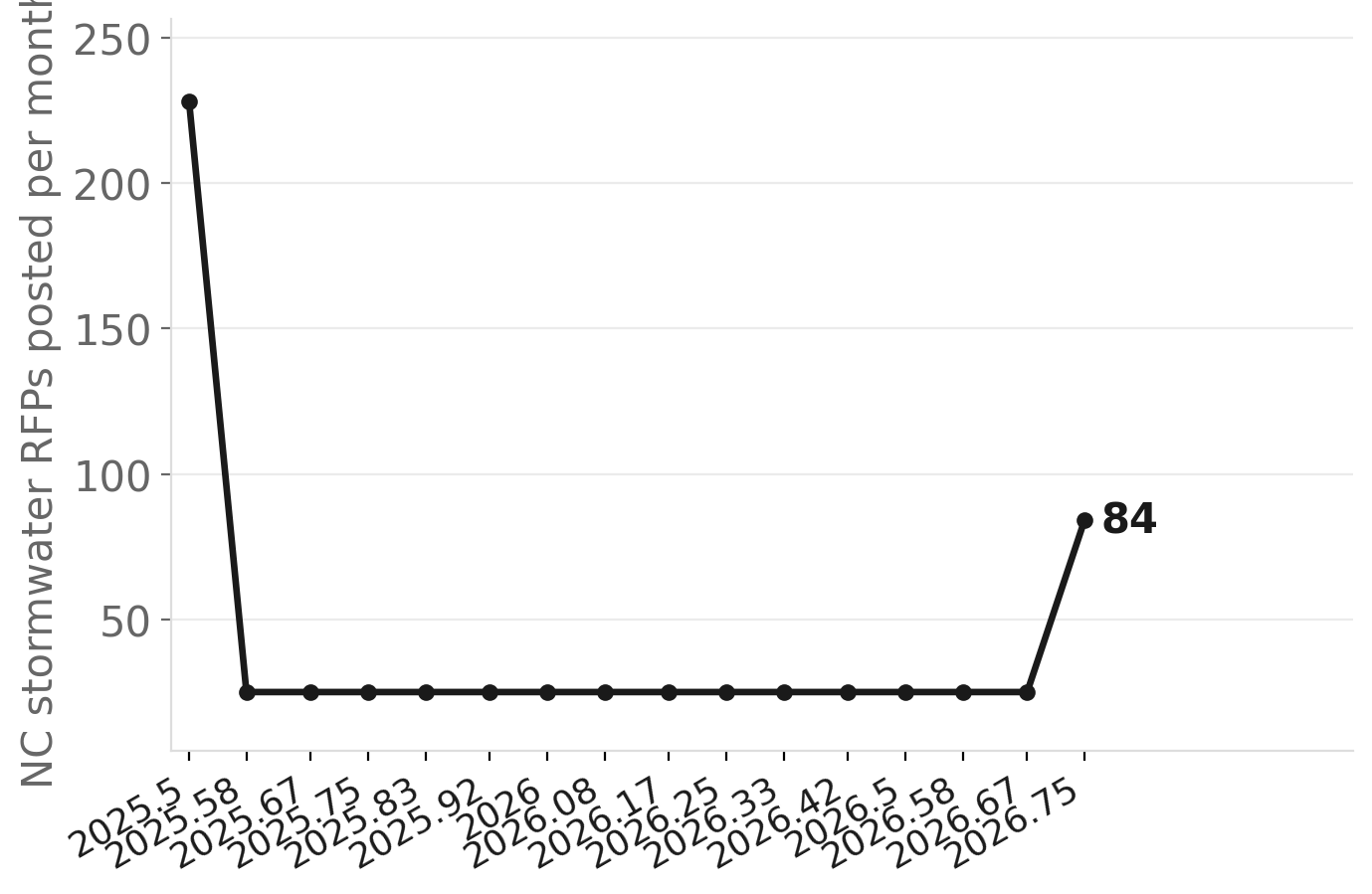
North Carolina issued 78 stormwater management RFPs in the last 30 days, more than three times the state's 12-month monthly average of about 25, and October 2026 alone logged 84, the highest single-month count in more than a year of tracking. The numbers reflect something that rarely shows up cleanly in procurement data: the collision of two separate funding pipelines, both bottlenecked for different reasons, breaking loose at the same moment.
The first pipeline is federal. FEMA's Building Resilient Infrastructure and Communities program, known as BRIC, had awarded North Carolina communities roughly $200 million in pre-disaster mitigation grants before the Trump administration canceled the program outright in April 2025. Stormwater projects in Buncombe, Haywood, Yancey, and several coastal counties were frozen mid-development. After NC Attorney General Jeff Jackson led a 19-state coalition lawsuit, a federal judge in Massachusetts permanently enjoined FEMA to restore the program in December 2025. FEMA resisted through February 2026 before the court issued an enforcement order. On March 20, 2026, FEMA conceded and filed a plan to restart BRIC and open $1 billion in new grant applications. Projects that had been designed, permitted, and stalled for the better part of two years were suddenly back on a procurement track.
The second pipeline is Helene. Hurricane Helene made landfall in September 2024 and caused an estimated $60 billion in statewide damage, with water infrastructure across 28 western counties among the hardest-hit systems. By July 2026, Governor Josh Stein and NC DEQ Secretary Reid Wilson announced that the state had awarded more than $1 billion in water and stormwater recovery grants across 222 projects, funded through a combination of federal block grants (CWSRF, DWSRF, and CDBG-I dollars disbursed through NC DEQ and the State Water Infrastructure Authority) and more than $700 million in state appropriations from three successive Helene recovery budget packages. Those grants don't spend themselves: the award of funds triggers engineering contracts, feasibility studies, and construction procurement. The RFP spike is, in part, that machinery turning.
Source: NationGraph.
The two stories are distinct but operationally inseparable right now. BRIC funds pre-disaster mitigation capital projects at the local level, culvert replacements, stormwater hardening, floodplain buyouts. The Helene recovery grants fund post-disaster repair and resilience for systems already damaged. The NC state appropriation runs in parallel, often pre-funding work in anticipation of federal reimbursement. The state's LASII program (Local Assistance for Stormwater Infrastructure Investment) has its own competitive grant cycles, with roughly $24.6 million allocated for planning grants, running independently of either Helene recovery or BRIC. A small but active EPA Clean Water Act Section 221 award of $3.4 million to NC DEQ for sewer overflow and stormwater reuse planning adds another lane. These are five distinct mechanisms, not one federal program, but they converge on the same local engineering firms, the same procurement calendars, and the same municipal public works departments.
The geographic spread of current RFPs makes clear this is not a western-NC disaster story wearing a stormwater hat. Buncombe County, Helene's ground zero, leads western counties with 9 RFPs, including engineering work on a revised stormwater ordinance. But Wake County leads the state with 10 RFPs covering utility studies, injection grouting, and stormwater control measure maintenance, projects driven by Piedmont growth pressure and the LASII and Section 319 grant cycles, not disaster recovery. Durham has 5 RFPs, Mecklenburg 4. Western Helene counties account for about 18 percent of the current 30-day total; the Piedmont metros account for the majority. The stormwater modernization wave is real and statewide, and Helene's funding moment is accelerating it everywhere.
The RFP timeline itself carries a signal worth noting. A prior spike of 228 RFPs occurred in July 2025, the month immediately after the multi-state BRIC lawsuit coalition formed and state attorneys general filed. Local procurement offices, apparently anticipating eventual legal success, began advancing project development. The current spike follows FEMA's March 2026 concession and the July 2026 Helene billion-dollar milestone announcement by roughly the same lag. The market is reading the legal and funding calendar and moving with it.
What this means for residents and local officials: the procurement pressure is real and concentrated. Engineering and environmental consulting capacity in the state is being drawn toward stormwater work at a pace that could extend timelines for individual projects, particularly in counties simultaneously managing Helene repair contracts and new BRIC pre-disaster projects. Governor Stein has pressed Congress for an additional $10 billion federal Helene recovery package, including $1 billion through EPA. Congress has not approved new Helene funding since 2024, and more than $758 million in unmet NC water and stormwater needs remained on DEQ's books as of July 2026.
The next signal to watch is the BRIC application window. FEMA committed to opening $1 billion in new BRIC grant applications as part of its March 2026 concession. If that window opens on schedule, a third procurement wave, projects that weren't even in the pipeline when Helene hit, could follow within 12 to 18 months. Local governments that have not yet begun their BRIC project development will be competing for engineering capacity with counties that have already been through two cycles of this.