New York State obligated $52.8 million in federal NEVI grants for highway EV charging on a single day, August 24, 2026, more than four times what the state recorded in the same 90-day window a year ago, and more than double any other state in the country over that stretch. The number looks like acceleration. It is closer to the opposite.
The surge is the product of a multi-year pileup. The National Electric Vehicle Infrastructure Formula Program, created by the Infrastructure Investment and Jobs Act in 2021, apportions funds annually to state departments of transportation on FHWA approval of state deployment plans. New York was among the earliest adopters, opening its first NEVI-funded fast-charging site in December 2023, and it had run two competitive solicitation rounds, a $21 million upstate round in September 2024 and a $28.5 million downstate round in December 2024, before this latest batch. Then the program stopped.
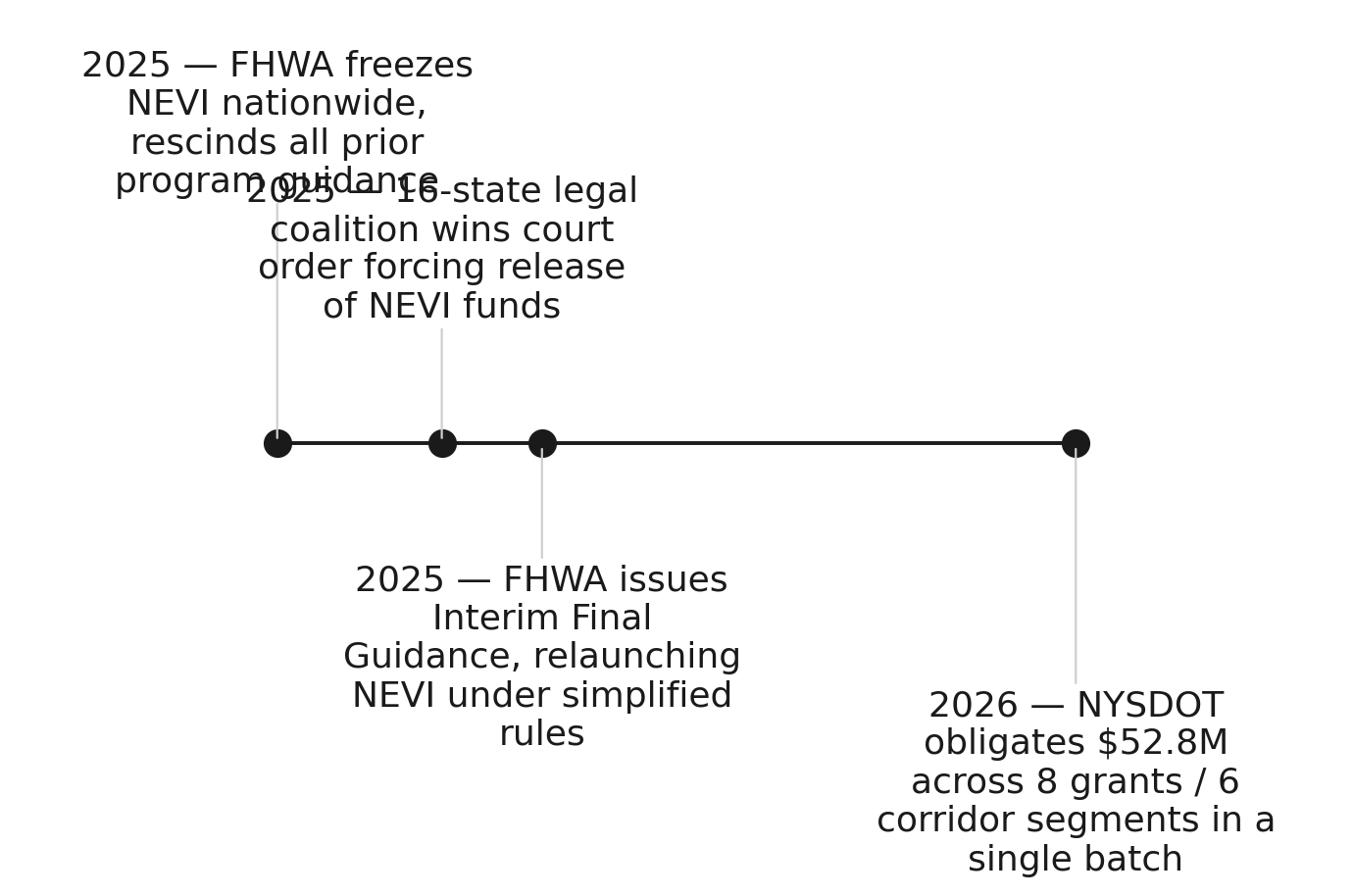
On February 6, 2025, FHWA froze all NEVI obligations nationwide, rescinding prior program guidance as part of the Trump administration's broader rollback of EV policy under Executive Order 14154. The freeze halted project-level commitments across all 50 states. A coalition of 16 states filed suit in May 2025. A federal court order in June 2025 forced fund release. FHWA issued new Interim Final Guidance on August 11, 2025, relaunching the program under simplified rules, states needed to describe intended fund use, submit a Community Engagement Outcomes Report, and address cybersecurity, but the Biden-era equity and outreach requirements were gone. New York's updated NEVI Plan was approved by FHWA in September 2025. The final year of the five-year program, FY2026, was unlocked for obligation in October 2025.
Source: NationGraph.
The eight grants recorded August 24, 2026, represent NYSDOT drawing down those accumulated and newly released funds in a single corridor-by-corridor batch. Each grant is sized at approximately $6.6 million and covers a named highway segment: Hudson Valley, Capital Region 1 and 2, I-87 Capital Region, I-90 Central 1 and 2, and I-90 Western 1 and 2. All eight run through 2036, a ten-year performance window that spans design, installation, and operation. The uniformity of the grant sizes and the simultaneous obligation date point to deliberate tranching rather than organic project sequencing, this is a state locking in corridor commitments before the program's FY2026 expiration closes the window.
There is one important caveat in the year-over-year comparison. The prior-year figure, $12.93 million, went to the Metropolitan Transportation Authority under a separate Federal Transit formula grant program for transit fleet charging, a structurally different award to a different recipient for a different purpose. The two are not the same funding stream. The real baseline for NEVI highway charging in New York is not $12.93 million; it is close to zero for the months the freeze was in effect.
The shift in how this batch was structured also tells a story. The previous two solicitation rounds, the upstate $21M round and the downstate $28.5M round, awarded funds competitively to private charging operators. The August 2026 batch obligates directly to NYSDOT project identification numbers. That suggests the state has moved to self-executed corridor buildout for the final NEVI tranche, bypassing a competitive round it may not have had time to run before the program expires.
New York's total NEVI allocation across the five-year program is approximately $175 million, among the largest in the Northeast and reflecting the state's high-traffic interstate corridors. As of its active grant portfolio, NYSDOT now holds $63.6 million across 11 NEVI grants. Nationally, the Electrification Coalition notes that FHWA apportioned $885 million in FY2026 NEVI funds, the final year of the original program, meaning states are now competing against a hard calendar to obligate funds before appropriations lapse. At least 384 EV charging ports had been built through NEVI nationally as of late 2025, a figure that will climb sharply if states can complete project-level obligations before the deadline.
For drivers in New York, the practical effect is a fast-charging buildout concentrated along the two interstate spines that carry the most long-distance traffic: I-87 running north through the Hudson Valley and Capital Region, and I-90 running west toward Buffalo. Both corridors have had gap coverage problems that limited EV adoption for anyone traveling beyond the metropolitan area. The 2036 performance window means actual charger installation is not imminent in all cases, site acquisition, utility coordination, and construction will take years, but the federal funding commitment is now locked.
What to watch next: whether Congress reauthorizes NEVI in any form as part of the broader federal transportation reauthorization process, and whether NYSDOT's direct-obligation approach for these eight corridor grants moves faster to construction than the competitive rounds that preceded it. The FY2026 obligation window is closed; the build window is just opening.