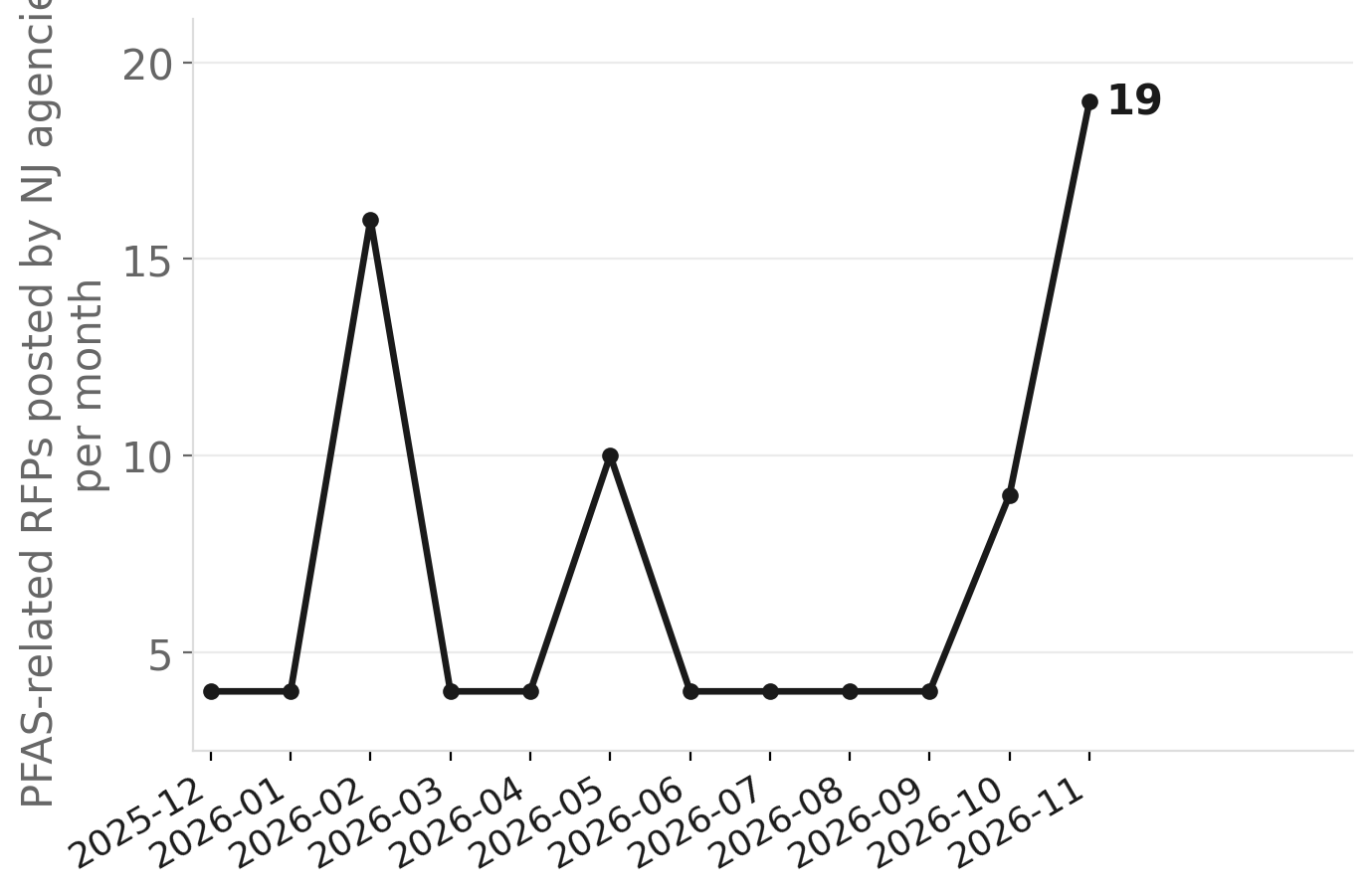
New Jersey municipalities posted 19 PFAS-related RFPs in the last 30 days, against a 12-month monthly average of roughly four, a 4.8x surge that outruns every neighboring state and traces back to two specific legal events that arrived in quick succession this year.
The explanation is not that contamination suddenly worsened. It is that two distinct instruments, arriving eight weeks apart, together closed the gap between "we must act" and "we can afford to act."
On June 15, 2026, the New Jersey Department of Environmental Protection formally adopted enforceable remediation standards for PFNA, PFOA, PFOS, and GenX under N.J.A.C. 7:26D. Before that rule, interim PFAS criteria set thresholds but did not mandate sampling at every site. The 2026 rule changed that: as environmental law firms Cullen and Dykman and Riker Danzig have noted, PFAS analysis is now embedded in the default investigative scope wherever a site's contamination history is uncertain, which, in a state with decades of industrial manufacturing by DuPont and 3M, describes a large share of active remediation sites. Licensed Site Remediation Professionals must now revisit existing workplans. The obligation is no longer theoretical.
Source: NationGraph.
Then, on August 7, 2026, the U.S. District Court approved a $2.5 billion statewide PFAS settlement with 3M, DuPont, Chemours, and Corteva, the largest single-state environmental settlement in U.S. history. The settlement's structure is specific: $90 million goes directly to 18 counties for PFAS remediation at county-owned properties, including airports and fire training academies; a minimum of $150 million flows to the NJ Water Bank for utility project loans; and $795 million is earmarked for broader abatement and water quality work. Counties that had a regulatory mandate but no clear funding path now have both.
Bergen County is the clearest illustration of what happens when obligation and money arrive simultaneously. Seven of the 19 statewide RFPs in the past 30 days originated there: Ridgewood is procuring granular activated carbon treatment systems at three facilities, Park Ridge is seeking permanent treatment for wells 12 and 18, and Ramsey is soliciting design work for the Arrow Road treatment facility. These are not exploratory contracts. They are hardware procurements, the kind that follow engineering studies, not precede them.
The activity is distributed across 13 distinct issuing agencies statewide. Mercer County accounts for four NJDEP laboratory services RFPs, Morris has posted three, Burlington two, and Gloucester, Middlesex, and Sussex one each. The breadth matters: this is not a single state agency running a coordinated program. It is dozens of local governments and county bodies acting on the same legal signal at roughly the same time.
Federal money is also in the mix, though it flows through state administration rather than directly to municipalities. Active federal PFAS grants in New Jersey total approximately $54.4 million: a $33.6 million EPA WIIN Act Small and Underserved Communities Emerging Contaminants grant, administered by NJDEP and running through 2030, and a $13.9 million Drinking Water State Revolving Fund tranche tagged for PFAS projects. These federal dollars provide the technical and financial scaffolding on which municipal projects now hang, but they are distinct from the litigation settlement funds and serve different purposes.
Timing matters here in another way. The EPA proposed in May 2026 to roll back federal maximum contaminant levels for PFHxS, PFNA, and GenX, a move that would have weakened the federal floor for several PFAS compounds. New Jersey's June 15 rulemaking landed after that proposal, and DEP Acting Commissioner Ed Potosnak was explicit about the state's posture: "Even as we see wavering at the federal level, New Jersey remains firm." The state locked in its own enforceable standards precisely as the federal framework was becoming less reliable. That sequencing appears to have accelerated, rather than paused, local procurement activity.
For residents, particularly in Bergen County and the other affected areas, the near-term change is practical: treatment systems that have been in planning for years are now entering construction procurement, which means installation timelines are compressing. For water utilities drawing from aquifers with uncertain contamination histories, the June rule means their remediation professionals may already be revising site workplans.
The RFP volume is also staircase-shaped, not a single spike. February 2026 saw 16 PFAS RFPs statewide; May saw 10; October and November are running at 19 and climbing. Each step corresponds to a regulatory or legal event. If that pattern holds, the next signal to watch is how quickly NJDEP and AG Matthew Platkin's office move to distribute the $90 million county allocation from the settlement trust, and whether that distribution triggers a second procurement wave among the 18 counties named in the agreement.