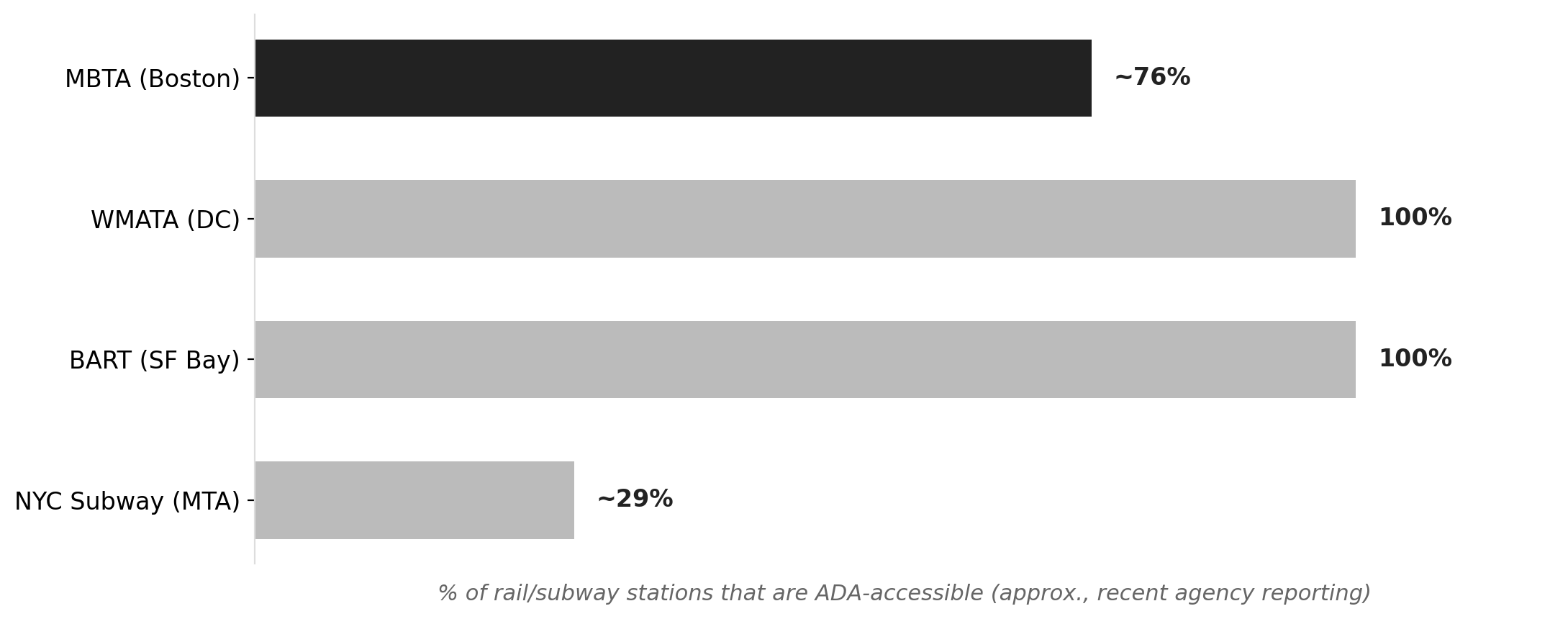
Three of Boston's busiest subway stations are finally getting the elevator access that disabled riders have been promised for more than 30 years. The MBTA is moving forward with six elevators across Downtown Crossing, Park Street, and Central Square, a project that represents one of the most concrete deliverables yet under federal court settlements that have been pushing the agency toward full ADA compliance since 2006.
Park Street, the system's original 1897 station and the critical transfer point between the Red and Green lines, will receive new accessible transfer elevators along with Downtown Crossing. At Central Square in Cambridge, which sits on a Red Line corridor serving Harvard, MIT, and tens of thousands of daily commuters, the MBTA will replace an existing elevator and add two more. The Downtown Crossing work is labeled Phase 2, continuing earlier accessibility improvements at that station.
The project comes after decades of the MBTA struggling to retrofit a subway system built long before accessibility was a legal requirement. The agency was sued in 2002 by the Boston Center for Independent Living, and a 2006 settlement, extended and tightened in 2018, created binding obligations under the Plan for Accessible Transit Infrastructure. Elevator reliability has remained a chronic problem: disabled riders have repeatedly been stranded when the agency's aging elevators failed, drawing sustained criticism from advocates and extensive local news coverage.
Source: NationGraph.
General Manager Phillip Eng, appointed in 2023 amid Federal Transit Administration safety findings about the agency, has made state-of-good-repair work a centerpiece of his tenure. This project reflects that push, using a Construction Manager at Risk delivery method the MBTA has increasingly adopted for complex jobs after years of cost overruns on traditional contracts.
The MBTA has posted a request for qualifications on BidExpress for seven specialty trades, including elevators, HVAC, waterproofing and fire protection, to begin the contractor selection process.