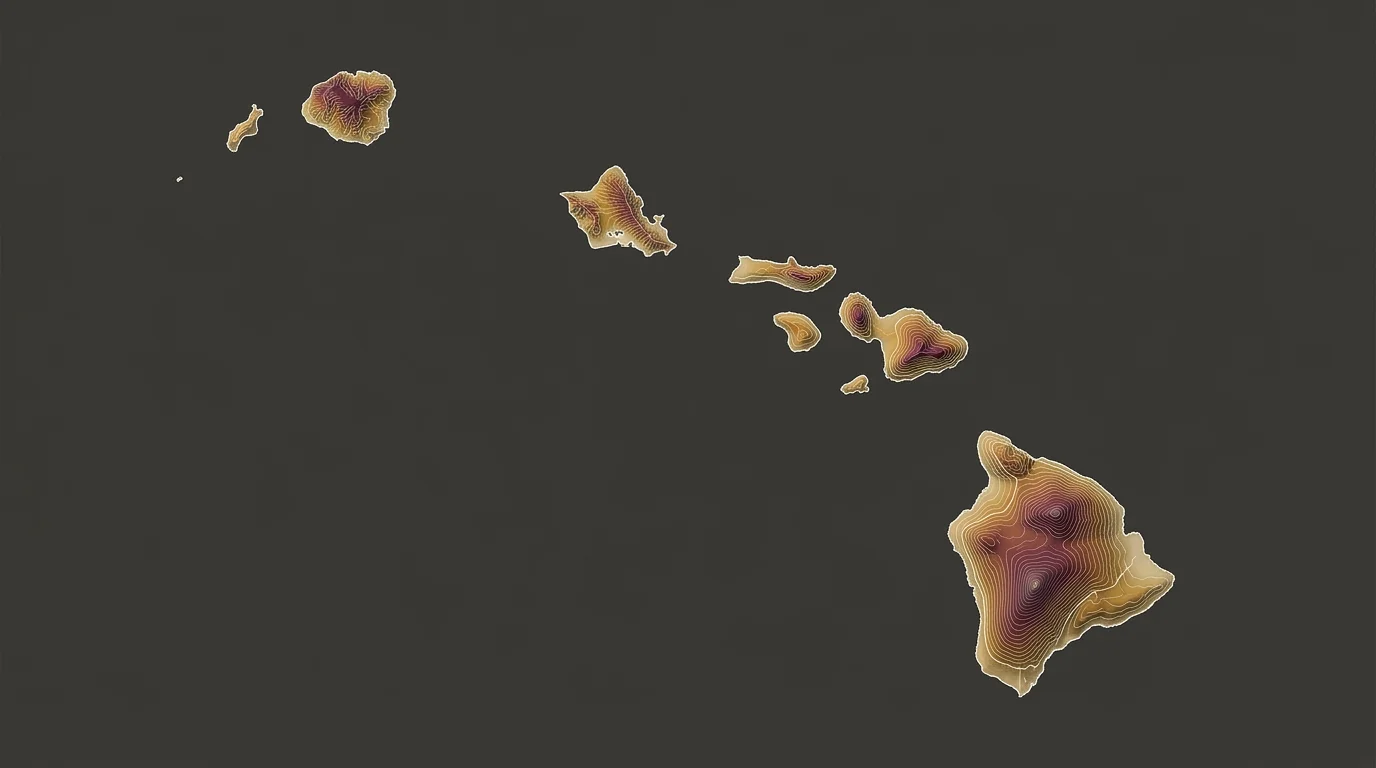
Federal agencies committed $16.35 million in new AI grants to Hawaii in the past 90 days, up from $955,000 in the same window a year ago, a 1,611 percent increase that makes the state second only to Washington among comparable Western states for new AI grant commitments, despite having a fraction of Washington's population or research infrastructure.
The surge does not reflect a coordinated federal AI strategy for Hawaii. It reflects three entirely separate programs, run by three different agencies, targeting three different problems, that happened to close awards in the same quarter. Understanding what each one is, and is not, explains both why the money landed here and what it is actually meant to do.
The largest award is an $8.63 million NOAA grant to the University of Hawaii's Cooperative Institute for Marine and Atmospheric Research, covering a new five-year tranche running through September 2031. CIMAR has been NOAA's designated Pacific Islands research hub for decades; the university was selected to host the institute in a 2021 competition that carried a potential ceiling of $210 million over five years. What is new in this tranche is explicit: AI-enhanced forecasting and monitoring are now embedded as a named research theme, not an afterthought. For a state whose agricultural and fishing industries depend on Pacific weather prediction, and whose emergency managers face hurricane seasons with limited overland evacuation options, that is a meaningful shift in what the federal government is funding CIMAR to do.
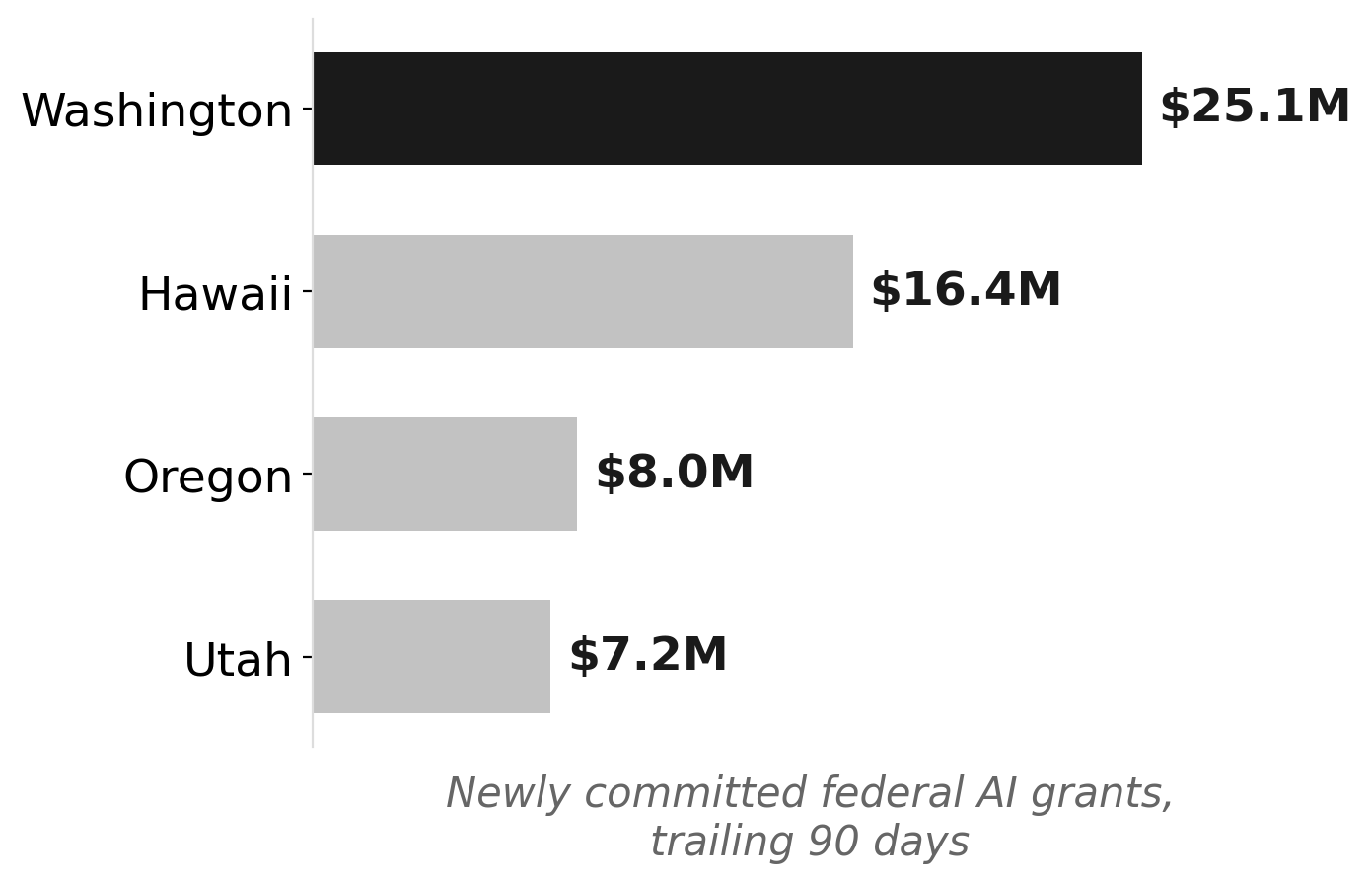
Source: NationGraph.
The second-largest award is a $4.2 million grant from the Federal Highway Administration to the Hawaii Department of Transportation for an AI-driven smart corridor management system. The project will deploy sensors and cameras at 67 signalized intersections across Honolulu, using adaptive routing algorithms to manage one of the most congested urban road grids in the country, a city hemmed in by mountains and ocean with few alternative corridors. The grant came through FHWA's ATTAIN program, funded by set-asides in the Infrastructure Investment and Jobs Act, as part of a $96 million round of advanced technology transportation grants. It has nothing to do with the NOAA award; it was reviewed by a different agency under a different statute for a different purpose.
The remaining roughly $3.5 million consists of multiple smaller NSF grants to UH community colleges and the Purple Maia Foundation. Kapiolani Community College and UH Maui College each received NSF Advanced Technological Education awards for applied AI and data science programs targeting working adults, with UH Maui also receiving $441,645 for a CyberAI Innovation program. Hawaii ranks in the top five states nationally for unmet cybersecurity workforce demand, a gap the UH system has been moving to address through a coordinated AI workforce initiative across all seven of its community colleges. The Purple Maia grant, $642,291 from NSF's Computer and Information Science and Engineering directorate, funds something narrower still: community-maintained AI infrastructure for rural Hawaiian farm communities without reliable internet or power, targeting local food security on islands that import roughly 85 percent of their food.
That last grant points to something the aggregate dollar figure obscures. Hawaii's interest in AI is not abstract. Geographic isolation creates specific vulnerabilities, in food supply, in transportation, in the ability to train workers locally rather than lose them to mainland opportunities, that federal equity-focused programs are structured to address. NSF's ATE program explicitly prioritizes community colleges serving Native Hawaiian, Pacific Islander, and working-adult students, which describes the UH system's enrollment profile closely. The FHWA ATTAIN program funds states with acute transportation constraints. NOAA funds its Pacific hub to do Pacific science. Hawaii fits each of these criteria independently.
The national policy backdrop gives Hawaii's UH system a reason to keep pressing. The bipartisan NSF AI Education Act of 2026, introduced by Senators Cantwell and Moran on March 3, would establish at least five community college Centers of AI Excellence coordinated with the CHIPS and Science Act's Regional Tech Hubs. The program model the bill describes, faculty training, industry partnerships, applied AI technician credentials, is what UH's community colleges are already executing with current NSF funding. If the bill passes, Hawaii is positioned to compete for a formal designation. NSF separately announced a $100 million State and Regional AI Infrastructure Hubs initiative in August 2026, with community colleges explicitly eligible, which represents another near-term grant round the UH system is watching.
Hawaii's total active AI grant portfolio now stands at 31 awards totaling $36.5 million in obligated funds, with $5.2 million outlayed so far. The 90-day surge accounts for nearly half that total by dollar value. Whether the pace continues depends on competitive grant cycles that Hawaii does not control. What the state does control is whether the workforce programs, the transportation deployment, and the research infrastructure being funded right now are built to compound, turning a coincidence of federal timing into something that lasts past the next grant cycle.