Florida schools and colleges filed 19 school safety procurement solicitations in October 2026, nearly six times the monthly average of 3.3 recorded between August 2025 and September 2026. The spike wasn't a coincidence, and it wasn't a budget cycle. It was a compliance clock running out.
HB 757 (Ch. 2026-80), signed by Governor DeSantis on May 15, 2026 at the state's annual Commissioner's Summit on School Safety in Miami, took effect October 1. The law does something no prior Florida statute had done: it extends the K-12 school safety framework built after the 2018 Parkland shooting to all public colleges and universities, roughly 40 postsecondary institutions that previously operated outside those requirements entirely. Threat management teams, annual security risk assessments using the Florida Safe Schools Assessment Tool, Guardian Program participation, and deployment of the FortifyFL mobile panic alert system are now mandatory across the full public education system. Compliance reports are due October 1 and March 1 each year. The October 1 effective date and the first reporting deadline landed on the same day.
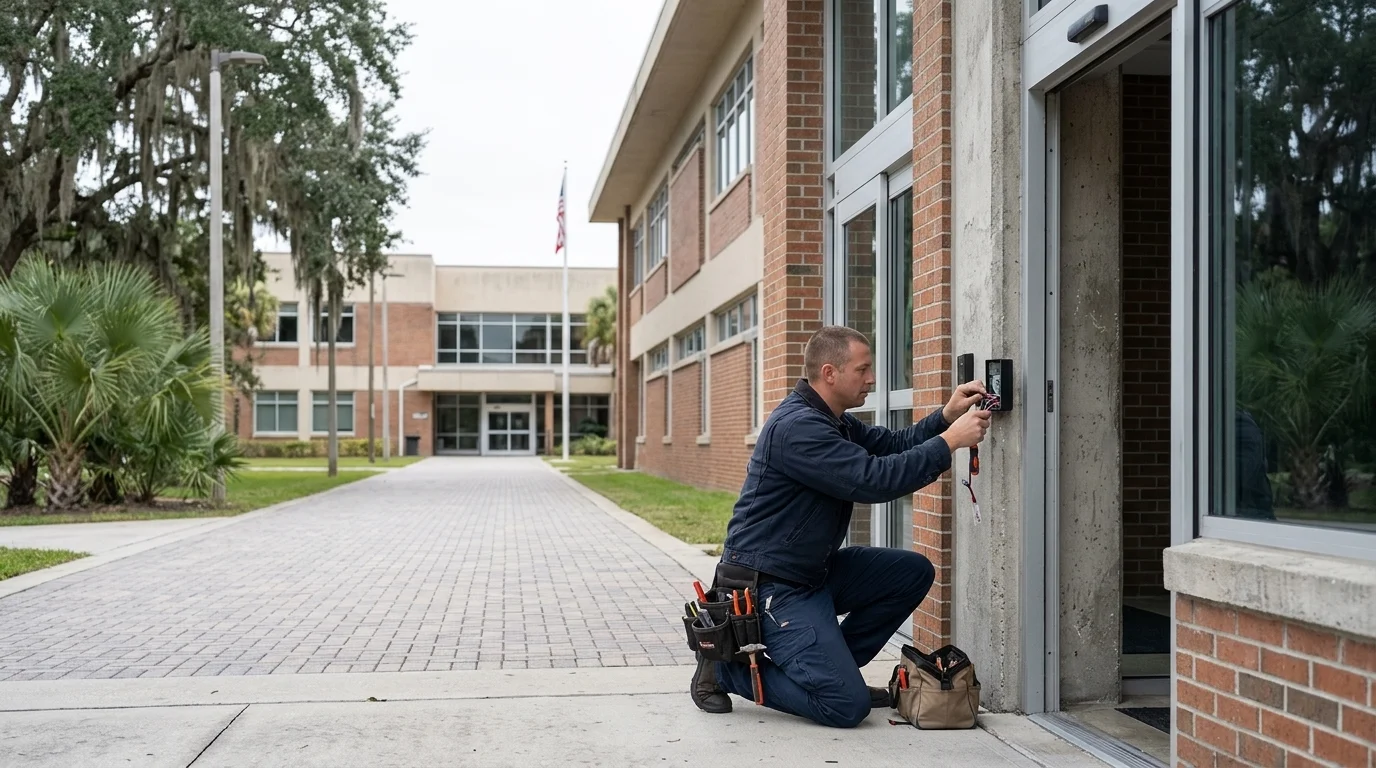
The procurement filings are the paper trail of that mandate hitting in real time. Almost the entire October surge is concentrated on and after October 25, institutions pushing solicitations out the door within weeks of the law going live. The Florida Department of Education leads with four statewide RFPs, including one for a Statewide Mobile Panic Alert System and two contracts for maintaining the Florida School Safety Portal. County districts are procuring in parallel: Osceola is seeking access control systems and advanced radar for bus safety; Palm Beach has posted solicitations for school renovations and driveway security improvements; Duval is procuring door hardware and keying systems alongside school construction contracts; and Leon County has re-bid its school guardian services contract. Broward, Orange, Lake, and Alachua counties are also in the market, covering GPS transport systems, comprehensive campus renovations, bus infraction detection, and fire suppression.
The state appropriations attached to HB 757 explain both the urgency and the scale. The FY2026-27 General Appropriations Act set aside $4.2 million specifically for Florida College System guardian training, the most visible new cost the law created for institutions that had no guardian programs before. The broader HB 757 implementation funding package draws on multiple state appropriation lines: a $1.6 billion cumulative Safe Schools Allocation funding officers and guardians across K-12 districts, $258 million in school hardening grants for physical security improvements, $103 million in technology services supporting portal and alert infrastructure, and $34 million for the Guardian Program statewide. These are parallel arms of the same statutory mandate, not separate initiatives.
None of that money is automatic at the district level. At an October 12, 2026 board meeting, a school safety specialist urged the district to prepare for HB 757 implementation and to incorporate security improvements into ongoing renovation projects. Board members pushed back with questions about shrinking grant awards and gaps in SRO reimbursement, flagging a concern that the state funding package may not cover the full cost of compliance for every institution. That tension, between a mandate with hard deadlines and a reimbursement structure with soft edges, is part of what drove solicitations out the door fast: districts can't wait to see how grants shake out before they start procurement.
Florida has been the most aggressive state on school safety mandates since Parkland, building an eight-year statutory framework through the Marjory Stoneman Douglas High School Public Safety Act and successive amendments. HB 757 is the largest single expansion of that framework, both in the number of institutions it covers and in the breadth of requirements it imposes simultaneously. Prior waves of K-12 procurement happened gradually as districts phased in hardening grants over multiple budget years. The college and university sector has no equivalent runway; every public postsecondary institution in the state is starting from scratch on the same October 1 timeline.
What to watch next: the March 1, 2027 compliance reporting deadline will show which institutions cleared the initial requirements and which are still procuring. Districts and colleges that couldn't lock in vendors before year-end will be filing into a compressed market. The $20 million School Hardening Grant appropriation for the 2025-26 year was already oversubscribed relative to demand; if the FY2026-27 allocation doesn't expand proportionally to cover postsecondary campuses, the gap between what's mandated and what's reimbursed will widen before the spring deadline.