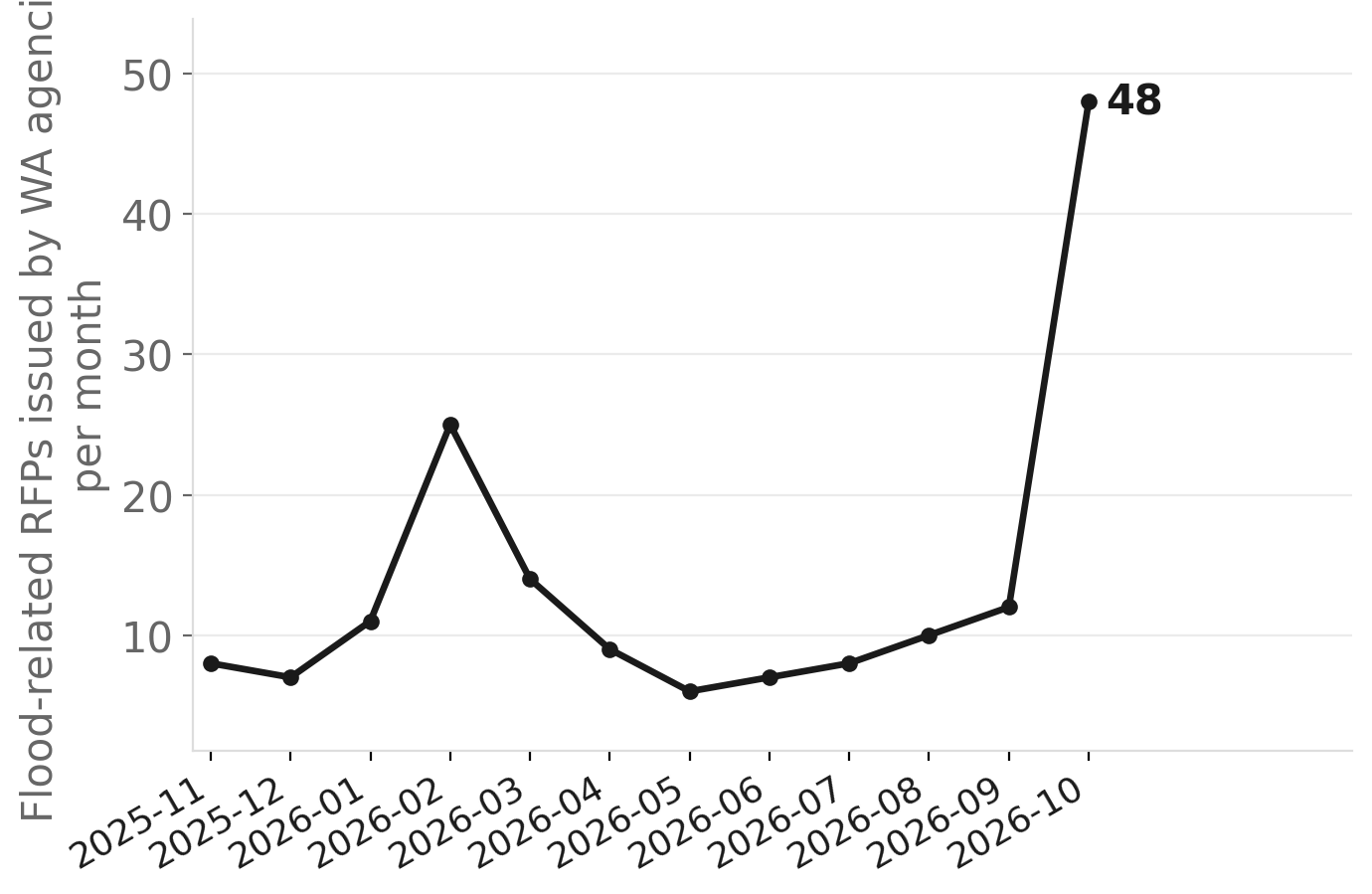
Washington state agencies issued 48 flood-control procurement requests in October 2026 alone, 5.2 times the trailing 12-month average of roughly 9 per month. The surge is not a gradual rise: RFP volume spiked in February 2026 during the immediate post-disaster scramble, fell back through spring, then hit a new peak in October as reimbursement money finally reached local budgets. Counties have roughly eight weeks before the next atmospheric-river season is statistically likely to arrive.
The catalyst was the series of atmospheric rivers that struck Washington between December 5 and 19, 2025, overwhelming the Nooksack River and its tributaries, forcing rooftop rescues in Sumas, and mobilizing roughly 400 National Guard soldiers across Skagit, Whatcom, and King counties. Whatcom County officials called it the largest and most severe disaster in the county's 167-year history. Governor Bob Ferguson submitted a \$182.3 million FEMA Public Assistance request in February 2026, the largest such request Washington had made to FEMA in more than 40 years, and FEMA approved the major disaster declaration on April 11, covering ten counties and multiple tribal nations.
FEMA Public Assistance reimburses 75 percent of qualifying repair costs, roads, levees, bridges, water control facilities, but it pays out over years as individual projects complete, not as a lump sum counties can spend immediately. That reimbursement lag is exactly why the October procurement surge is happening now rather than in January. Governor Ferguson's March 2026 transportation budget addressed the cash-flow problem directly: it included $45 million in state bridge-loans to counties and cities to begin repairs while awaiting FEMA reimbursement, alongside $65 million in federal highway repair funds for state roads. Those bridge-loans are the financial bridge between the disaster declaration and the contractor showing up with equipment. Counties that applied in spring, secured engineering assessments over summer, and drew on state loans in August and September are the ones issuing RFPs in October.
Source: NationGraph.
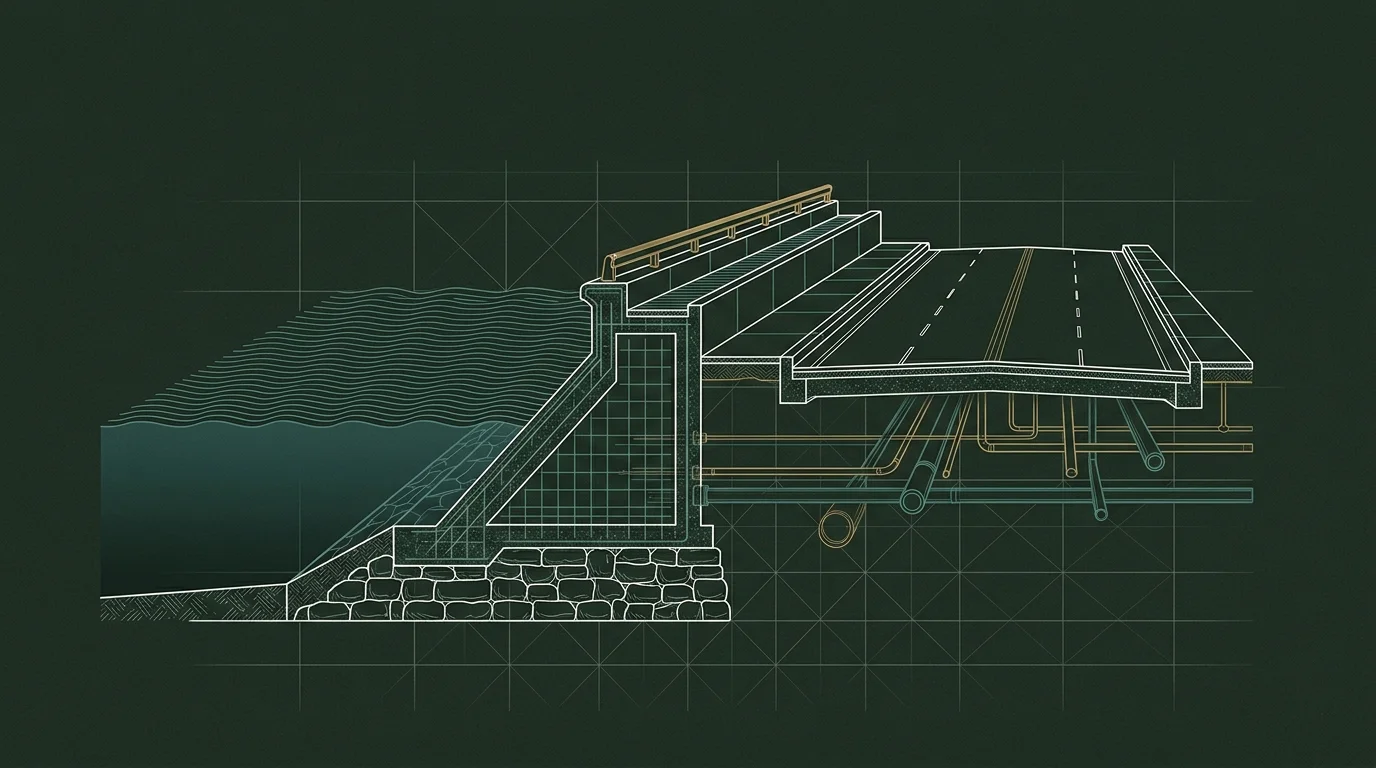
The geographic footprint of the procurement surge matches the federal disaster declaration almost exactly. King County (combining city and county agencies) accounts for 15 of the 48 October RFPs, Whatcom County for 7, and Pierce, Skagit, and Snohomish counties for 3 each. The project types span the full post-flood repair spectrum: levee and flood barrier procurement in Pierce County, culvert replacements on Boeing Creek in Shoreline and Newaukum Creek in Enumclaw, river infrastructure assessments, Sumas Square flood mitigation and housing rehabilitation through the Whatcom Housing Authority, stream restoration in Lake Stevens and Woodinville, and park washout repair in Skagit County. The breadth of contract types reflects how comprehensively a major flood event damages public infrastructure: it is not just levees that fail but the entire web of culverts, streambanks, parks, and low-lying structures that connect a river to the communities beside it.
For context on how Washington-specific this surge is: Oregon logged 6 flood RFPs in the same 30-day window; Idaho and Montana logged 2 each. The December 2025 event was a Washington disaster, and the procurement response is a Washington phenomenon.
The mitigation funding picture is more complicated. The Trump administration denied Washington's separate $36.6 million Hazard Mitigation Grant Program request in April 2026, HMGP funds future-oriented mitigation projects like flood walls and structure acquisitions, distinct from the Public Assistance reimbursements covering past damage. The state is appealing that denial and has also secured a court order, through Attorney General Nick Brown, requiring FEMA to reverse its cancellation of more than $150 million in withheld BRIC mitigation funds. A $3.5 million HMGP grant to the Whatcom County Flood Control Zone District, approved in May 2026 to acquire and demolish five flood-hazard-area structures, represents the narrow slice of mitigation funding that has moved forward.
On the longer horizon, the Water Resources Development Act of 2026, authored by Rep. Rick Larsen and passed the House 415-9 on September 16, specifically authorizes a Nooksack River flood risk reduction feasibility study for Whatcom County. WRDA authorizes Army Corps of Engineers studies and projects but does not itself appropriate construction dollars; a separate appropriations act would be required before any Corps construction moves. The Nooksack study is a planning signal for the decade ahead, not a contract anyone can issue today.
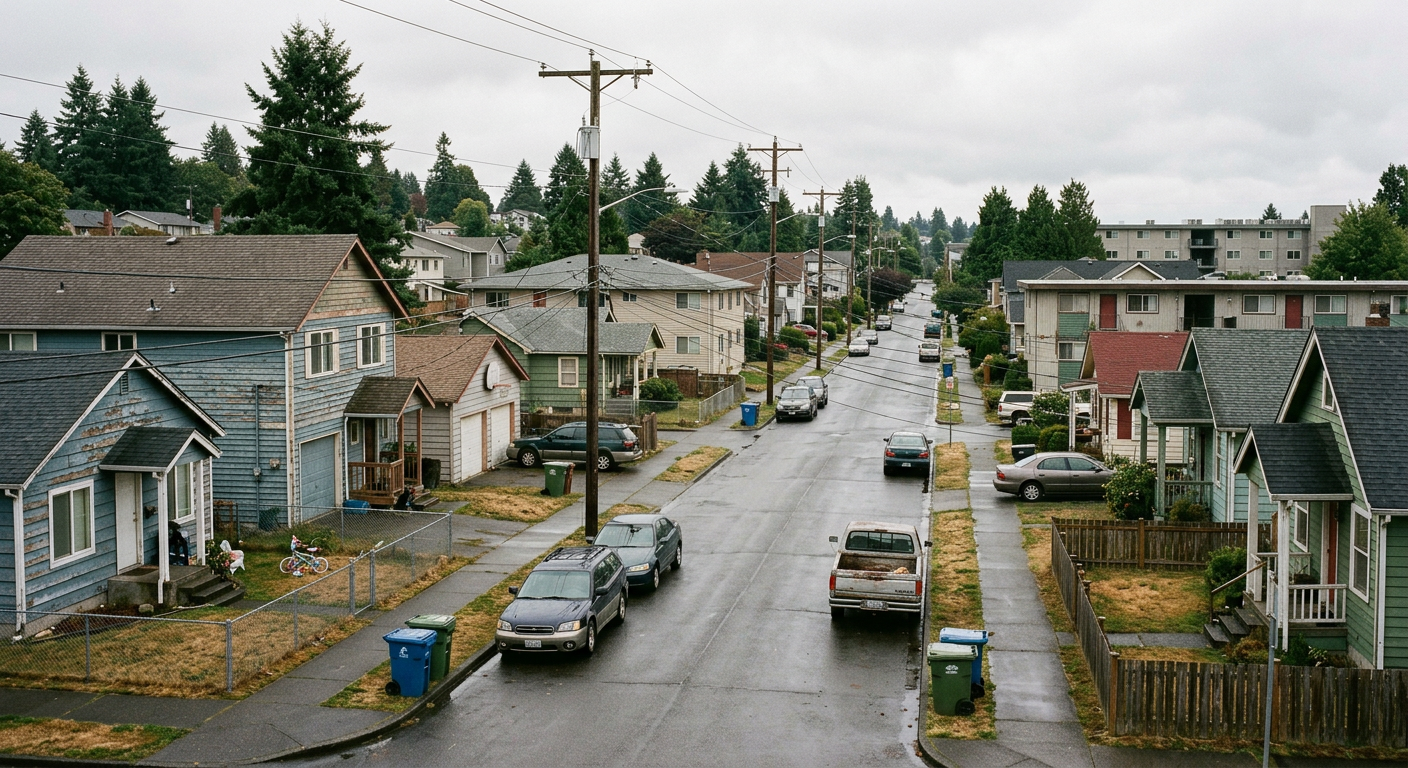
What changes for a resident in one of the ten declared counties is primarily visible at the contractor and permitting level: more engineering firms are being solicited, more culvert and stream-channel work is going out to bid, and more of the visible flood damage from last winter is finally entering the repair queue. The question local governments face now is whether they can move contracts to execution before November rains stress the same infrastructure again. Counties that cannot award and mobilize contracts in the next several weeks may find themselves managing active construction sites through the beginning of the next wet season, which is precisely the scenario the state bridge-loan program was designed to prevent.