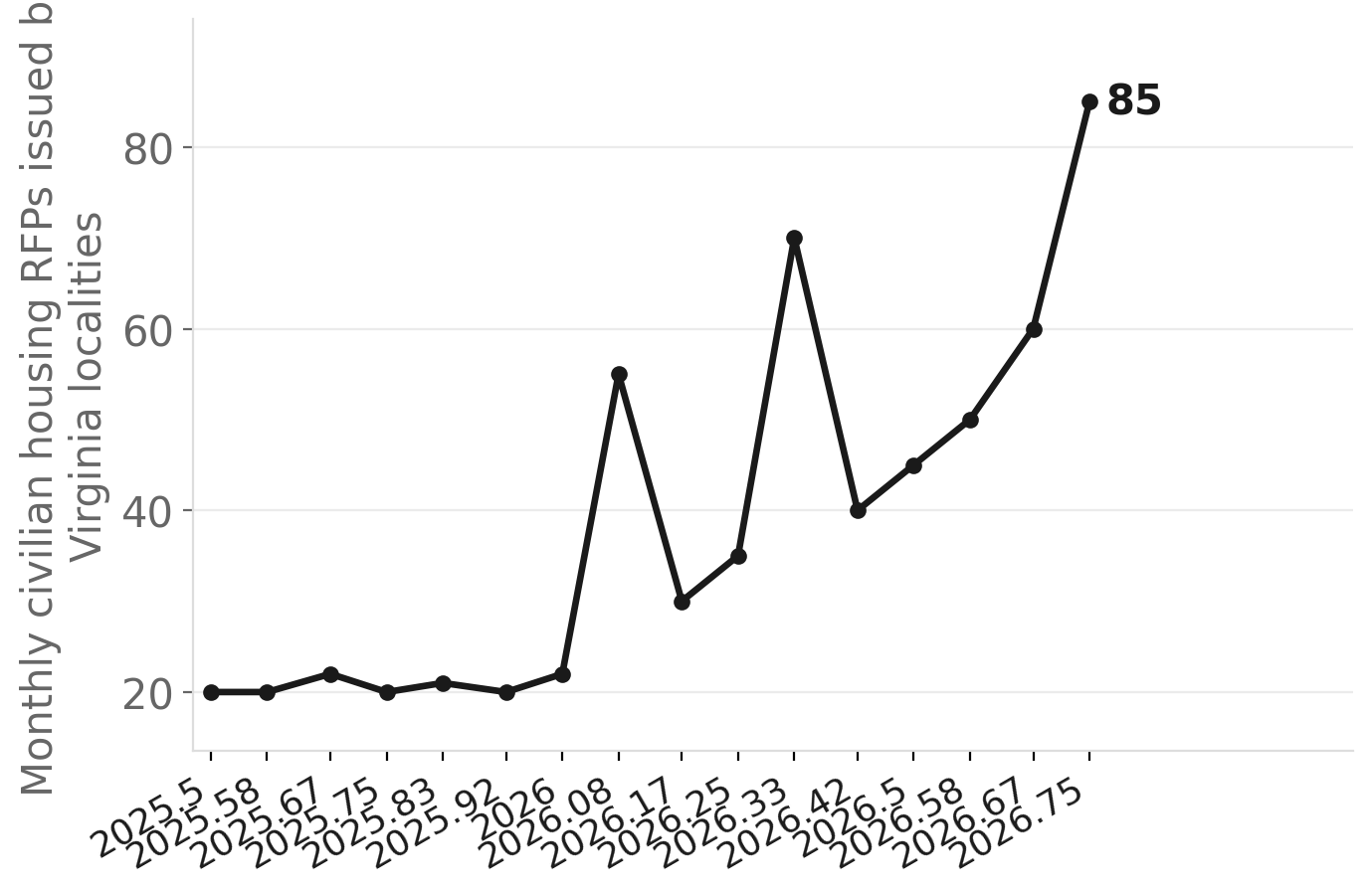
Virginia localities issued roughly 85 genuine civilian housing RFPs in October 2026, more than four times the baseline of about 20 per month that held through most of 2025. That number is not a one-time spike driven by a single grant deadline. It is the visible footprint of three overlapping policy triggers arriving in the same 12-month window, each one unlocking a different layer of program authority that did not exist before.
The first trigger came on April 8, 2026, when Governor Spanberger signed a landmark housing affordability package that included four distinct statutes. HB352 created performance-based affordable housing grants that localities can now offer to private developers. HB867 and SB74 gave localities opt-in authority to run their own local affordable housing programs. HB594 established fast-track rezoning for qualifying affordable developments. HB806 enabled Industrial Development Authorities to finance affordable housing for the first time. Each of these was a new power, not an expansion of an existing one. Virginia localities historically lacked the statutory authority to run these kinds of programs at all, which means the procurement surge is not routine implementation, it is agencies building program infrastructure from scratch. The Virginia Mercury described the April package as among the most consequential housing legislation the General Assembly had passed in years.
The second trigger came from Washington. The 21st Century ROAD to Housing Act (P.L. 119-101), enacted July 11, 2026 on an 85-5 Senate vote, changed what CDBG dollars can pay for: for the first time, entitlement communities can direct up to 20 percent of their annual Community Development Block Grant allocations to new affordable housing construction. Previously, CDBG funds were restricted from new construction. The change took effect October 1, 2026, the same month housing RFPs surged. Virginia localities are CDBG entitlement communities, and their procurement offices are now designing solicitations around construction authorities that did not exist in their last annual action plans.
Source: NationGraph.
These are legally distinct instruments doing different things. The April state package created locality-level program authority and new IDA financing tools but did not directly appropriate state dollars to localities. The Virginia Housing Trust Fund, a separate state appropriation channeled through DHCD and Virginia Housing, holds a $70.5 million FY2026 Competitive Loan Pool for affordable development and preservation. The CDBG expansion flows through HUD formula grants, bypassing the state entirely. The Low-Income Housing Tax Credit program, administered by the Virginia Housing Development Authority with 2026 final rankings approved June 17, runs through private developer procurement, a fourth track operating independently of the other three. All four are active simultaneously, targeting different actors and generating different kinds of RFPs from different issuing agencies.
The geographic spread of October's activity reflects that layering. Norfolk, Virginia Beach, the Virginia Housing Development Authority, Charlottesville, Prince William County, and the Waynesboro and Hampton Redevelopment and Housing Authorities are among the top issuers. That list spans coastal cities managing older housing stock, inner-suburb jurisdictions absorbing population pressure near transit, and smaller cities standing up preservation programs for the first time. The urgency behind preservation solicitations in particular connects to a hard number: more than 18,000 affordable units in Virginia face expiring affordability protections by 2030.
The third trigger is forward-looking. On November 18, 2026, Spanberger unveiled eight proposals for the 2027 General Assembly session, opening January 13, including an Affordable Housing Preservation Fund, transit-oriented development zones keyed to rail corridors, and authority to release surplus state land for housing. Virginia Housing Alliance executive director Brian Koziol called the package a signal that the state recognizes its housing challenge requires many tools working together. Localities reading that signal are pre-positioning, issuing planning, design, and feasibility RFPs now so they can move quickly once the 2027 session produces additional enabling authority.
The 18-month procurement record makes the legislative-cycle pattern legible in a way no single news story could. Housing RFPs spiked in February 2026 around General Assembly crossover, again in May when the April laws took effect, and again now in October as CDBG new-construction authority went live and 2027 pre-positioning began. Each wave is mechanistically distinct.
For residents and developers, the practical implication is a compressed procurement calendar. Localities are issuing more solicitations, in more program categories, with shorter runway to respond, than at any point in recent memory. For anyone watching the 2027 session, the procurement data already answers one question: Virginia localities are not waiting to see what the General Assembly passes. They are building the capacity to use it before the bill is signed.