South Carolina public agencies issued 14 artificial intelligence RFPs in October 2026, against a trailing 12-month monthly average of roughly 2.1, a 6.7x spike that cuts evenly across education and government. The state doing all this buying still has no statutory definition of the word "artificial intelligence" on its books.
That gap is not an accident. It is the opening agencies are moving through.
The procurement engine traces directly to the SC Department of Administration's June 2024 AI Strategy, developed with Gartner across input from more than 80 state agencies. That document established a Center of Excellence with dedicated procurement subgroups, giving agencies both a framework and institutional cover to begin acquiring tools. For more than a year, that machinery has been warming up. October's numbers suggest it reached operating temperature.
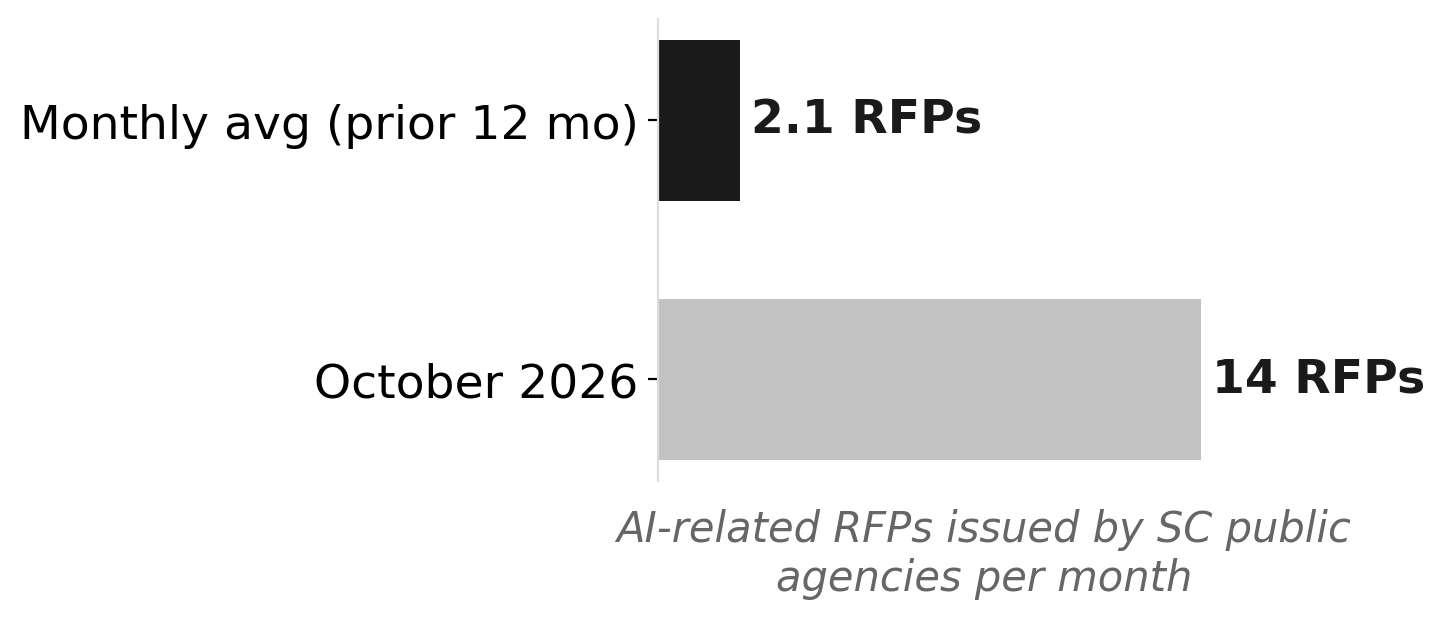
Source: NationGraph.
The accelerant arrived on September 16, 2026, when Sen. Tom Young (R-Aiken) convened the first meeting of the Senate's new Special Committee on Artificial Intelligence. As South Carolina Public Radio reported, the committee is running an 18-month study of AI use across state government, with a final report targeted for summer 2028. Both chambers now have standing AI committees. Legislative staff testimony at the September hearing noted that South Carolina lacks a statutory AI definition, a distinction shared with fewer than a third of states, per National Conference of State Legislatures tracking.
For a procurement officer watching that hearing, the math is straightforward: a committee studying the problem for two years before writing a final report means compliance requirements are real but not imminent. Agencies that move now can embed tools before any governance framework arrives. The Senate committee is not a funding mechanism and carries no enforcement power yet. Its role is as a regulatory clock, and agencies appear to be reading it correctly.
The fourteen October procurements span the state geographically and by function. On the government side, the South Carolina Department of Transportation issued two requests for information on AI-assisted project costing. Horry County is pursuing AI-based property assessment modeling. Myrtle Beach is soliciting AI roadway monitoring. The SC Department of Environmental Services is seeking an AI environmental monitoring platform. The SC Department of Education issued a sole-source contract for AI workplace training, a procurement structure that bypasses competitive bidding entirely, suggesting urgency as much as a specific vendor preference.
The education side of the split is equally broad. Aiken County and Chester County school districts are both seeking K-12 AI platforms. Coastal Carolina University is incorporating AI into a learning management system procurement. Greenville Technical College has an RFP out for construction of a Cybersecurity and AI Center, a capital project, not a software license, indicating that some institutions are building infrastructure to support AI deployment at scale.
That institutional depth has a research foundation behind it. South Carolina currently holds 46 active federal AI grants totaling roughly $61 million obligated, with Clemson University and the University of South Carolina leading as recipients through NSF and DOE programs. That federal research portfolio does not directly fund state agency procurement, but it creates a talent and vendor ecosystem that makes deployment more practical.
South Carolina is not operating in a legal vacuum, exactly. Gov. McMaster signed four AI laws in May 2025, all criminal statutes addressing AI-facilitated offenses. But the state has no comprehensive AI governance framework. A pending Senate bill, S. 963, would create a Consumer Protections in Interactions with Artificial Intelligence Systems Act, and two education-focused AI bills are under committee review. If any of those advance, agencies mid-procurement will face retroactive compliance questions about tools they are buying today.
That is the bet agencies are making: that locking in a procurement now is preferable to waiting for rules that may impose vendor restrictions, audit requirements, or disclosure obligations. States that enacted comprehensive AI governance first, Colorado passed SB 205 in 2024, and Texas has its own active framework debate, gave agencies less room to move. South Carolina's current posture, with an executive procurement strategy and a legislative study body but no enacted statute, is an unusually open window.
The question the October numbers raise is whether the window is closing or still widening. The Senate committee's two-year study scope suggests the latter, but pending bills can move faster than study timelines. The next signal to watch is whether S. 963 clears committee before the 2027 session ends, and whether the volume of agency procurement between now and then forces the legislature to treat the governance question as more urgent than a summer 2028 final report implies.