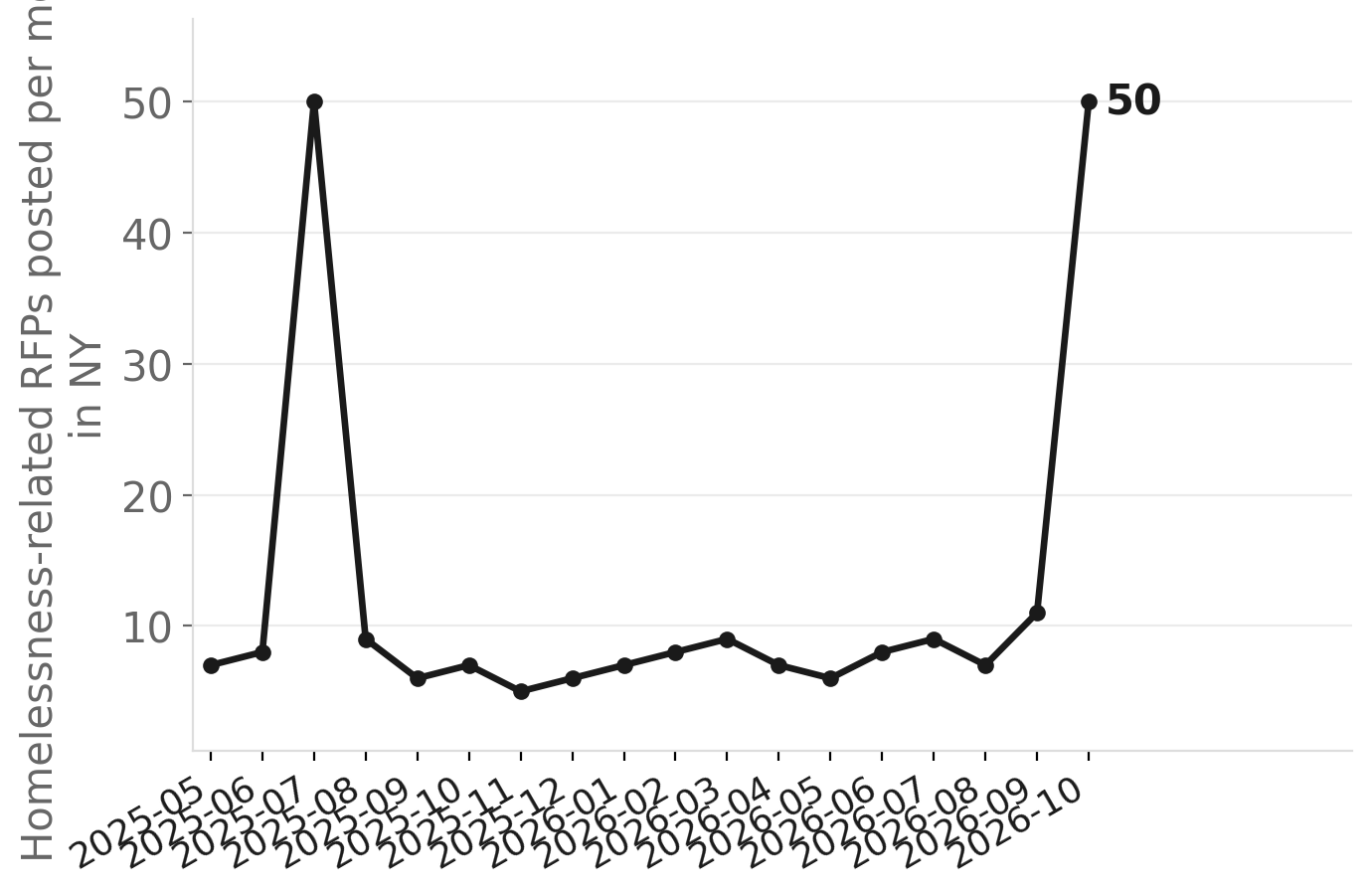
New York homelessness-response solicitations have hit 49 in the last 30 days, against a 12-month average of roughly 7 per month. That seven-fold spike is not a statistical fluke: it reflects a hard deadline. On December 31, 2026, the federal funding behind approximately 7,788 HUD Emergency Housing Vouchers held by New York City households is scheduled to expire, and as the Coalition for the Homeless documented in its 2026 State of the Homeless report, neither Governor Hochul nor Mayor Mamdani has announced a replacement plan.
What you see in the procurement data is what a city and state trying to paper over that cliff with contracts looks like.
Thirty-six of the 50 October RFPs are substantive new solicitations from state and county agencies: OTDA, OMH, Erie, Westchester, Broome, Saratoga Springs, Binghamton, Niagara, and others. This is the largest single-month total in at least 18 months. The concentration matters. These are not the routine rolling-bid shelter listings that NYC posts continuously. They are capital awards, outreach team contracts, and scattered-site housing solicitations that typically take months to assemble and are now all landing in the same October-November window.
Source: NationGraph.
The reason they are landing together is that Albany is simultaneously standing up three distinct programs that were always designed to operate in sequence, and the federal deadline has compressed that sequence into a single procurement cycle.
The first layer is supply. The Homeless Housing and Assistance Program, funded entirely through state appropriations, received $153 million in the SFY2027 budget, up $25 million from the prior year, to build and preserve supportive housing units. The Empire State Supportive Housing Initiative, also state-funded, sits at $240 million this year to cover the operating costs of those same units once they open. Together, HHAP and ESSHI are the brick-and-mortar side of the state's response.
The second layer is demand. The Housing Access Voucher Program, launched in March 2026 with a $50 million state appropriation, is New York's first statewide rental subsidy, covering 100 percent of fair market rent for individuals currently homeless or at imminent risk of losing housing. HAVP is the instrument designed to move people from shelter into private-market apartments, filling the gap left by expiring federal vouchers. Sponsors Senator Brian Kavanagh and Assemblymember Linda Rosenthal, along with a coalition of housing advocates, are pressing for the program to be funded at $250 million in FY2027, arguing the current $50 million pilot cannot absorb the scale of what federal withdrawal will require.
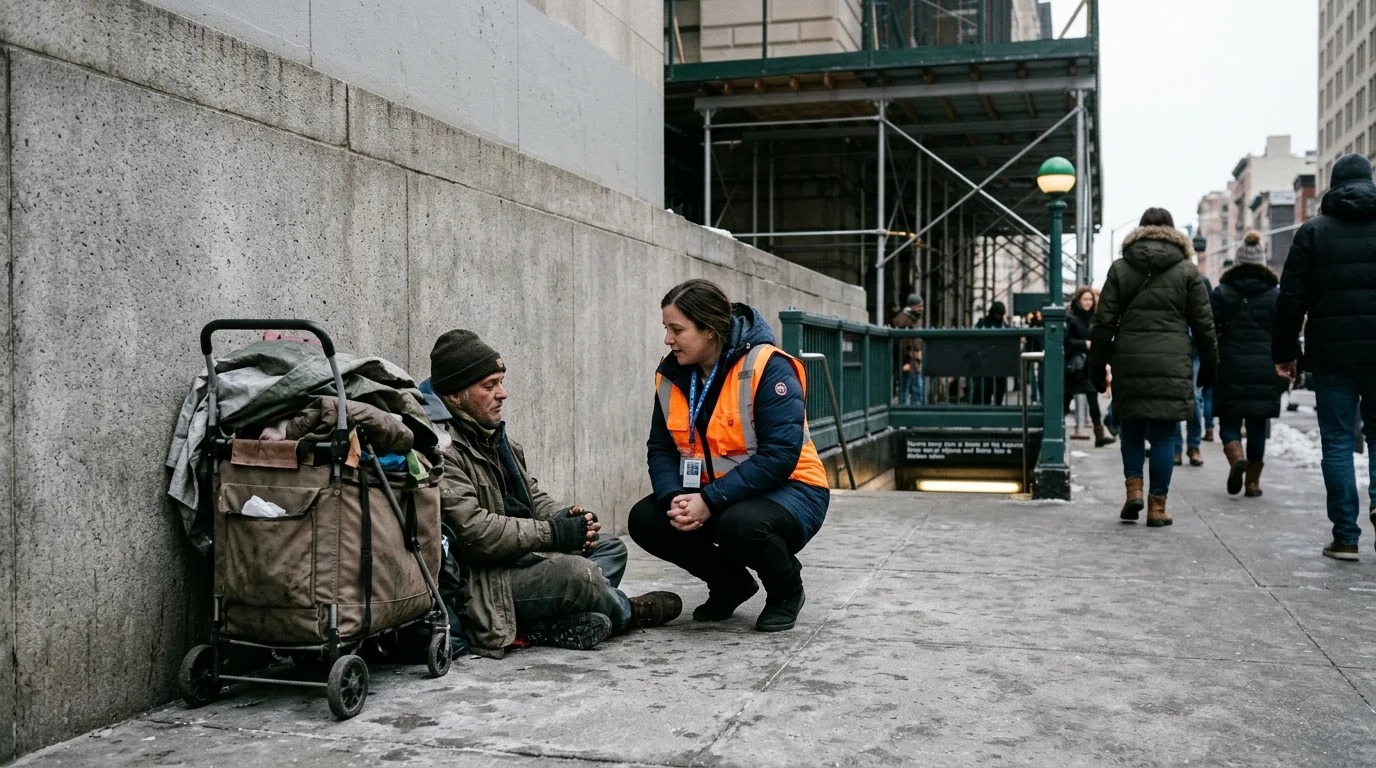
The third layer is engagement. OMH's Safe Options Support program, which uses Critical Time Intervention outreach teams to connect unsheltered individuals with mental illness to housing, now operates 31 teams statewide and recently crossed 1,000 permanent housing placements. OMH listed new SOS CTI team and overnight-team RFPs in its Q2 FY2027 procurement calendar; those solicitations are now entering the award and contract stage. Without this outreach layer, neither the HHAP units nor the HAVP vouchers reach the most isolated members of the street population.
These three layers are not interchangeable, and the story the data tells is precisely that all of them are procuring at once. That simultaneity reflects the scale of what is at risk. The shelter provider Win estimated that New York faces roughly $4.5 billion in lost federal housing program funding under the Trump administration's FY2026 HUD proposal. NYC DHS's own council budget analysis found that 84.5 percent of its federal family-shelter funding, roughly $507 million, is at risk from the administration's restructuring of Continuum of Care grants, which currently deliver $165 million annually to New York City alone.
New York's exposure is structurally larger than peer states for a reason that predates the current federal posture. Under the city's decades-old court-enforced right-to-shelter mandate, every dollar of federal housing support that disappears must be replaced by city or state funds or translated into more shelter beds. There is no option to absorb the gap through program attrition. With the city's rental vacancy rate sitting at 1.4 percent and the shelter census at record levels, the math closes only through procurement.
The political pressure is also compounding. Assemblymember Simone and State Senator Eric Bottcher introduced legislation this session to allow municipalities to establish neighborhood street teams combining outreach providers and health professionals, adding urgency to the OMH procurement wave already in motion.
The next signal to watch is the FY2027 executive budget, expected in January, where the size of HAVP's appropriation will reveal how much of the $4.5 billion exposure Albany believes it can realistically absorb. The procurement wave already underway represents the state's current answer. The budget will show whether that answer is built to last.