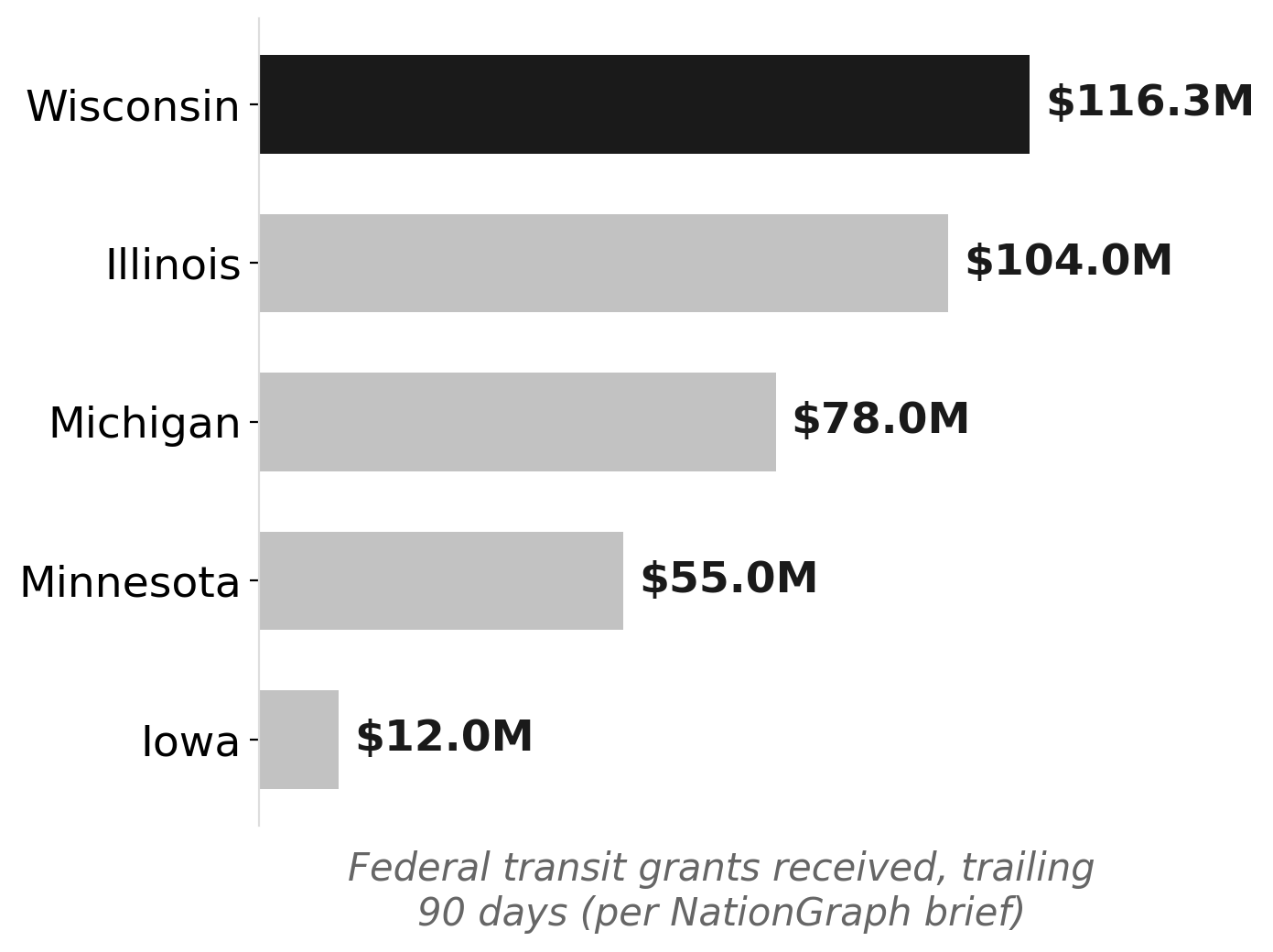
Wisconsin pulled in $116.3 million in federal transit grants over the last 90 days, an 85% jump from the $62.8 million recorded in the same window a year ago, and more than any neighboring Midwest state: Illinois collected $104 million in the same period, Michigan $78 million, Minnesota $55 million, and Iowa $12 million.
The surge is not the product of a single program or a single city. It reflects four distinct federal funding streams, each with its own eligibility rules and recipient base, that converted to signed grant agreements in the same narrow fiscal quarter after years of separate application and review cycles.
The largest single award is a $49.5 million Section 5311 Formula Grant for Rural Areas and Tribal Transit, executed September 10, 2026, running through July 2029. That money flows through WisDOT before reaching local rural operators and tribal nations across the state, which is why a single formula grant to a state agency can carry that size. Section 5311 and Section 5307, the urbanized-area formula program, are both reauthorized under the 2021 Infrastructure Investment and Jobs Act, but they serve entirely different geographies: 5311 covers rural and tribal routes; 5307 goes directly to transit authorities in cities. Milwaukee County claimed $30.9 million in new 5307 formula funds starting September 1, layered on top of a $63.4 million 5307 grant that has been disbursing since April 2025.
Source: NationGraph.
The third stream is competitive rather than formula-based. Madison's city transit system won a $17.4 million award under the FTA's Section 5339 Low or No Emission program to purchase replacement low-emission buses. That award was confirmed in a January 15, 2026 Federal Register notice (FR Doc 2026-00643), which also announced that FTA would fold available FY2026 Low-No funds into the FY2025 round, compressing the timeline and accelerating when grant agreements could execute. Madison is separately mid-build on a Bus Rapid Transit line backed by a $110.6 million FTA New Starts award announced in 2023, which means the city is now drawing from two distinct federal capital programs simultaneously.
The fourth stream is the broadest in eligibility. Appleton's $25 million RAISE grant, which carries no transit-specific requirement and competes across all surface transportation categories, formally entered the grant record in April 2026, nearly 22 months after the original June 2024 award. Valley Transit GM Ron McDonald and local officials described a lengthy federal agreement process before execution. Construction on the new downtown Valley Transit Center, which will include 14 bus bays and affordable housing on upper floors, is now expected to begin in 2026 and finish in 2028. For Fox Cities transit, which has historically had limited access to competitive federal programs, the executed agreement marks the program's formal start, not just a promise.
What makes the Wisconsin number remarkable is the simultaneity. IIJA transit apportionments for the state total $599.2 million over five years, stepping from roughly $114.6 million to $125.4 million annually per Congressional Research Service data, so the pipeline was always known and growing. But formula money, competitive Low-No awards, and discretionary RAISE grants move on different calendars with different approval chains. That all four happened to execute in the same trailing 90 days produced the spike that now separates Wisconsin from its neighbors.
The state has also moved to reinforce the capital infusion on the operating side. Wisconsin's FY2025-27 biennial budget, approved by the Joint Finance Committee in July 2025, added $4.5 million in state transit operating assistance for 2025-26 and $14.6 million for 2026-27 across all system tiers, from large urban operators to rural community transit. State operating aids and federal capital grants are separate funding streams covering different line items, but the budget action signals that Wisconsin is treating the IIJA capital wave as something to sustain, not just absorb.
For riders and local operators, the practical effects depend on geography. Rural and tribal systems waiting on 5311 disbursements from WisDOT will see capital available for vehicle replacement and service continuity. Milwaukee County's 5307 funds support both capital and operating costs for the region's largest transit network. Madison bus riders will eventually board newer, lower-emission vehicles purchased with the Low-No award. Appleton's new transit center, a project that spent nearly two years in federal paperwork after its award, will begin physical construction before the end of this calendar year.
The next signal to watch is whether Wisconsin can sustain the intake pace. The IIJA apportionment schedule guarantees the formula dollars through the law's five-year horizon, but the competitive awards, Low-No and RAISE, require new applications each cycle. FTA has already published a FY2026 Notice of Funding Opportunity for Buses and Bus Facilities, which means the next competitive round is open. Whether Wisconsin's mid-sized systems, which gained their first major RAISE win in Appleton, can convert that experience into a second application will shape whether this quarter looks like a convergence or a ceiling.