New Jersey logged 39 water infrastructure RFPs in the trailing 30 days, against a baseline of roughly 3.7 per month, a 10.6x spike concentrated almost entirely in a single batch of 31 solicitations published October 25 by more than 20 distinct municipalities across Middlesex, Burlington, Monmouth, Hudson, Somerset, Ocean, Camden, and Morris counties.
This is not an emergency signal. It is a clock.
Every fall, New Jersey towns that want access to low-interest NJ Infrastructure Bank Water Bank loans must have an engineer of record under contract before they can submit an application for the upcoming state fiscal year. The NJIB's SFY2027 cycle, which anticipates roughly $276 million in combined Clean Water and Drinking Water SRF capitalization, is now open. Towns without a signed engineering contract will not make the queue. The October batch is what that deadline looks like from the procurement side: dozens of small municipalities, each owning its own separate water or sewer system, all reaching for the same finite pool of qualified engineers at the same moment.
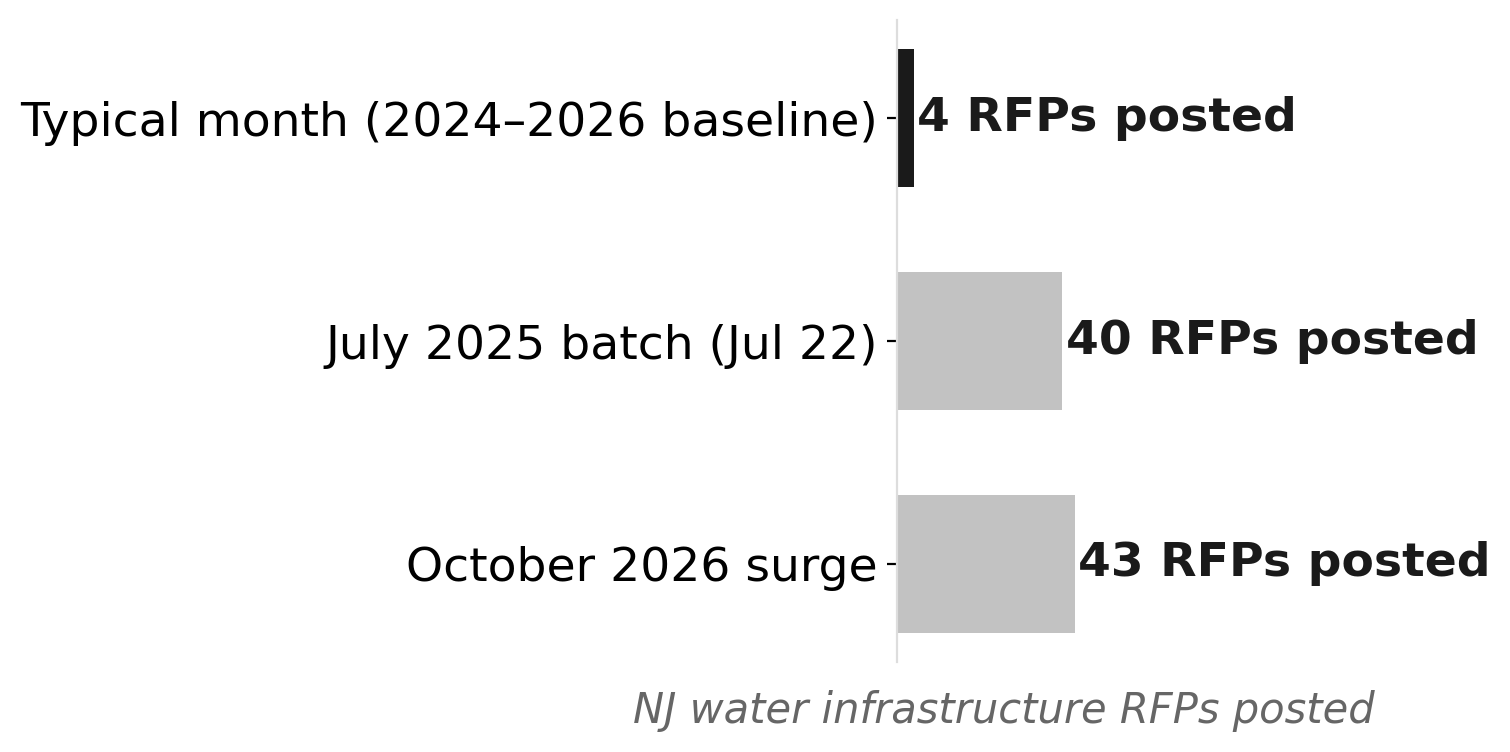
Source: NationGraph.
A parallel batch of 40 RFPs appeared on July 22, 2025, confirming that this is a semiannual procurement cycle with a recognizable shape, not a novel response to any single event. The projects in the current wave span the full range of what aging New Jersey water systems need: water main replacements, automated meter infrastructure upgrades, sewer engineering contracts, and annual engineer-of-record retainers that serve as the entry ticket to Water Bank financing.
What makes this October's wave larger than prior years is a convergence of two amplifying pressures. The first is lead service line replacement. The IIJA directed $123 million for FY26 lead service line replacement programs in New Jersey alone, and cities already mid-program, Elizabeth drew a roughly $19.9 million NJIB loan, East Orange roughly $19 million, are entering new procurement phases that require additional engineering capacity. The second is the IIJA's authorization expiration. As the NJIB's SFY2027 Water Bank report documents, the law's five-year authorization expired September 30, 2026. SRF revolving funds have longer obligation windows and existing loans continue disbursing, but FY25 and FY26 were the peak years nationally for SRF capitalization at $2.6 billion per year. Future reauthorization levels are uncertain, and municipalities that want to capture maximum principal forgiveness and low-rate financing have reason to move now rather than wait.
The NJ Infrastructure Bank model is what makes federal SRF capitalization translate so directly into municipal procurement activity. EPA block grants flow to NJDEP, which co-administers the Water Bank with NJIB. NJIB converts that federal capitalization into revolving loans to local government units, below-market rates, with principal forgiveness available for disadvantaged communities. The ~$469 million active federal water infrastructure grant portfolio currently held by New Jersey, spanning 57 grants and led by the EPA Clean Water SRF ($100.7 million) and Drinking Water SRF programs, represents the pipeline that is now driving engineering demand across the state's hundreds of small municipal utilities.
A smaller subset of October procurements reflects a separate and distinct driver: the New Jersey Water Infrastructure Protection Act. WIPA, a 2015 state statute, governs the potential sale or long-term lease of municipal water and wastewater systems to private buyers. Several municipalities, including Blairstown Township and Hopewell Borough, have initiated WIPA-related solicitations for appraisal consultants and feasibility studies, recognizing that the same capital investment gap that drives Water Bank applications also makes outright system privatization worth exploring. Mendham Township ran a WIPA procurement this fall and terminated it after drawing no buyer proposals, a signal that the privatization market is not absorbing every struggling system. WIPA procurements share search-vector overlap with the SRF-driven wave but operate under entirely different mechanics and policy logic.
For residents in the towns currently issuing RFPs, the near-term implication is straightforward: the engineering contracts being signed this fall will determine which projects get Water Bank financing for construction starting in 2027. Towns that miss the application window wait another year. Given that the IIJA's peak SRF capitalization years are now closing and future federal water funding levels depend on a reauthorization Congress has not yet passed, missing the SFY2027 cycle carries more downside than it would have in 2022 or 2023.
The next signal to watch is the NJIB's SFY2027 Intended Use Plan, expected in early 2027, which will show how many of these October procurements translated into submitted loan applications, and how much of the $276 million anticipated capitalization gets committed in the first funding round.