Nevada posted five electric vehicle-related RFPs in the past 30 days, 3.5 times its 12-month average of roughly 1.4 per month, and the timing is not an accident. On August 31, 2026, the Nevada Department of Transportation obligated $33.6 million in federal NEVI grants across five contracts, all with performance periods running through 2029. That single-day obligation triggered a procurement wave that is now visible in state solicitation data.
The backstory behind that wave is one of the more costly administrative failures in recent state infrastructure history. Nevada was awarded $38 million under the National Electric Vehicle Infrastructure Formula Program when Congress passed the Infrastructure Investment and Jobs Act in 2021. For nearly four years, NDOT failed to spend any of it. The delay had consequences: when Congress passed a federal budget bill in February 2026, it clawed back unobligated NEVI funds from states that had not submitted qualifying deployment plans. Nevada lost approximately $12.7 million, roughly a third of its entire allocation, because it had not yet moved. As Nevada Current reported, other states had moved much faster.
What finally unlocked the spending was a regulatory reset from Washington. The Federal Highway Administration issued interim final NEVI guidance on August 11, 2025, restoring spending authority to states under revised rules and requiring updated deployment plans within 30 days. Nevada submitted its revised plan and received FHWA approval on September 9, 2025. Twelve months later, NDOT converted that approval into actual grant obligations. The ~$25.3 million remaining after the February cut is now the deployable balance NDOT is working against.
Source: NationGraph.
The active solicitations reflect both the urgency and the breadth of what Nevada is trying to stand up quickly. The Nevada Department of Administration is soliciting maintenance contracts for existing EV charging stations in Carson City, with responses due October 2, 2026, a sign that the state is shoring up operational infrastructure even as it procures new capacity. The Tahoe Transportation District is separately procuring services for a mixed electric-bus fleet, drawing on a distinct federal program: the Federal Transit Administration's Low or No Emissions Bus Program, which directed $8.8 million to the Regional Transportation Commission of Washoe County in April 2026. These are complementary but separate funding streams doing different jobs, and Nevada is moving on both simultaneously.
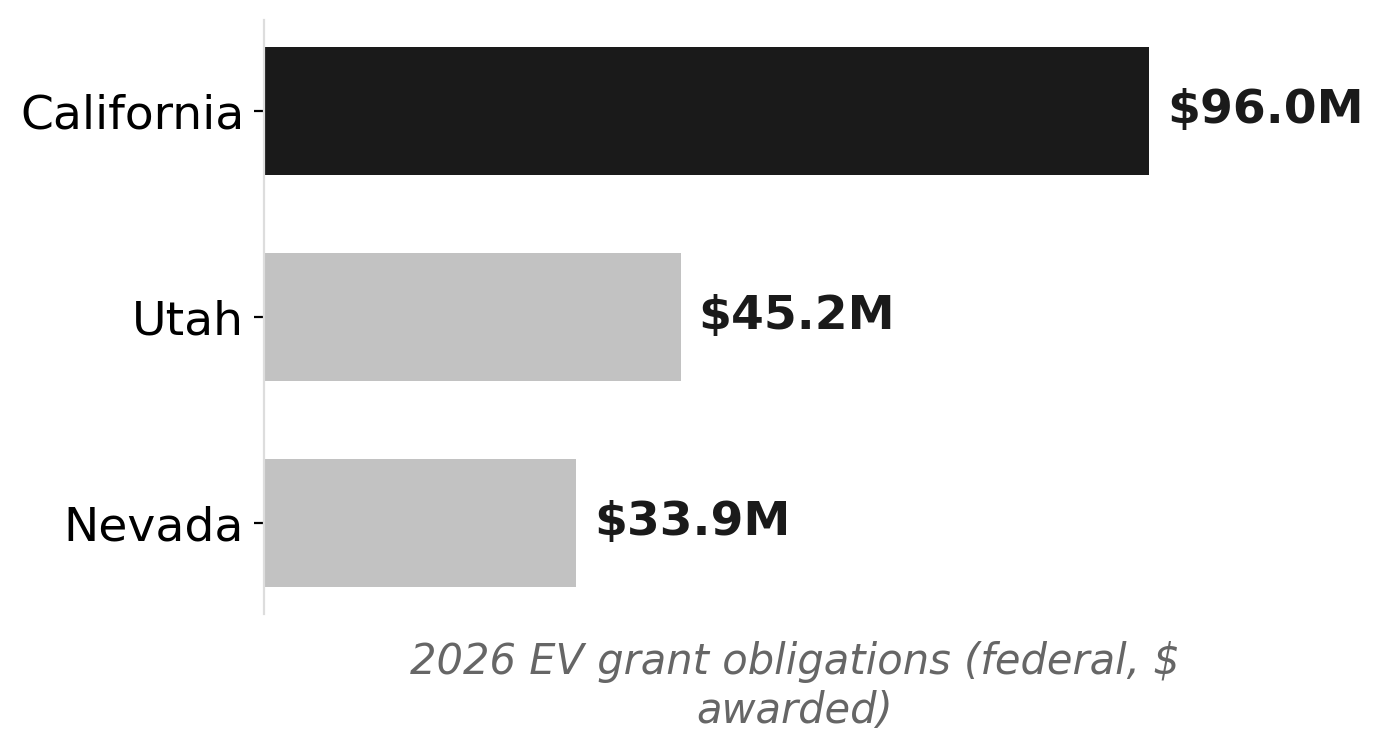
The geographic stakes make speed especially consequential. Nevada is 87 percent federally owned land, and the gaps between Las Vegas and Reno along I-15 and I-80 are among the longest charging deserts on high-traffic western corridors. NDOT's deployment plan targets I-11, I-15, I-80, and I-580 as priority corridors, routes that funnel tens of millions of vehicle-trips per year. For EV drivers, the difference between a corridor with chargers and one without is not inconvenience; it is a hard barrier to travel. Nevada ranks third among western states in 2026 EV grant obligations at $33.9 million, behind California's $96 million and Utah's $45.2 million, but it has historically been among the slowest to translate obligations into hardware in the ground.
One persistent bottleneck may be easing, at least on paper. The Nevada Public Utilities Commission issued a ruling in late 2025 requiring NV Energy to track and report grid-connection timelines for EV charger installations starting in January 2026, the first such mandate of its kind in the country. Slow utility interconnection has historically delayed charger deployments after procurement is complete. The PUC rule does not fund projects, but it creates accountability data that did not previously exist, which could accelerate execution once the current wave of contracts is awarded.
The overriding political pressure, though, is coming from the federal level. The Trump administration's FY2027 budget proposal, released in April 2026, called for canceling all remaining unobligated NEVI and Clean Fuels Initiative funds nationwide. The proposal has not been enacted, but it is not theoretical either: Nevada already lost $12.7 million under a previous round of the same logic. States that delay are exposed; states that have obligated funds and can demonstrate active procurement are on stronger footing. The August 31 obligation and the September RFP surge are, in part, Nevada's answer to that threat.
Whether the state can actually convert this procurement sprint into chargers on the ground before the next budget cycle is the open question. The five new NEVI grants run through 2029, which gives NDOT runway, but the February 2026 cuts demonstrated that runway can be shortened without warning. The next signal to watch is whether the October 2 solicitation deadline produces qualified bidders and whether NDOT can move from award to construction faster than it moved from allocation to plan submission.