Lead contamination has been confirmed in the drinking water at four of Lyndhurst, New Jersey's nine school buildings, including Jefferson Elementary, putting the Bergen County district's roughly 2,300 students at the center of a growing problem with aging school plumbing statewide.
Testing conducted in late November and early December 2024 covered all nine district buildings. Four of them, Jefferson, Columbus, Washington and Lyndhurst High School, subsequently received exceedance notifications on Feb. 28, 2025, confirming that at least one water outlet in each building tested above New Jersey's 5 parts per billion (ppb) lead action level. The Jefferson School water testing results are among the documents the district has posted publicly.
The findings reflect a collision between infrastructure age and a rule that got much tougher in 2020. New Jersey lowered its school lead action level from 15 ppb to 5 ppb under Governor Phil Murphy, quadrupling the sensitivity of the standard and making it one of the strictest in the country. Most of Lyndhurst's school buildings date to the early and mid-20th century, when lead solder, brass fixtures and in some cases lead service lines were standard construction materials. The water supply itself, delivered by the Passaic Valley Water Commission, arrives lead-free. The problem emerges as water sits in aging interior plumbing overnight, over weekends or during the long breaks that are a defining feature of the school calendar.
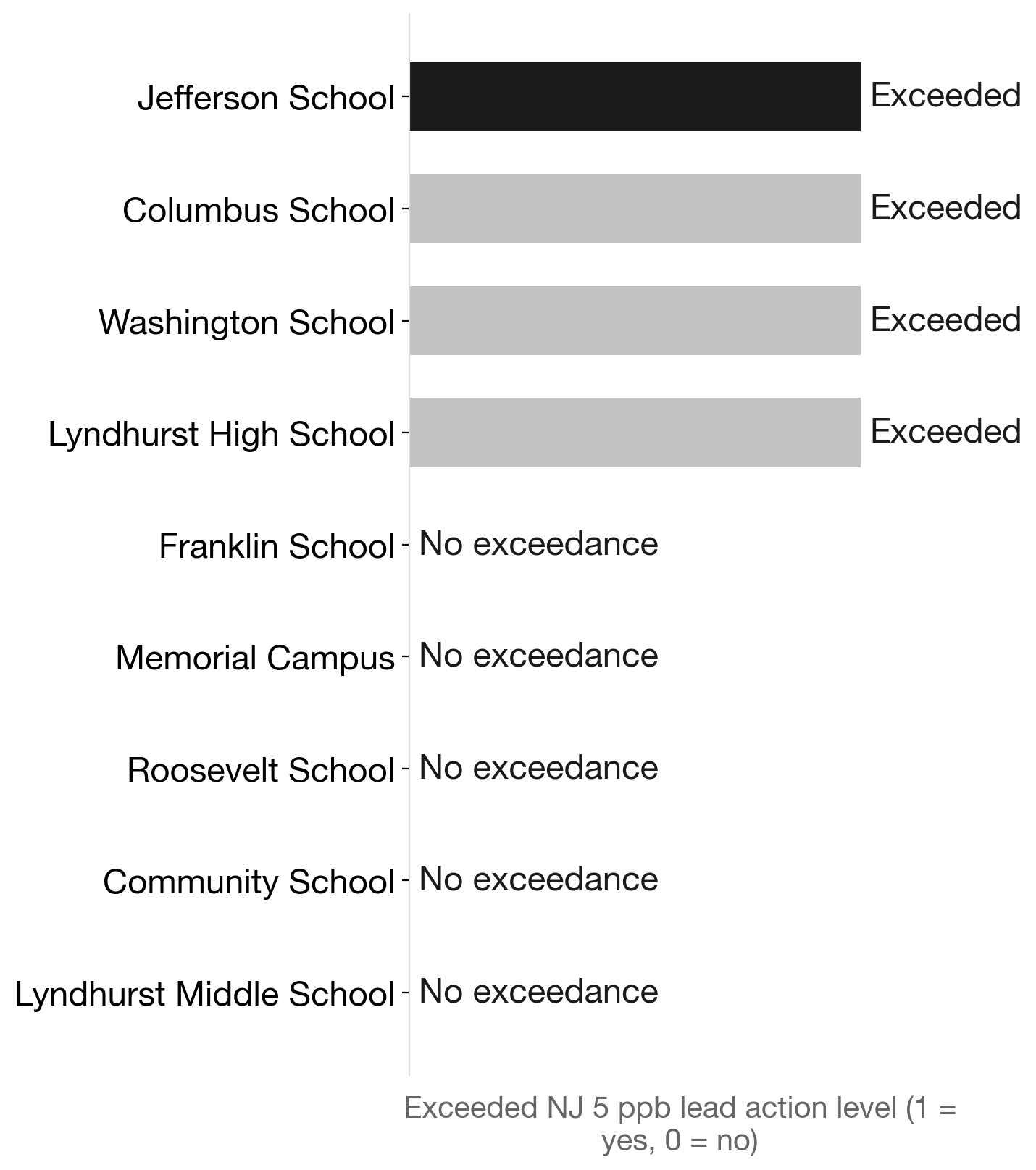
Source: NationGraph.
New Jersey's school testing mandate traces back to the Flint, Michigan water crisis and the 2016 Newark school scandal, when elevated lead forced the shutdown of drinking fountains at 30 schools. The state adopted mandatory three-year testing cycles for all public school water outlets that same year, and subsequent waves of tighter rules have since caught districts, many of them previously considered clean, that older standards would have passed.
For Lyndhurst, a working- and middle-class township of about 22,000, fixing the problem is a capital expense, not a routine budget line. Replacing lead-bearing plumbing fixtures and service lines requires the kind of facilities investment the district has been weighing for years; a 2019 referendum presentation on capital planning shows the conversation predates the current testing cycle. Under state rules, exceedances trigger mandatory remediation of affected outlets, parent notification and re-testing to confirm the fix worked.
The district has not publicly announced a timeline or cost estimate for the required repairs. Parents in the four affected schools are entitled to notification under state law, and affected outlets must be taken out of service until remediation and confirmatory testing are complete.