New York State is expanding a program that sends mental health professionals to psychiatric emergencies instead of police, deepening a shift in crisis response that began after Daniel Prude died in Rochester, N.Y., in March 2020 following a police encounter during a psychotic episode.
The state Office of Mental Health has posted a second round of Health-Led Community Behavioral Health Crisis Response pilots, building on a first cohort launched in 2023. The program deploys teams of clinicians, paramedics and peer support workers to answer 911 calls flagged as behavioral health emergencies, with no police involvement. That distinction matters to advocates who have criticized "co-response" models, where officers and clinicians arrive together, as still routing mental health crises through the criminal justice system.
The pilots are part of Governor Kathy Hochul's commitment of roughly $1 billion over multiple years to rebuild New York's psychiatric infrastructure, announced in the FY2024 state budget. They also slot into the national framework built around the 988 Suicide and Crisis Lifeline, which launched in July 2022 and requires states to develop not just a phone line but mobile teams capable of responding in person.
Source: NationGraph.
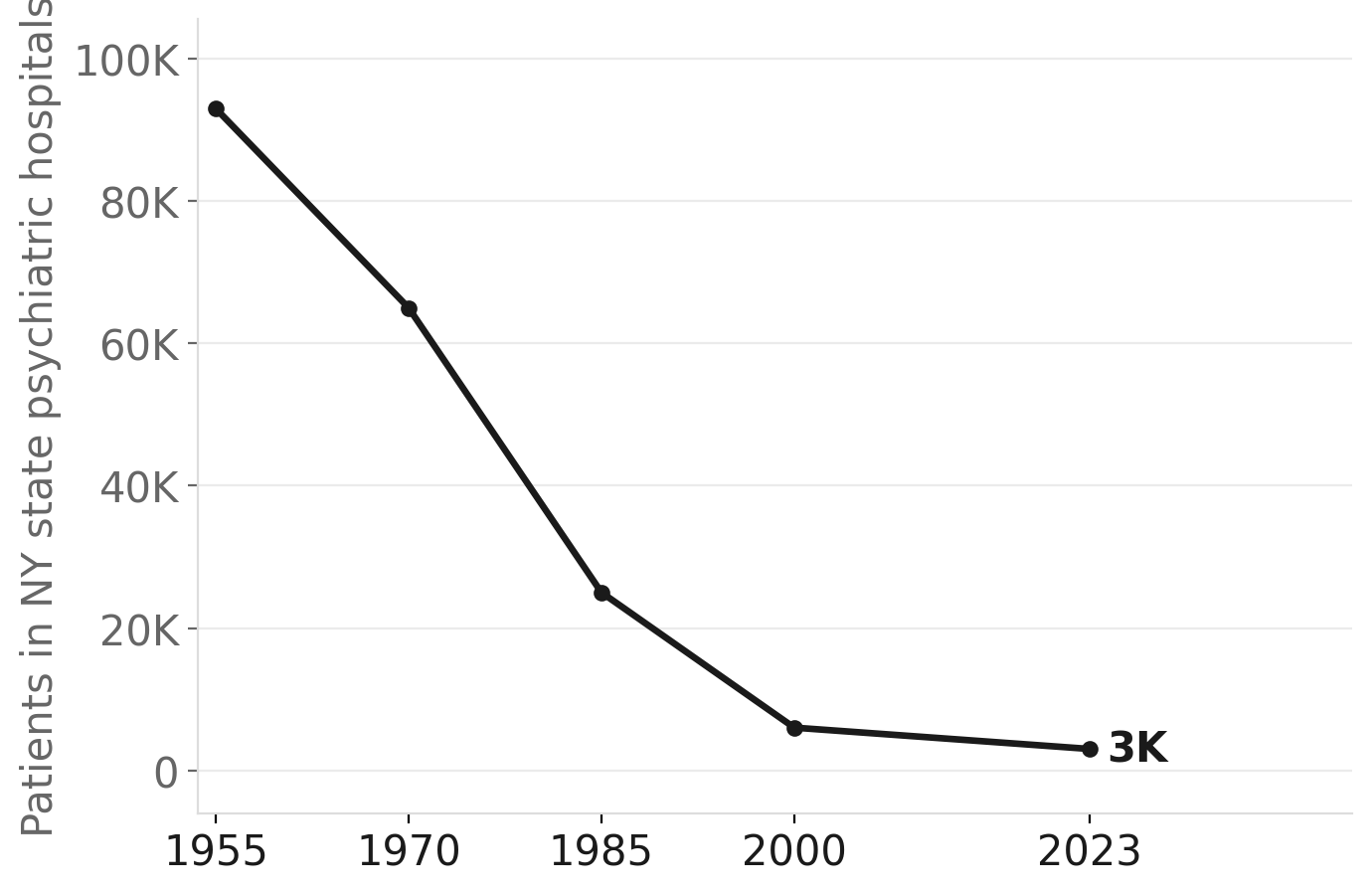
New York faces a particular challenge in building that capacity. Decades of deinstitutionalization gutted the state's inpatient system, dropping the census at state psychiatric hospitals from roughly 93,000 in the 1950s to under 3,000 today, without a corresponding buildup of community-based care. Rural counties upstate often have no mobile crisis teams at all, leaving sheriff's deputies as the default responder. The new pilot round could help address that gap.
The Prude case, made public in September 2020, converged with the national reckoning over policing following George Floyd's death and drew attention to alternatives like Eugene, Ore.'s long-running CAHOOTS model and Denver's STAR program. New York City launched its own pilot, B-HEARD, in Harlem in 2021, though early reviews found it reached only a small fraction of eligible calls and still frequently involved police.
The expansion comes with a notable political tension. Hochul has simultaneously pushed to loosen the standards for involuntary psychiatric hospitalization under Kendra's Law and increased police presence in the subway system, moves that sit uneasily alongside the voluntary, health-led philosophy underlying these pilots. The state is, in effect, running both experiments at once.
Specific funding amounts and the number of sites to be selected under Round 2 were not detailed in publicly available materials. Providers and localities interested in running pilots will learn more through the application process now underway.