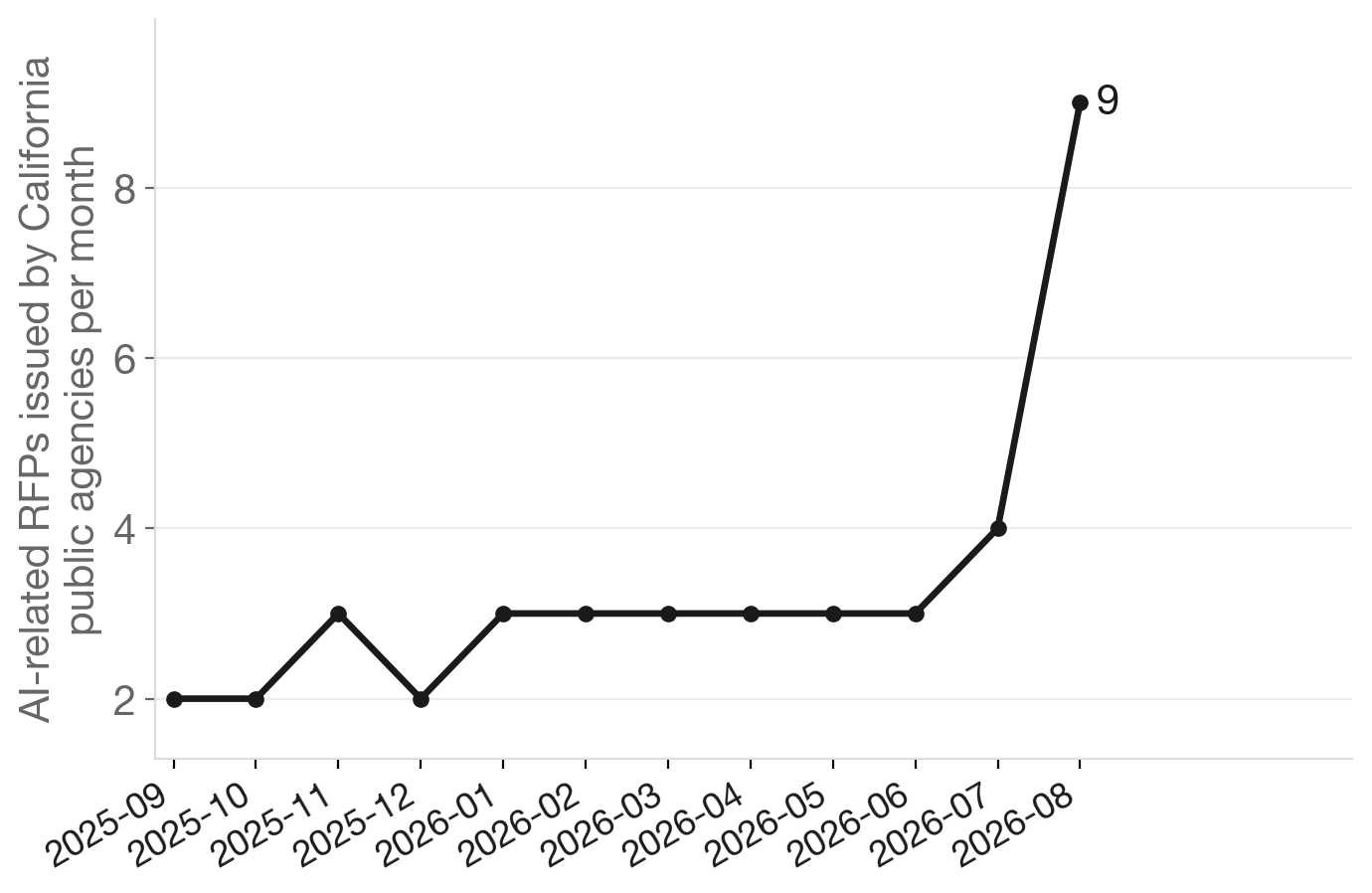
California issued nine AI-related RFPs in the 30 days ending August 27, 2026, 3.2 times the trailing 12-month average of 2.8 per month. The surge spans sewer systems, police precincts, building-permit counters, and housing authorities, and it did not begin until the last week of July. That timing is not coincidental.
On July 28, 2026, a 120-day compliance clock set by Governor Newsom's Executive Order N-5-26 expired. Signed March 30, the order directed the California Department of Technology and the Department of General Services to publish new AI vendor certification requirements and to expand employee access to vetted generative AI tools, all within that window. Agencies that had been holding procurement decisions pending the new rules now had what they needed to move. The RFPs that followed are the compliance deadline made visible.
The breadth of the current cohort is what distinguishes it from earlier activity. A 2025 spike, which peaked at 17 RFPs in July of that year, was largely driven by education institutions and a large CalSTRS investment-analytics project. The 2026 cohort reads differently: the Alameda City Housing Authority is soliciting AI governance policy consulting; the Los Angeles Department of Building and Safety wants an AI-powered permit-check assistant; the Sanitation Districts of Los Angeles County issued an AI/ML solicitation for sewer-pipe analysis; and the San Diego Police Department is procuring an AI report-writing tool. These are operational agencies solving operational problems inside a framework that, two months ago, did not yet exist in certified form.
Source: NationGraph.
Legal analysts watching the order noted at the time that California was, as Pillsbury Law described it, 'using the power of the buyer, not only the power of the legislator', a procurement-first approach that can move faster than broad legislation. That calculation is now showing up in solicitation documents. The certification standards CDT and DGS have set for vendors bidding on California contracts will travel with those vendors into other markets, effectively making California's rules a commercial baseline the private sector must meet regardless of where it operates. Thirty-three of the world's top 50 privately held AI companies are headquartered in California, according to the Governor's office, which makes the self-referential quality of this moment unusual: the state is simultaneously the country's largest AI procurement market and the home of the companies it is now certifying.
The EO did not arrive in isolation. The Transparency in Frontier AI Act, which took effect January 1, 2026, already required large AI developers to publish transparency frameworks and submit risk assessments to the state. A second Newsom executive order signed May 21 added workforce-disruption requirements, described by the Governor's office as first-in-the-nation. Together, these instruments give California the densest state-level AI regulatory stack in the country, and they are now functioning as a procurement trigger rather than a compliance burden.
No other state is close in volume. California's nine RFPs in this window compare to three in Colorado, two in Texas, and one in Virginia. Federal research dollars flowing to California institutions provide some backdrop for why state agencies feel ready to act: NSF alone carries $243 million obligated across 201 active grants to California universities, with HHS adding another $532 million across 140 grants. Agencies are not building AI literacy from scratch; they are beginning to operationalize a research infrastructure that has existed for years.
The cascade is also reaching smaller jurisdictions. Meeting minutes from the Nevada Irrigation District in Grass Valley, dated August 26, show the utility drafting a formal AI governance policy citing cybersecurity, data privacy, and ethical-use risks, a signal that EO N-5-26's downstream pressure is visible well below the state-agency tier.
For residents and vendors, the immediate consequence is a procurement market that is moving quickly and setting terms that are unlikely to soften. Vendors who cannot meet CDT's certification requirements will not be eligible for California contracts, and given the state's market size, that exclusion carries commercial weight beyond Sacramento. For residents, the near-term question is delivery: whether AI-assisted permit approvals, report writing, and infrastructure monitoring perform as promised is something that will be legible in agency performance data within 12 to 18 months of these contracts being awarded.
The next signal to watch is whether CDT publishes its vendor certification registry on schedule and how many vendors clear the initial threshold. If the list is short, agencies holding open RFPs will face a constrained field. If it is broad, the current wave of solicitations may be only the first cohort of a much larger cycle.