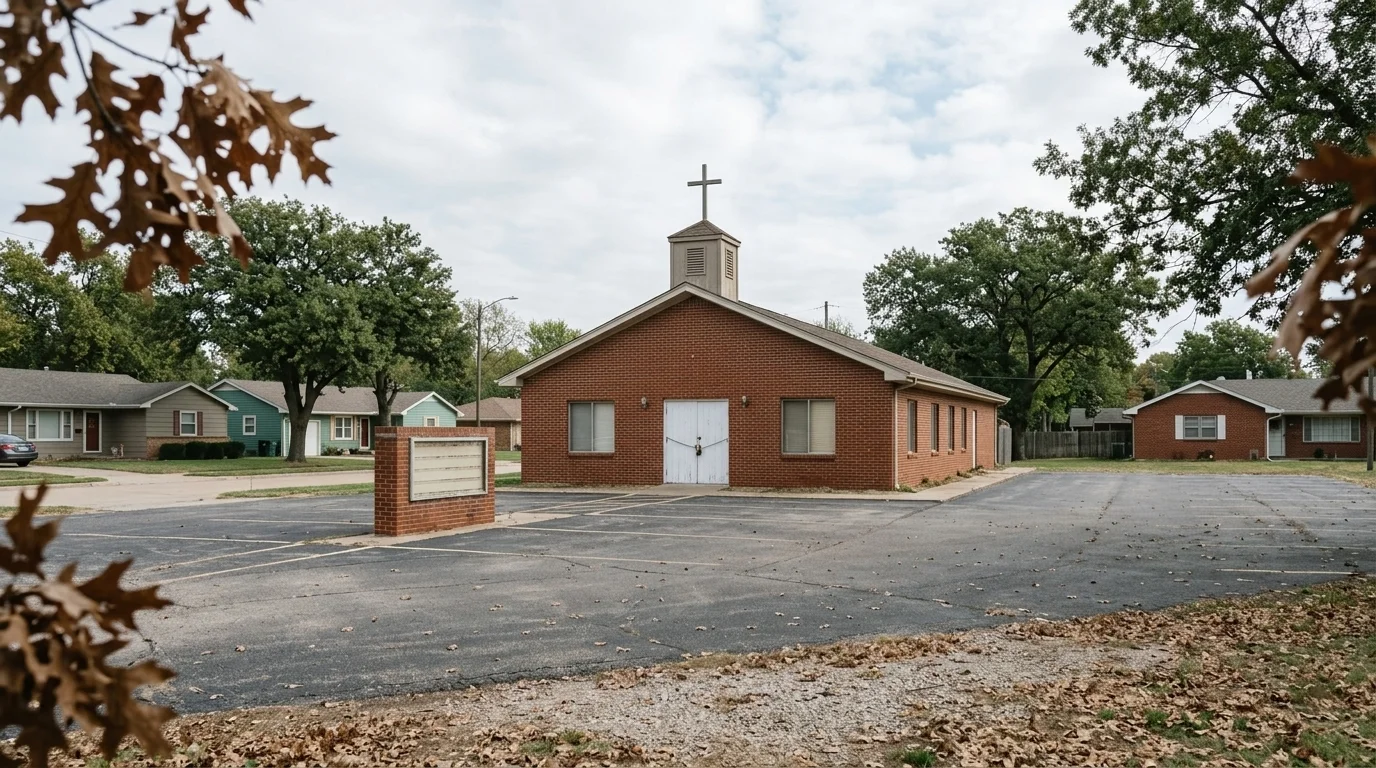
Bloomington, Minn., is turning a shuttered Lutheran church into new homes, betting that duplexes and townhouses can fill a gap that decades of single-family zoning left behind.
The city's Housing and Redevelopment Authority already owns the former St. Mark's Church property at 8630 Xerxes Avenue South, a nearly 4-acre parcel near 83rd Street that the congregation vacated amid the broader wave of mainline Protestant church closures that has accelerated since COVID. Now the HRA is hiring engineers to lay the groundwork for new owner-occupied housing, ranging from single-family homes to so-called missing-middle types like duplexes, fourplexes and townhouses. The civil engineering services solicitation was posted Aug. 6.
The term "missing middle" describes the housing types that were common in American neighborhoods before World War II but were largely zoned out of existence in the postwar suburban buildout. Bloomington, a first-ring suburb of about 90,000 people that took shape mostly between 1950 and 1970, is a textbook example: roughly 60% of its residential land is zoned exclusively for single-family homes. With the city largely built out, nearly all new housing has to come from infill and redevelopment rather than vacant land.
The HRA's decision to purchase the St. Mark's site outright, rather than waiting for a private developer, signals that the city wants direct control over what gets built and at what scale. The owner-occupied framing is a deliberate choice, too, designed to appeal to neighbors in the surrounding single-family area while still adding more units than a conventional subdivision would.
Median home prices in Bloomington have climbed above $370,000, and the city's 2040 Comprehensive Plan explicitly commits it to expanding missing-middle housing options. The HRA is among the more active in the Twin Cities suburbs, with dedicated levy authority that makes acquisitions like this one possible. The agency has also recently put 70 state-funded rental vouchers to work for low-income families as part of a broader push on affordability.
How many homes ultimately get built on the Xerxes site, and what mix of types, will depend on the engineering and site planning work now getting underway. That process will also be an early test of how much density the surrounding neighborhood will absorb without the political backlash that has derailed similar proposals elsewhere in the metro.