Torbay, Newfoundland and Labrador is moving to remove toxic PFAS chemicals from its municipal drinking water supply, joining a growing list of small Canadian communities forced to confront contamination that researchers have linked to cancer, thyroid disease and developmental harm in children.
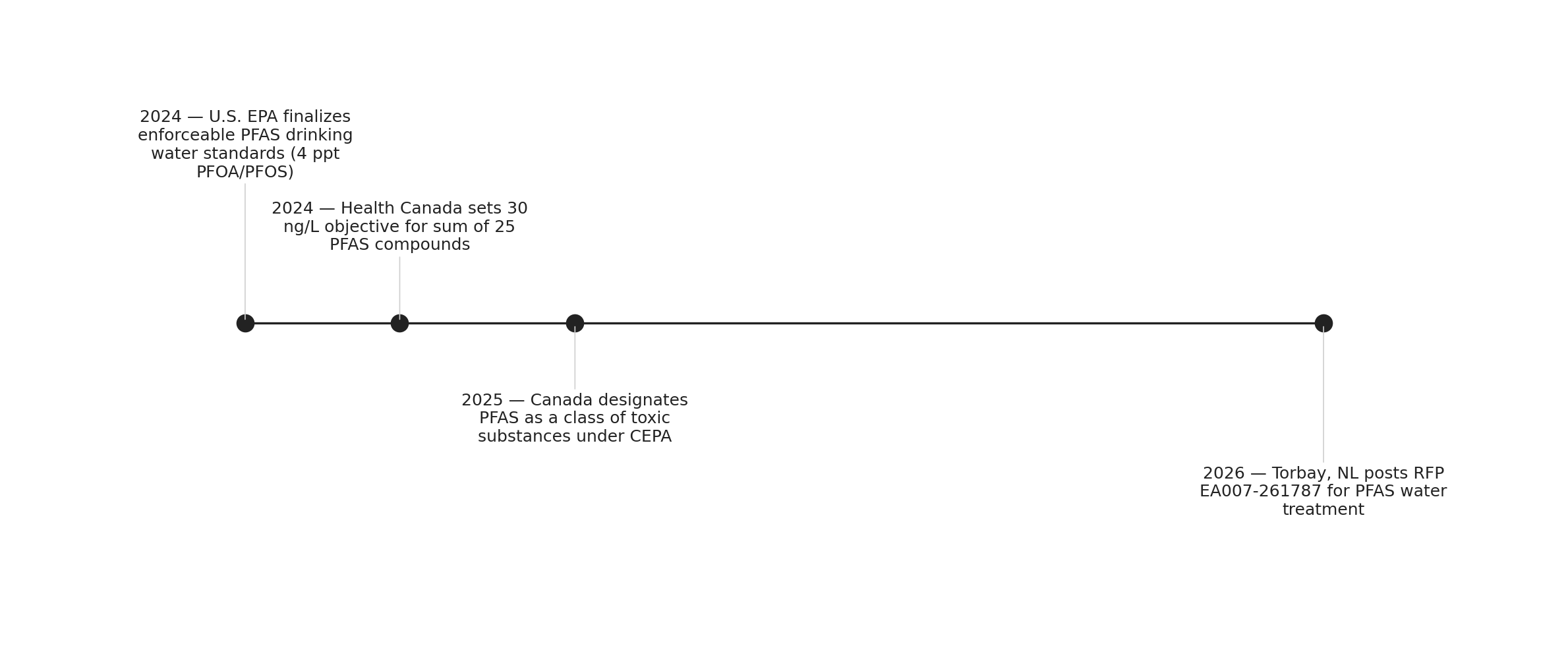
The town of roughly 8,000 people, situated immediately north of St. John's International Airport on the Avalon Peninsula, has posted a procurement through the federal CanadaBuys platform seeking a contractor to install water treatment infrastructure. The federal posting suggests cost-sharing with Ottawa, which matters for a bedroom community without the tax base to absorb what can be multi-million-dollar treatment systems on its own.
PFAS, short for per- and polyfluoroalkyl substances, are a class of thousands of synthetic chemicals used for decades in non-stick cookware, waterproof fabrics, food packaging and, above all, the aqueous film-forming foam sprayed at airport and military fire training sites. They earn the nickname "forever chemicals" because they do not break down in the environment or the human body. Torbay's proximity to St. John's Airport, a major historical user of firefighting foam, makes that source a likely culprit, though the town has not publicly confirmed where its contamination originated or how long it has been present.
Source: NationGraph.
The procurement follows Health Canada's August 2024 decision to tighten its drinking water objective to 30 nanograms per litre across 25 PFAS compounds, a significant tightening of earlier single-compound guidelines. Canada also designated PFAS as a class of toxic substances under the Canadian Environmental Protection Act in 2024-2025. Other Newfoundland communities near airports and military sites, including Gander and Happy Valley-Goose Bay, have faced similar scrutiny as provinces ramp up testing.
Treatment options typically include granular activated carbon filters, ion exchange resin systems or reverse osmosis, none of which come cheap for small municipalities. Torbay's situation previews what dozens of similar communities across Atlantic Canada will face in coming years as federal standards tighten and testing expands.
Residents are still waiting for answers on how elevated their exposure has been and for how long. The contractor selection process is now underway.