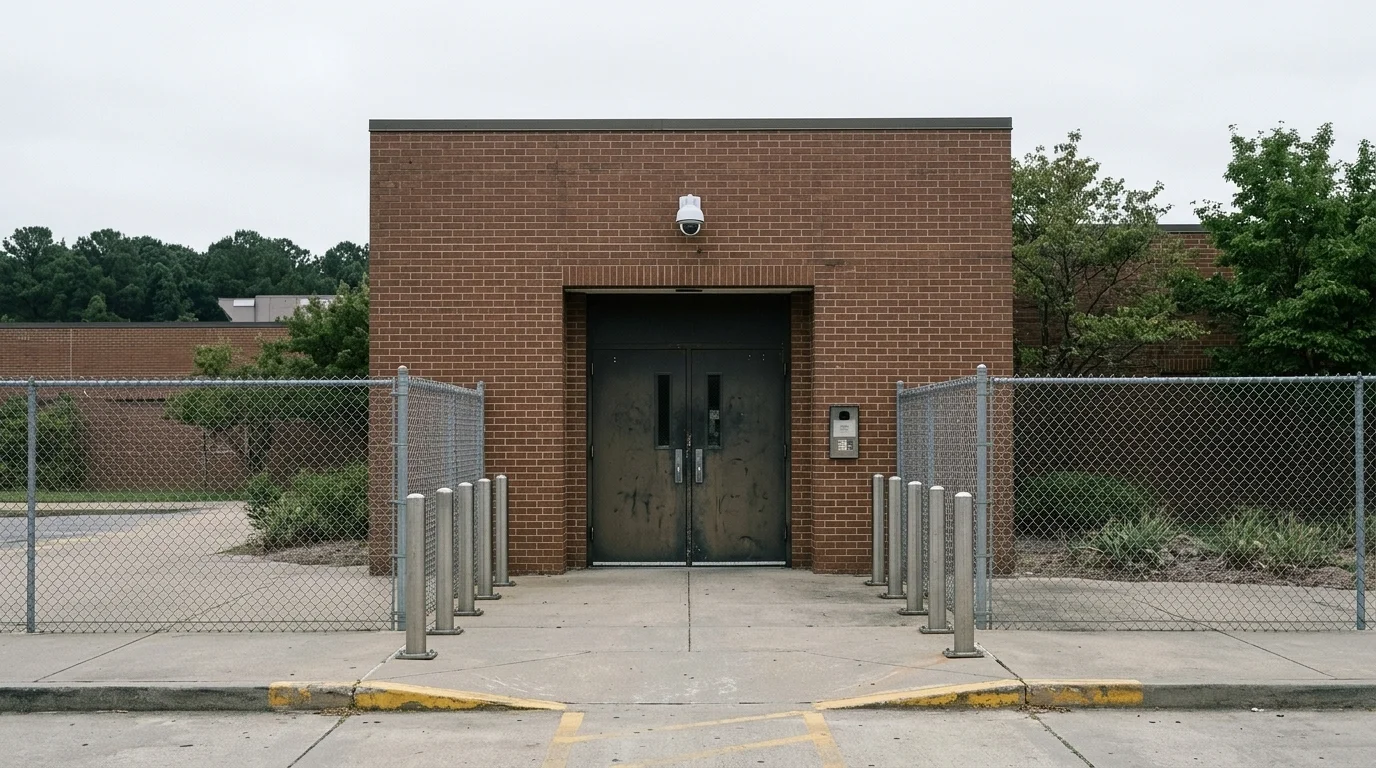
North Carolina school districts have filed 18 school safety procurement bids in the last 30 days, against a monthly average of roughly 2.4, a 7.4-fold spike that traces directly to a single budget event: Governor Josh Stein signed the state's $34.4 billion FY2026-27 budget on July 7, 2026, activating a $30 million nonrecurring School Safety Grants program administered by the NC State Bureau of Investigation's Center for Safer Schools (CFSS). Districts that want a share of that money know what's at stake: in the prior grant cycle, the CFSS received nearly $88 million in applications against only $30 million available. That 2.9-to-1 oversubscription rate is why 13 agencies across 11 counties are filing procurement bids now.
The CFSS competitive application process rewards districts that can demonstrate project readiness. Filing a formal RFP for security cameras, exterior locks, fencing, metal detectors, or weapons-detection systems signals to the grant committee that a district has done the planning work and can execute quickly. This creates a rational incentive to move early in the fiscal year, roughly 90 days after the July budget signing, when grant cycles typically open. The procurement surge is wide rather than concentrated: Wake County Public Schools and Guilford County Schools each submitted three bids, Chapel Hill-Carrboro submitted two, and rural and mid-size districts in Swain, Pender, Cleveland, and Chatham counties also appear in the 30-day window. The pattern suggests a statewide mobilization, not a few large urban systems dominating the queue.
The urgency is not manufactured. NC school violence rose 9.3 percent between the 2021-22 and 2023-24 school years, according to state budget office data. Bomb threats and hoaxes climbed 80.8 percent over the same period. Those figures were central to Governor Stein's budget argument, and they explain why this grant program is oversubscribed by so wide a margin even before the current application window closes.
The $30 million equipment grant and a separate $63 million School Resource Officer appropriation share an administrator at the CFSS but fund different things. The equipment grant covers physical security infrastructure and student crisis services; the SRO program funds 535 sworn officer positions at middle and elementary schools. A district can pursue one without the other, and the current procurement spike is most directly tied to the equipment cycle, where project documentation, vendors selected, scopes defined, costs estimated, matters for scoring. The CFSS itself was reorganized in December 2024, moving from the NC Department of Public Instruction to the SBI under Senate Bill 382, centralizing school safety grant administration under law enforcement rather than the education agency.
Three North Carolina districts are also receiving supplementary federal support through the DOJ's School Violence Prevention Program: Edenton-Chowan Schools ($499,000), Burke County Schools ($469,000), and Yadkin County Schools ($341,000). Those federal grants are a separate layer and are not driving the October procurement spike, but they illustrate that some districts are stacking funding sources wherever the competitive landscape allows.
North Carolina is not alone in this posture. South Carolina recorded the same 18-RFP volume in the same 30-day window, shortly after its governor announced a $40 million school safety grant program of its own. When two neighboring states deploy comparable appropriations in the same fiscal year, the downstream procurement behavior mirrors as well. The regional dynamic suggests that state-level safety grant programs, more than any single incident, are the proximate engine of what looks like a sudden surge in school security spending across the Southeast.
For the 115 public school districts in North Carolina, the competitive math is straightforward and unforgiving. The state has signaled it will fund roughly one dollar for every three requested. A district that arrives at the CFSS application window without a completed procurement process, vendor quotes, or a defined scope is effectively conceding ground to districts that have done that work. The 18 bids filed in the last 30 days represent districts that have read that math correctly.
Senate Bill 782, the Safe Schools Transparency Act introduced in April 2026, would create an additional $25 million School Safety Fund as a separate statute, but it has not yet been enacted. If it clears the legislature, a second competitive cycle could open within the same fiscal year, extending the procurement pressure further into 2027. The next signal to watch is CFSS's award announcement from the current grant cycle: when that list publishes, the gap between what districts requested and what the state can pay will become concrete, and the districts left out will begin preparing their next application immediately.