Boston is moving to keep its universal pre-K promise intact by contracting with neighborhood daycares, Head Start centers, and nonprofits to provide publicly funded seats for four-year-olds across the city, a strategy that city leaders say is essential for reaching the families who need it most.
The city's Universal Pre-K program currently serves roughly 4,000 to 5,000 children per year through a mixed-delivery model that pairs Boston Public Schools classrooms with seats at community-based organizations. That model was designed from the start to extend pre-K beyond what BPS buildings could hold, while also preserving a network of neighborhood providers that disproportionately serve Latino families, immigrant households, and children whose first language isn't English. More than half of BPS students are Latino, and nearly half speak a language other than English at home.
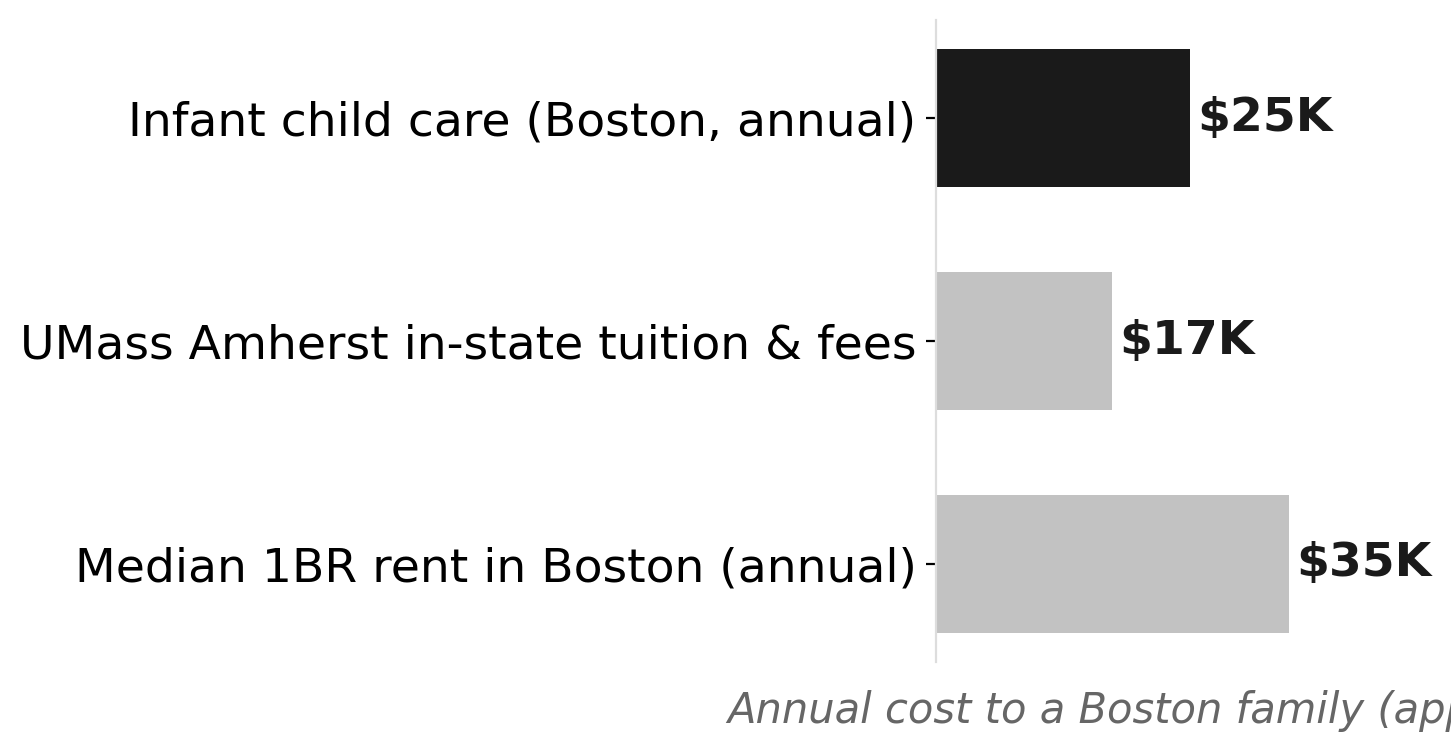
The stakes for those families are high. Boston is one of the most expensive cities in the country for child care, with infant care alone often topping $25,000 a year. Publicly subsidized pre-K is one of the few meaningful affordability levers available to working parents.
Source: NationGraph.
But the financial scaffolding holding the system together is shifting. Federal pandemic relief money is winding down, and community-based providers have grown increasingly dependent on state stabilization grants to stay afloat. A persistent workforce crisis compounds the pressure: teachers at nonprofit and daycare providers earn significantly less than their BPS counterparts, driving turnover and making it harder to maintain quality. The city is now contracting with providers at a moment when costs, particularly teacher wages moving toward BPS parity, are climbing.
Boston first committed to universal pre-K access under Mayor Martin Walsh in 2014 and declared the goal achieved for four-year-olds in 2022 under Mayor Michelle Wu. But advocates and reporters have raised questions about waitlists in some neighborhoods and uneven quality across the system. The community-based sector is a critical part of the answer, offering full-day, full-year care that working parents need, unlike the shorter BPS school day.
The city has posted the solicitation on its bid listings portal. The contract value, per-child reimbursement rate, and total seat count have not been publicly disclosed. Which providers are selected, and how many seats they can ultimately deliver, will be the clearest test yet of whether Boston's mixed-delivery model can hold together as the funding landscape tightens.