California's local governments issued 136 homelessness-related procurement requests in the last 30 days, against a monthly baseline of roughly 35, a 290 percent surge concentrated in October 2026, when the state logged 148 RFPs in a single calendar month, the highest single-month count in at least 14 months of data. The cause is not a sudden crisis of conscience. It is a deadline.
The California Department of Housing and Community Development released the HHAP Round 7 Notice of Funding Availability on August 7, 2026, making $829.35 million in regional allocations available from September 1 under AB 179, signed by Governor Newsom on July 13. At $900 million total from the state General Fund, Round 7 is 78 percent larger than the $500 million Round 6 baseline, the largest single HHAP appropriation yet. When HCD published preliminary allocations in September, local governments had their numbers. October became the month they converted those allocations into contracts.
But HHAP Round 7 is not simply more money. AB 179 attached a set of conditions that have no precedent in earlier rounds: cities must provide local matching funds, demonstrate they have obligated at least 50 percent of their Round 6 disbursements, comply with CalICH encampment-addressing guidance, and maintain a compliant housing element. What was a relatively formulaic grant has become something closer to a performance contract. Jurisdictions issuing RFPs right now are not just spending money, they are demonstrating eligibility to spend it.
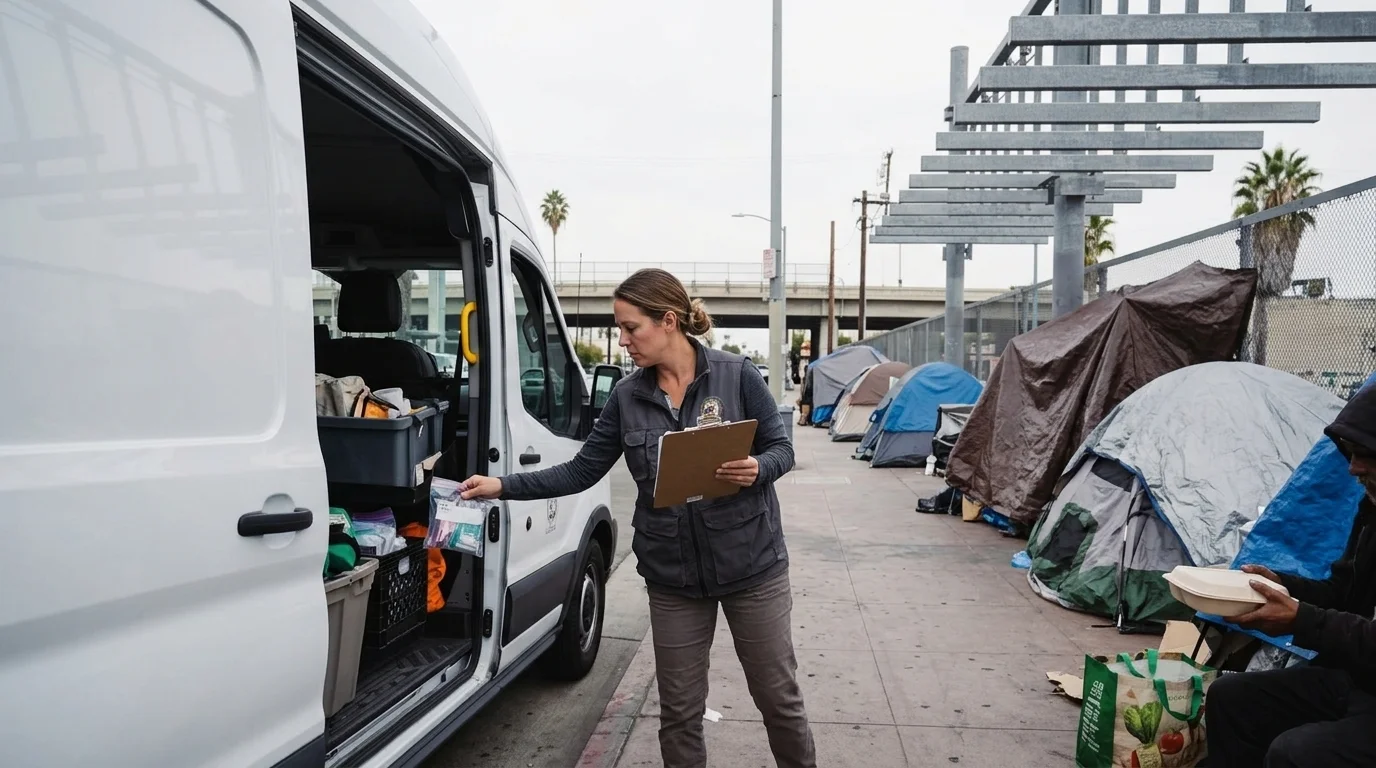
The geographic spread of October's procurement wave reflects that pressure operating statewide. Los Angeles County leads with 25 RFPs in the trailing 30-day window, followed by San Joaquin with 8, San Bernardino and Alameda with 7 each, and Sacramento, Marin, Santa Clara, and San Diego each with 6. At least 15 distinct counties are represented. The procurement types span the full HHAP-eligible spectrum: shelter operations, mobile outreach, encampment cleanup, permanent supportive housing property management, behavioral health rental subsidies, homelessness data software, and direct HHAP pass-through subcontracting. This is not a single program being implemented, it is an entire service delivery system being rebuilt on a compressed schedule.
The October spike also sits on top of an already-substantial funding base. California's active homelessness grant portfolio, excluding Section 8 housing vouchers, tops $2.1 billion across HUD Continuum of Care, HHS PATH, the Strategic Growth Council, and other programs. HHAP Round 7 adds to that stack, not under it. California also secured a legal victory in April 2026 blocking a Trump administration attempt to redirect HUD CoC funds from permanent housing toward temporary shelters, a ruling that cleared a major source of planning uncertainty and allowed local governments to finalize their HHAP budgets with greater confidence about the federal floor beneath them. That court win did not trigger the October procurement surge, but it removed a reason to wait.
The same is true of the California Housing and Homelessness Agency, which launched July 1, 2026 as a new cabinet-level body consolidating HCD, CalHFA, and CalICH. The CHHA reorganization created institutional pressure to show early results, but it appropriated no new funds and is not mechanically linked to HHAP eligibility. The procurement wave belongs to AB 179 and its compliance clock.
The political stakes around that clock are visible. At an October 30 summit in Riverside convened by the California Big City Mayors coalition, San Jose Mayor Matt Mahan said publicly that cities cannot build long-term solutions on year-to-year funding commitments. The coalition, 13 cities representing roughly 11 million Californians, called for a guaranteed $1 billion or more annually going forward, framing HHAP Round 7 as a floor rather than a ceiling. The urgency in October's RFP numbers is partly a function of that anxiety: local governments are obligating funds quickly in part because they cannot assume Round 8 will arrive on the same scale.
An additional accountability layer is now enrolled in state law. The California Housing Justice Act (AB 1165), enrolled September 1, 2026, requires the new CHHA to develop finance plans targeting an end to homelessness by 2030, with annual performance metrics published publicly. That means the contracts being issued this month will be tracked against outcome targets in ways that earlier HHAP rounds were not. Jurisdictions that spend fast but spend poorly will face a harder case for future allocations under the LAO's recommended accountability framework.
For residents in the 15-plus counties now procuring, the near-term visible change is activity: more shelter capacity bids, more outreach vehicle contracts, more encampment service agreements moving through local approval processes over the next 90 days. The longer-term question is whether the compliance architecture built into AB 179 produces durable outcomes or just faster spending.
The next signal to watch is HCD's final allocation letters, expected before the end of 2026. Jurisdictions that cannot demonstrate Round 6 obligation rates or housing element compliance by that point may see their Round 7 allocations reduced or delayed, which would make October's procurement rush look, in retrospect, like either very good timing or a very close call.