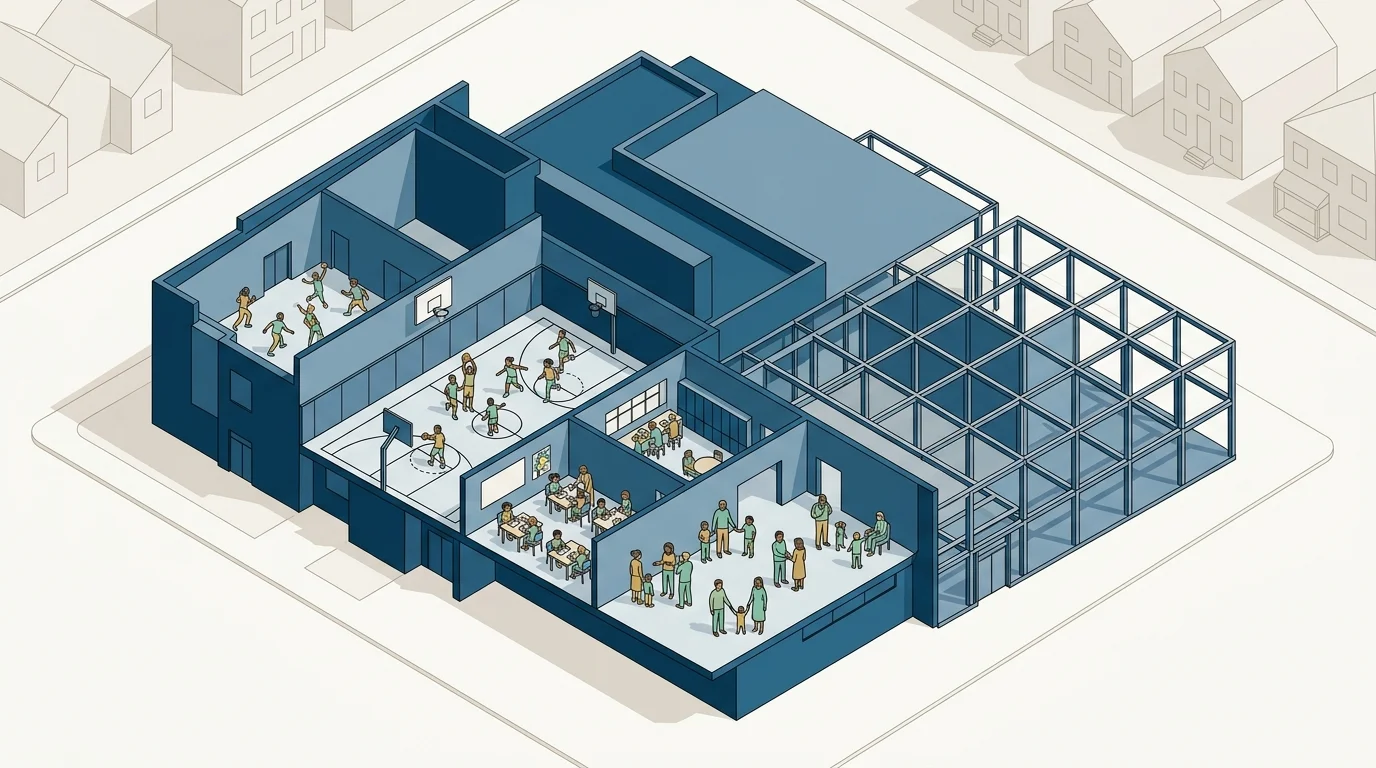
Madison, Wisconsin is moving to expand one of its busiest community recreation hubs, with the Madison Metropolitan School District seeking a contractor to enlarge the West Recreation Center on the city's west side.
The center is run by Madison School Community Recreation (MSCR), a school-district-operated program dating to 1926 that functions as the city's primary public recreation network, offering after-school programs, summer camps, youth enrichment, and community activities out of school buildings and dedicated centers across Madison. The west side location serves some of the most heavily used programming in the system, drawing families from neighborhoods like Allied Drive that are home to large Hmong, Latino, and East African immigrant and refugee communities.
The project is an expansion, meaning new square footage rather than just repairs, which suggests the district sees demand outpacing what the current facility can accommodate. Madison's west side has been one of the city's fastest-growing areas over the past decade, adding residential density and a more diverse population in corridors that have historically had fewer recreational amenities per capita than the isthmus and near-east neighborhoods.
The timing comes after years of community pressure and political action around MMSD's aging facilities. Voters approved a $317 million capital referendum in November 2020, the largest in district history, followed by additional referenda in 2024, to address a sprawling backlog of deferred maintenance and building upgrades across the district. The West Recreation Center expansion appears to be part of that broader push, though the specific budget and timeline for this project have not been disclosed publicly.
MSCR's role grew more visible during the pandemic, when recreation centers served as food distribution points and youth programming anchors during school closures, renewing public attention to how much lower-income communities depend on the facilities. There has also been ongoing scrutiny in Madison over whether referendum dollars are reaching the neighborhoods that need them most, making the west side expansion a concrete measure of that commitment.
The district is seeking bids through its procurement portal. A contractor has not yet been selected, and construction has not been scheduled.