William P. Hobby Airport in Houston, Texas is moving to rebuild one of its two main runways, a major construction undertaking at one of the nation's busiest single-terminal airports and the largest hub for Southwest Airlines.
The project targets Runway 13R-31L, a 7,602-foot strip that handles a significant share of the roughly 16 to 17 million passengers who move through Hobby each year. The Houston Airport System, which manages Hobby as a department of city government, is seeking engineering and construction firms to carry out the work.
The timing fits a familiar pattern. FAA guidelines generally call for major runway rehabilitation or full reconstruction every 15 to 20 years, depending on traffic and local conditions. Houston's subtropical climate, with extreme heat, heavy rainfall, and expansive clay soils beneath the airport, accelerates that deterioration. If the runway last underwent major work in the late 2000s or early 2010s, it's squarely due for a rebuild now.
Comparable runway reconstruction projects at similarly sized airports, including Chicago Midway, Dallas Love Field, and San Diego, have run anywhere from $200 million to more than $500 million. Specific cost estimates for the Hobby project have not been made public. Funding for projects of this scale typically draws on the FAA's Airport Improvement Program, which received a $15 billion boost under the 2021 Bipartisan Infrastructure Law and additional authorization under the FAA Reauthorization Act signed in 2024. The Houston Airport System is largely self-funded through airline fees and concessions, giving it some insulation from the city's general budget pressures, though major capital projects still require City Council approval.
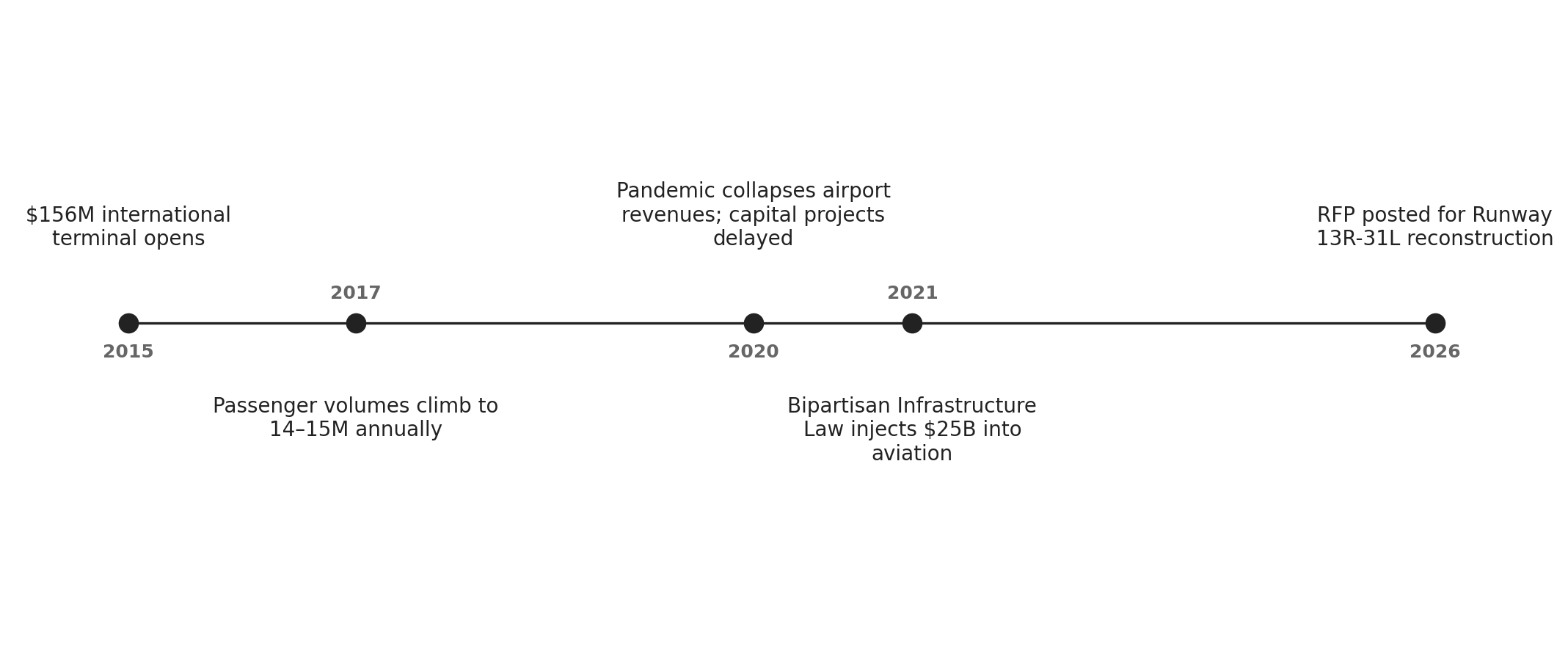
Hobby Airport modernization milestones, 2015–2026. Source: NationGraph research.
The logistics are as complicated as the finances. Hobby operates two parallel primary runways, meaning reconstruction of one forces all traffic onto the other during construction phases. Getting that sequencing right, while keeping Southwest's heavy schedule intact, will be a central challenge for whatever firm the city hires.
Hobby sits in southeast Houston, surrounded by predominantly Hispanic and Black residential neighborhoods that already live with the airport's noise footprint. Residents there will feel the effects of a prolonged construction period most directly.
The city has not announced a projected construction start date or completion timeline. Those details, along with full project costs, are expected to become clearer as the procurement process moves forward.